
Spain′s fiscal policy after three years of budget rollovers
Spain has operated under a rolled-over budget since 2023, and yet State and Social Security spending have climbed 14% and 20%, respectively, through a series of ad-hoc allocation adjustments which have helped meet one-off contingencies and investment targets funded from European funds. However, the lack of comprehensive budgetary planning has tended to weaken fiscal policy’s capacity to respond coherently to new priorities.
Abstract: The Spanish Congress has not approved a new budget since 2023, which means that the same accounts have been extended in nominal terms for the past three years. However, allocation adjustments, supplementary appropriations, and credit injections have made it possible to increase actual expenditure far above what the rollover implies. Central government and Social Security spending now run 14% and 20% above their initial budgeted levels, respectively, a gap worth 78 billion euros. Moreover, regional governments, unaffected by the freeze, have kept expanding their own budgets, compounding the divergence between formal budgetary limits and actual fiscal behaviour. Revenue has grown even faster than spending, up close to 24% across all levels of government, driven by economic growth and the decision not to index personal income tax schedules on inflation. Yet, spending increases have outpaced this windfall enough to leave fiscal policy broadly expansionary. Adjustments have also skewed budgetary priorities, favouring defence, industry, and economic affairs, while education and housing lag behind despite mounting social pressure. The result is a fiscal framework that avoids the contractionary drag typically associated with budget freezes but sacrifices the coherence and targeting a properly negotiated budget would provide.
IntroductionThe debate around public finances is typically high on the agenda in advanced democracies and forms the cornerstone of economic policy. This is why the annual approval of a new budget is usually an essential step in allowing governments to pursue their macroeconomic goals within a coherent and concerted framework. In this regard, Spain’s situation has drawn interest as the most recent set of Congress-approved public accounts dates to 2023. The country has been operating under rollover budgets ever since.
This unusually long period without new approved accounts has coincided with a build-up of geopolitical challenges, most recently the conflict in the Middle East,
[1] for which the budget drawn up three years ago was not designed. Since 2023, artificial intelligence has also burst onto the scene and Spain′s population has grown by close to one and a half million people, mostly immigrants. These technological and demographic developments, coupled with the growth cycle itself, have generated new priorities for public policy. The goal of this paper is to explore how Spain’s fiscal policy has responded to these developments in spite of the constraints implied by having to roll the budget over, and over.
Alargely expansionary budget in spite of the rolloversAs per article 134.4 of Spain’s Constitution, the rollover of the State budget limits the government’s room for manoeuvre in terms of both spending and revenue. The system is designed to ensure continuity so that the failure to pass a new budget does not imply the suspension of public activity (unlike in the U.S., for example, where the government may be forced to shut down certain public services). Nevertheless, the rollover limits the ability to respond to unforeseen developments or challenges since a budget that is carried over has the effect of freezing, at least in theory, the various budget allocations in current euros.
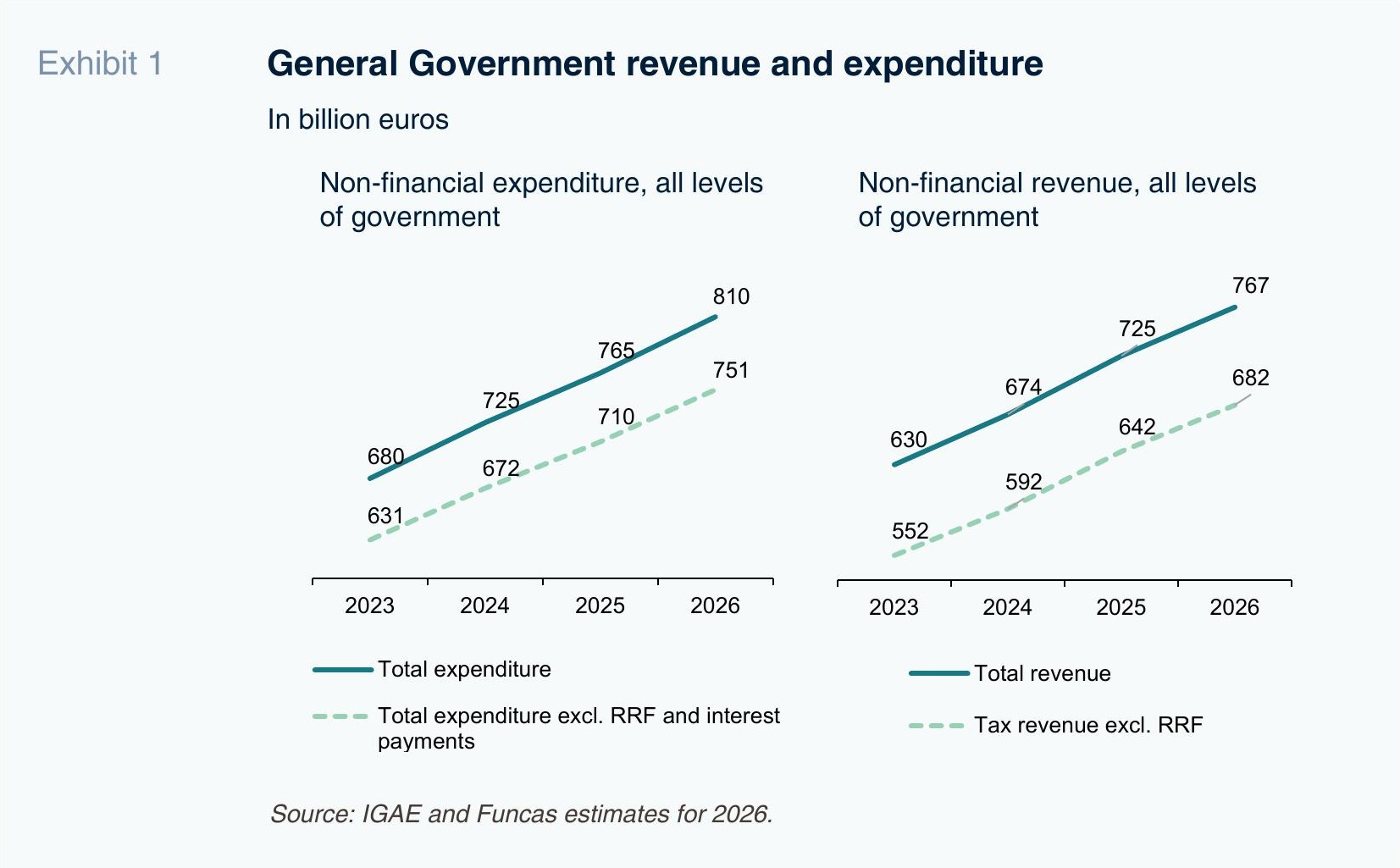
The reality, however, has been different. Far from stagnating, expenditure across all levels of government has increased by 19% during the three-year rollover period (discounting interest payments and the Next Generation European funds),
[2] while tax receipts have registered even higher growth, of close to 24% (Exhibit 1). This is partly shaped by the fact that the rollover of the state budget has not extended to the regional authorities, which draw up their own annual accounts. And the reality is that, with few exceptions, the regional governments’ finances have remained expansionary in nature.
Moreover, the expenditure incurred by the State and the Social Security system, the main areas of government affected by the budget rollover, is running 14% and 20%, respectively, above the initially contemplated budgeted amounts, which is equivalent to an increment of 78 billion euros (Exhibit 2).
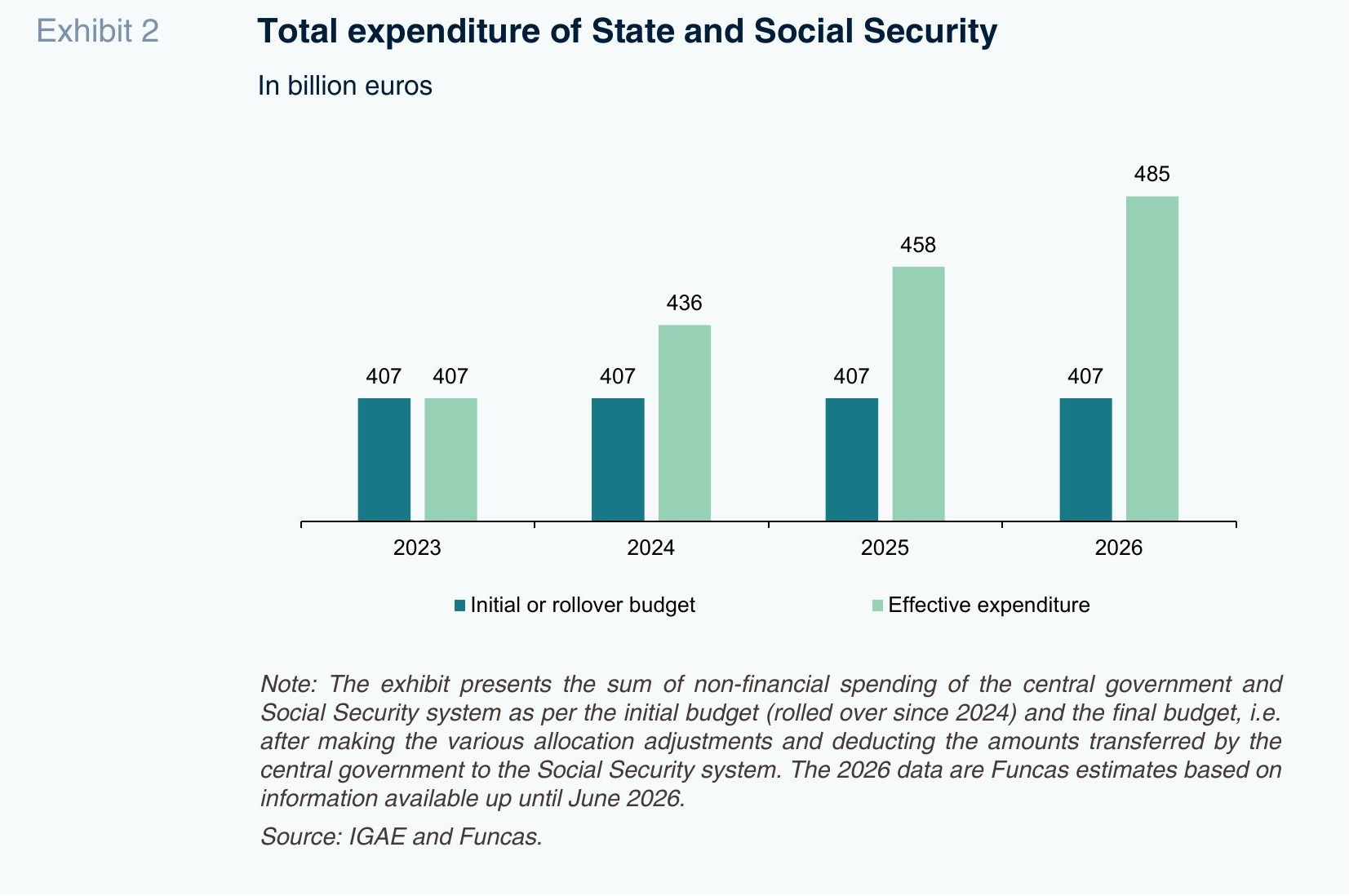
The gap between the budget rolled over and effective expenditure is explained by the use of several allocation adjustments and other instruments originally designed to cover one-off situations,
[3] which have ultimately proliferated in response to the needs arising in recent years, particularly inflation-driven requirements.
Among the mechanisms that allow for an increase in budgetary allocations, the most notable are, firstly, allocation increases, intended primarily for the servicing of debt and the payment of pensions and other social security benefits. Secondly, extraordinary and supplementary appropriations can be activated to allow a duly-justified increase in expenditure, generally through the approval of a decree-law.
[4] For example, the payments on account made to the regional and local authorities are adjusted using this mechanism. Lastly, credit injections allow for the incorporation of unforeseen revenue, such as that derived from the European funds. In this case, no parliamentary approval is required, as the additional funds are earmarked to specific expenditure items.
Despite being legally grounded, these mechanisms were originally intended as one-off adjustments rather than as sources of recurring funding, as has ultimately been the case. Note, however, that any increase in funds arising from budget allocation adjustments must be consistent with the expenditure ceiling; consequently, in practice, it is this target —rather than the limits set out in the rolled-over budgets— that has acted as an anchor to the system.
As with current expenditure, allocation adjustments have also been deployed to provide leeway for financial transactions (which are off-budget operations that do not appear in the deficit as conventionally measured). This has led to a significant deviation from what might be expected in a context of budgetary deadlock (Exhibit 3). Indeed, over the past three years, the State has authorised allocation adjustments totalling 47.7 billion euros in order to capitalise several public and private companies, extend loans and purchase financial assets.
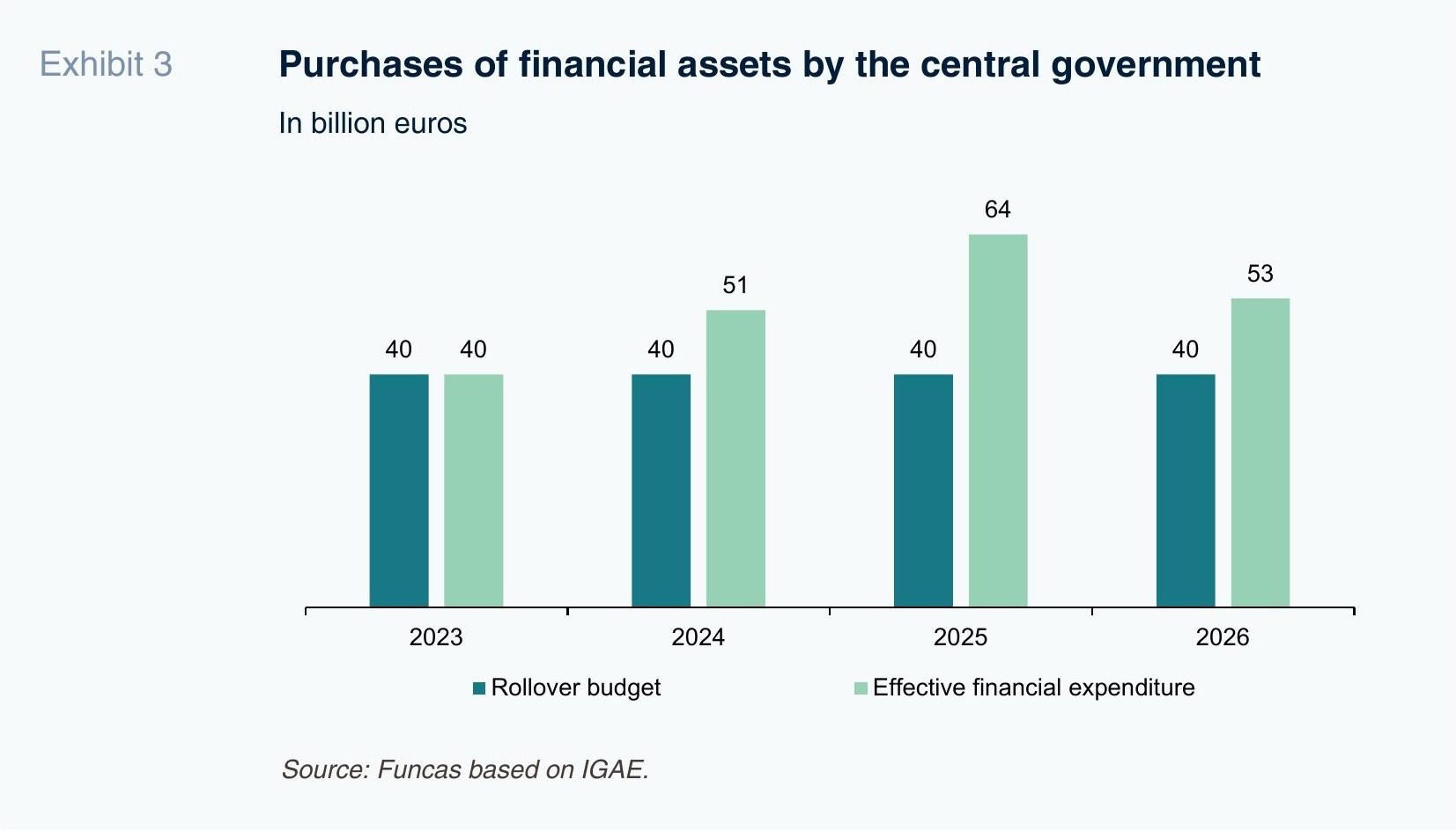
The increase in financial asset purchases means that public sector borrowing requirements have exceeded the deficit itself, defined as the difference between public revenue and non-financial expenditure. Last year, the public sector borrowing requirement amounted to 4% of GDP, compared with a deficit of just 2.4%. Given the size of borrowing requirements, public debt has followed a slow downward trend, despite the strong expansionary cycle.
As with spending, public revenue has expanded sharply, deviating from the levels provided by the rolled-over budgets. In 2025, for example, the revenue generated by the central government was 21% above the benchmark indicated by the extended budget. Unlike the situation with expenditure, however, this phenomenon has materialised automatically, without the need for discretionary measures by the government, having derived from the economy’s growth, as well as the decision not to adjust personal income tax thresholds to inflation developments. These factors, along with the European funds received under the Next Generation programme, have brought considerable revenues to the public purse.
Altogether, while under normal circumstances the rollover of the budget can be expected to slow down the economy, on this occasion fiscal policy has proven broadly expansionary, as the spending increases have more than offset the growth in revenue.
However, Spain’s economic momentum would have justified a more cautious approach in order to create a buffer ahead of potential adverse shocks. In short, unlike the normal budgetary cycle, in which policies are designed in response to the prevailing macroeconomic context and taking long-term priorities into account, the proliferation of piecemeal and disconnected adjustments has tended to undermine overall coherence.
Budgetary priorities versus the economy’s needsBeyond its macroeconomic impact, the rollovers have been executed unevenly across different categories of public expenditure and revenue, undermining the efficiency of fiscal policy in terms of responding to the country’s needs. In some cases, the spending freeze has been fully implemented, acting as a straitjacket, whereas in others it has been applied with flexibility.
The additional funds freed up through allocation adjustments have been earmarked to specific items, which in many cases have also benefited from credit transfers,
i.e., the reallocation of funds between functions without altering total expenditure. The use of transfers has become more widespread thanks to a regulatory change introduced via article 9 of the 2023 Budget Act, which has made it possible to move funds more flexibly between different budget categories without the need for parliamentary approval.
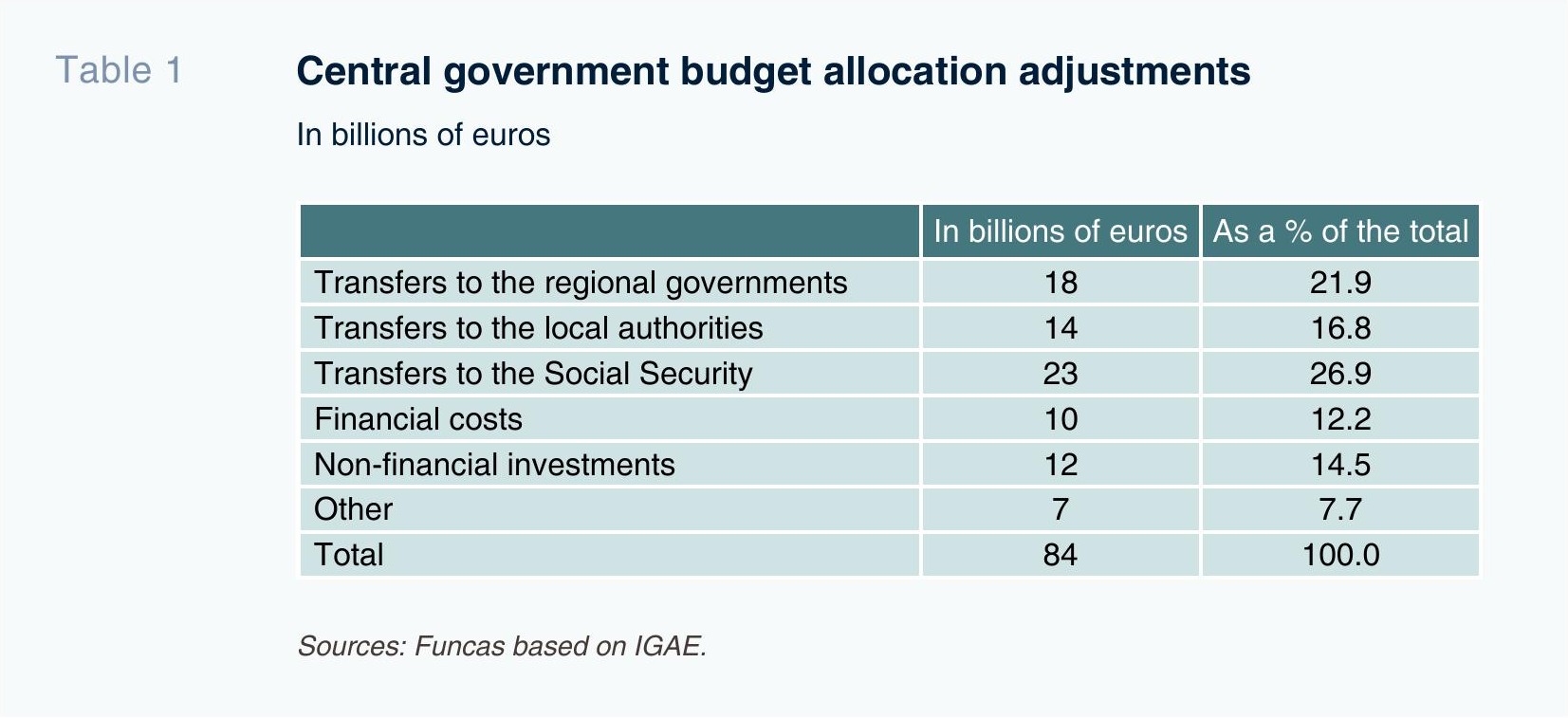
The upshot is that the central government′s payments to the regional and local authorities have scarcely been affected by the carryover of the 2023 budget: since that year, the regional and local authorities have received 32 billion euros in the form of allocation adjustments from the central government, over and above the initial allocation provided for in the extended budget (Table 1).
The Social Security system has also received an additional injection of funds to protect pensions and other benefits against inflation. Specifically, since the initial Social Security budgets, based on 2023 figures, were not sufficient to mitigate the effects of inflation, the Social Security system received additional allocations totalling 23.2 billion euros in 2024 and a further 37.5 billion in 2025, including transfers from the central government and other sources. Finally, another area that has expanded in recent years has been investment, notably in defence and rearmament.
The shift in priorities comes into clearer focus when examining the breakdown of the budgetary adjustments by function, an exercise that is only possible at the central government level due to limitations in the statistics available for the other levels of government. The analysis shows that the areas benefiting most have been defence, industry (a major recipient of European funds) and economic affairs (through equity contributions to companies). The most disadvantaged areas include education (although in this case it is the regional governments that control the bulk of the budget), as well as science, innovation and universities. The situation regarding housing is more complex. Although housing has received additional appropriations, evidencing its growing social significance, the percentage actually spent has been very low: payments executed amounted to 34% of available funds in 2024 and 28% in 2025, meaning that actual expenditure has barely increased during these years characterised by a housing crisis.
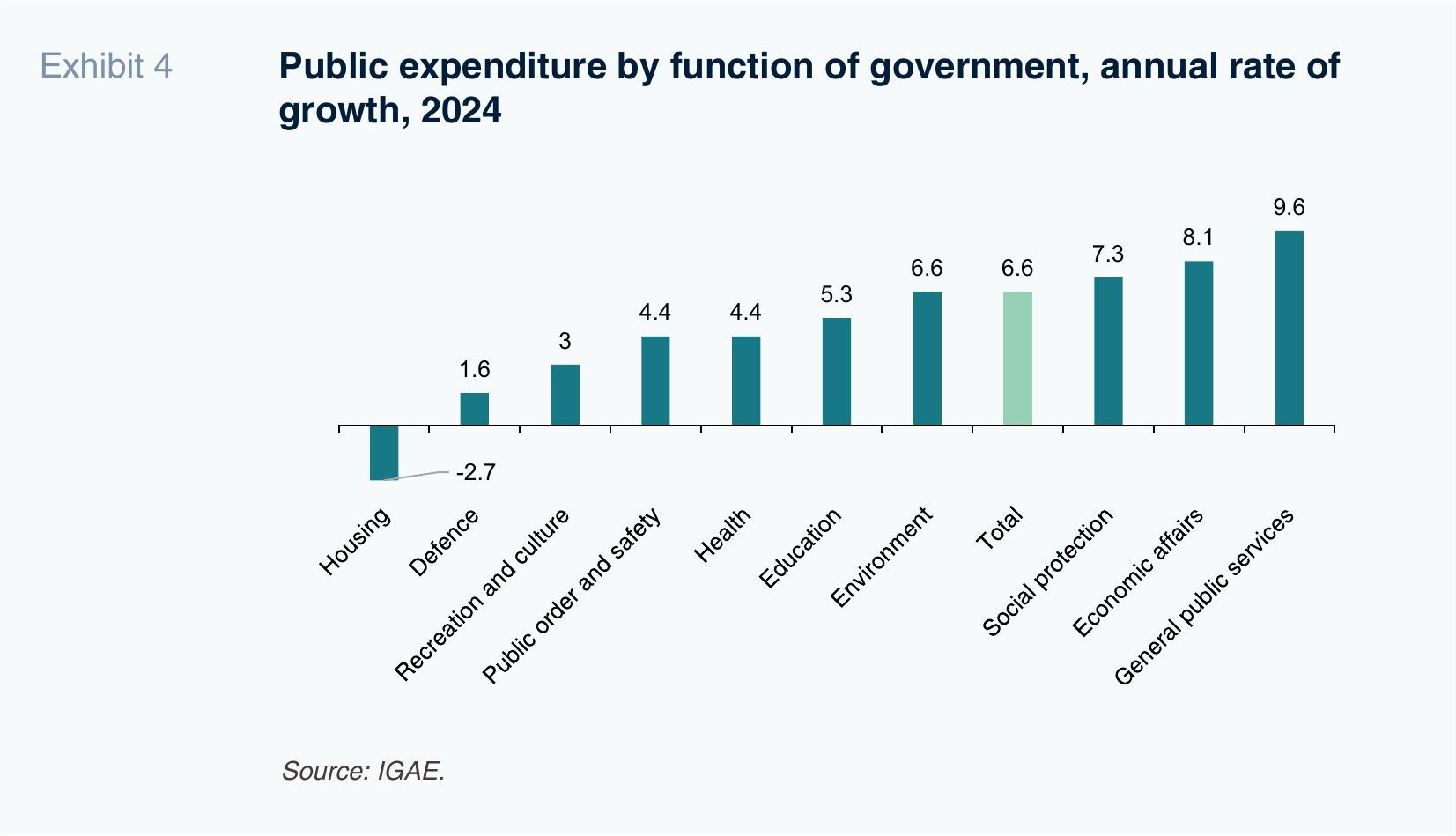
The snapshot is similar looking at all levels of government on aggregate. Based on data on the functional breakdown of expenditure for 2024, the last year for which this information is available, there has been a significant increase in the funds allocated to general public services, economic affairs and social protection (Exhibit 4). Conversely, education and housing appear to have taken a back seat, according to the expenditure data, highlighting the negative impact of the budget rollovers on fiscal policy efficiency. Lastly, the meagre growth depicted in defence expenditure is misleading, as the allocations recorded in these statistics do not include financial transactions and other capital injections into the sector.
Economic policy implications
In short, thanks to the flexibility provided by the normative framework, repeated budget rollovers have not prevented certain necessary adjustments, such as those needed to manage the European funds.
However, generally speaking, the successive budget extensions have undermined fiscal policy efficiency. From a macroeconomic perspective, the freeze on budget allocations has not played the contractionary role that might have been anticipated. To the contrary, primarily as a result of allocation adjustments and other instruments, which have provided the authorities with financial leeway and increased spending power. In tandem, the legislative deadlock has prevented the tax policy adjustments called for by the economic cycle. Lastly, regional governments, which fall outside of the scope of the general state budget affected by the budget freeze, have been able to stick with their budget plans. A more neutral fiscal policy would have made sense given Spain’s economic buoyancy and the need to create fiscal space to absorb future crises and support the economy in harder times.
In parallel, despite certain flexibility, the budget extensions have hampered the response to the country’s shifting needs. Supplementary appropriations have multiplied in a piecemeal manner, in response to unfolding crises, without an overarching and concerted budgetary framework. The result is that social priorities have not necessarily been reflected in the budgetary reality. Housing and education, for example, have not received sufficient attention. All of this highlights the importance of improving transparency around budgetary adjustments and periodically assessing their impact from the point of view of fiscal policy efficiency. Suffice to say that this should not serve as an excuse for further delaying the approval of a new budget that addresses the challenges of our times.
Notes
For further analysis of the impact of that conflict, refer to Torres and Fernández (2026).
For an analysis of the NextGen funds and their fit with the budget, refer to González Simón, et al.
For a recent analysis of this tool, refer to Galán (2026).
It is also possible to finance these credits using the contingency fund, although in practice this mechanism is limited by the size of that fund.
References
GALÁN SÁNCHEZ, R. M. (2026).
La prórroga presupuestaria en el contexto español: alcance constitucional y efectos funcionales en el sistema presupuestario [Budget rollovers in Spain: Constitutional scope and effective implications for the budgetary system], Estudios y Comentarios, INAP.
https://laadministracionaldia.inap.es/noticia.asp?id=1519944GONZÁLEZ SIMÓN, M. Á., LÓPEZ, G., and RODRÍGUEZ, B. (2026).
El impacto de los fondos Next Generation en la economía española. Funcas.
https://www.funcas.es/libro/el-impacto-de-los-fondos-next-generation-en-laeconomia-espanola/TORRES, R., and FERNÁNDEZ, M. J. (2026). Spain′s inflation outlook in the wake of the Persian Gulf ceasefire.
SEFO Vol. 15(4), July 2026.
https://www.sefofuncas.com/Europes-housing-challenge-Assessing-affordability-in-the-EU-and-Spain/Spains-inflation-outlook-in-the-wake-of-the-Persian-Gulf-ceasefire
Raymond Torres. Funcas