
Spain′s inflation outlook in the wake of the Persian Gulf ceasefire
The ceasefire between the United States and Iran pushed oil and gas prices closer to pre-conflict levels, easing inflationary pressures on the Spanish economy. However, the withdrawal of fuel tax relief and persistently high services inflation mean that overall inflation will normalize more slowly than energy markets.
Abstract [1]: The memorandum of understanding between the United States and Iran has eased the acute phase of the inflationary shock triggered by the conflict, with oil and gas prices moving towards pre-conflict levels as the Strait of Hormuz reopens to shipping. Even so, normalization will be gradual, as demining operations in the Strait and rebuilding damaged infrastructure could keep commodity prices above their pre-war levels through year-end. Production costs across Spanish industry continue to reflect the shock, feeding through to consumer prices with a lag and offsetting part of the disinflationary effect of lower energy costs. At the same time, the scheduled withdrawal of Spain′s fuel tax relief will add substantially to headline inflation. Beyond these energy-related developments, core inflation has proven more persistent than forecast, reflecting structural pressures that predate the conflict, particularly in services sectors. Altogether, inflation is projected to average 3.3% in 2026, well above the euro area as a whole, leaving monetary policy poorly positioned to address a shock that is becoming increasingly domestic in origin.
Introduction
The recently announced memorandum of understanding between the U.S. and Iran has created a window of opportunity for both the surrounding countries hardest hit by the armed conflict and the global economy at large. [2] The agreement contemplates an extendable 60-day ceasefire, and addresses geopolitical issues, including reaffirmation by Iran of its commitment not to develop nuclear arms (which it had already committed to under earlier agreements). It also contains decisions of major significance for the economy, most notably the full reopening of the Strait of Hormuz within a period of 30 days and a series of concessions for the Iran regime: the lifting of restrictions on its oil exports; the creation of a 300 billion dollar reconstruction fund and the release of frozen Iranian assets being retained abroad.
The memorandum, pending official ratification, leaves important points up for negotiation and does not dispel questions about the involvement of other regional players, potentially curtailing effectiveness of the ceasefire, which is key to full normalisation of maritime traffic through the Strait of Hormuz. Despite these uncertainties, the end of the conflict currently looks more likely, to which end this paper examines the economic impact in Spain, particularly on inflation —the variable most exposed to the geopolitical tensions— of a prolonged ceasefire.
Reaction of energy markets
The most immediate and tangible impact of the new scenario has been felt in commodities markets. The price of a barrel of Brent has sunk to around 72 dollars, with gas prices (Mibgas) slumping to around 43 euros, values that are approaching their pre-conflict levels. Therefore, with the reopening of the Strait and liberation of oil and gas exports from Gulf nations, which prior to the conflict accounted for roughly one-fifth of global trade in these commodities, the energy crisis might soon be a thing of the past.
However, several factors suggest that normalisation could take time. Firstly, on the supply side, demining operations in the Strait could be a complex and lengthy process. Elsewhere, the sense that crossing the Persian Gulf is dangerous will not disappear overnight, limiting traffic while pushing up the cost of insurance policies. Another possible cost is the toll that Iran reserves the right to impose following a 60-day trial period (although the memorandum does not address this matter, Tehran considers that the U.S. government has, in principle, given the concept its blessing).
However, the biggest unknown relates to the extent of damage to the region’s oil and gas fields, petrochemical complexes and other productive assets as a result of the missiles exchanged across the entire region. The International Energy Agency believes that in some cases the repairs could take as long as two years to complete.
Moreover, on the demand side, the countries that import oil will have to replenish much-diminished reserves. That effort will keep prices tight for some time, even if supplies from the Persian Gulf fully rebound (something which, as already noted, is likely to take time). By the same token, the countries that import gas will have to step up their purchases to rebuild stocks ahead of next winter.
Therefore, even if geopolitical tensions de-escalate rapidly, the prices of oil, gas and other commodities are likely to remain above pre-conflict levels until the end of the year.
The tide is, however, favourable and could gather momentum in the medium term. In addition, the perceived supply risk has underlined the need to reduce reliance on fossil fuels and imports from conflictive regions, accelerating efforts to electrify transportation and transition to renewable sources. It is a fact that demand for electric vehicles has increased in recent months, particularly in Asia. Moreover, the removal of sanctions against Iran will allow it to trade normally with Western countries and revisit pre-sanctions oil production levels. It is conceivable, therefore, that we could face a glut of oil and gas in the medium term.
The shock triggered by the war and its knock-on effects on production costs and consumer prices
Despite the relief provided by the memorandum of understanding, the run-up in commodity prices sparked by the Middle East conflict continues to ripple through the Spanish productive system.
The increase in transportation costs, the backbone of the supply chain, continues to face spill-over effects. Another example is aluminium, where prices have risen by over 25% in the last three months, impacting production costs across a broad range of industrial goods that rely on that metal as an input. Similarly, producers of fertilisers and chemical products like plastic have only partially passed through the increase in costs to their customers. And oil derivatives can represent virtually all of the variable costs of certain products such as ammonium, which is used to make fertilisers and is the basis of many disinfectants and nylon, the latter used extensively in the textile industry.
Elsewhere, the conflict has thrown supply chains into disarray, prompting delays in the dispatch of key components, from sulphur to helium. It will also take a while for those supply chains to return to normal.
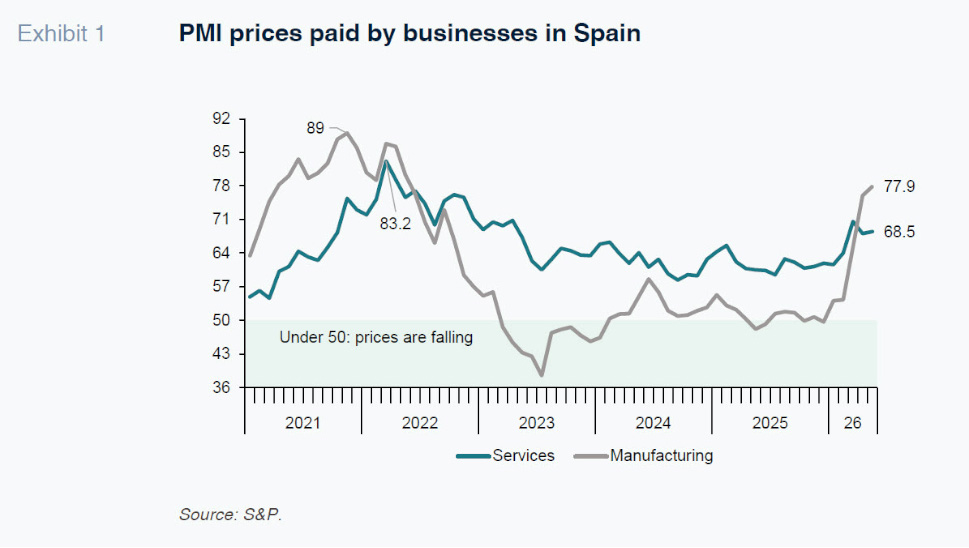
As a result, the escalation in production costs, already palpable, will not dissipate immediately. In April, the Spanish industry production price index increased by 8.5% year-on-year, going on to jump 10.5% in May (leaving behind the year-on-year contractions observed during the months prior to the conflict). In the services sector, price statistics are released with more of a lag, but indicators derived from PMI business surveys also reveal growing upward pressures, albeit less acute than in the manufacturing sector (Exhibit 1).
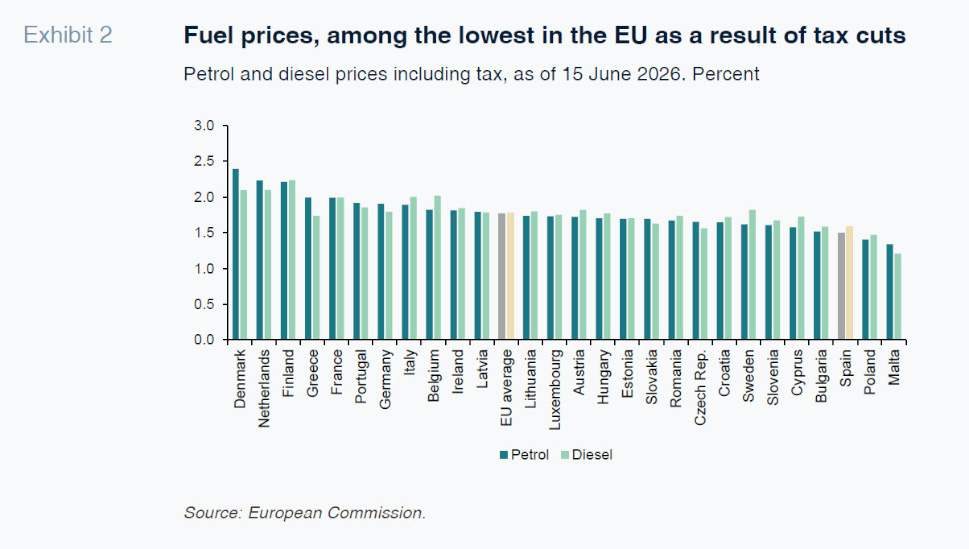
The run-up in production costs is also evident in the consumer price index, which has been hovering at over 3% year-on-year in recent months, one point above pre-conflict trends. This outcome is primarily attributable to the abrupt increase in fuel prices, which have increased by nearly 15% over the period despite the energy tax cuts introduced by the Spanish government to mitigate the effects of the war (a measure that sets Spain apart in Europe and explains why fuel costs are a lot lower than in other major EU economies, as suggested in Exhibit 2). Core inflation, which excludes volatile energy and food prices, has also risen as the shock has trickled through to end prices.
This phenomenon is set to linger for the next few months, offsetting to some extent the positive impact of energy deflation. Overall, however, it is likely that the pass-through of the shock to consumer prices will be much smaller than at the time of the Ukraine war four years ago, when the economy was experiencing sharp growth in demand (which is not the case today, especially in the three largest eurozone economies, which may be on the verge of recession).
Inflation outlook
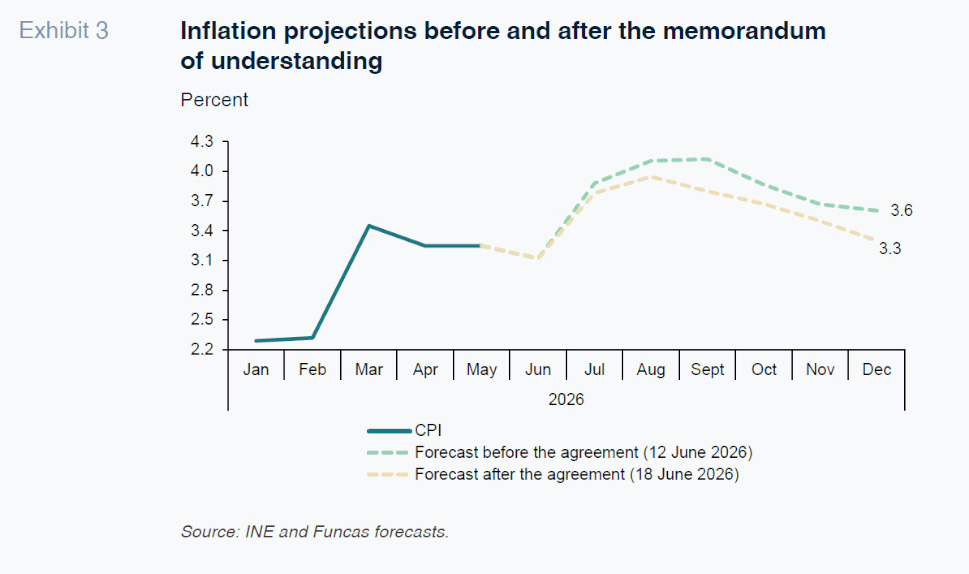
Looking to the months ahead, the drop in oil prices since the ceasefire was announced signals a shift towards a less fraught scenario, although prices are not expected to return to pre-conflict levels for the time being. Crude futures prior to the agreement suggested that inflation would top 4% during the summer (assuming the rollback of the tax measures on 30 June 2026), easing to around 3.6% by the end of the year, implying an annual average rate of 3.4%. The new scenario depicted by futures markets is for inflation to land 0.2 to 0.3 percentage points below the pre-agreement forecast, implying an average annual rate of 3.3% (Exhibit 3).
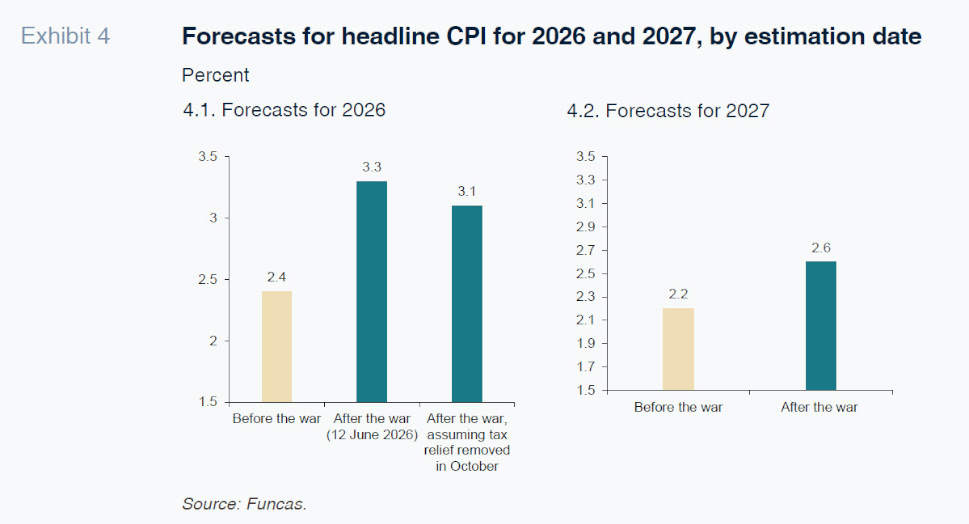
By comparison, before the conflict, inflation was expected to average 2.4% in 2026 (Exhibit 4). In any case, the removal of the fuel tax relief will increase the inflation rate by between 0.8 and 0.9 percentage points, so that its monthly profile, and by extension the annual average, will depend significantly on when those taxes are reinstated. If the taxes are not reintroduced until 1 October, for example, the inflation spike would not materialise until then, leaving the average annual rate at 3.1%. In that instance, the step effect of the increase in taxes would extend until September of next year instead of June, so that the average annual rate in 2027 would be higher than if the taxes are reinstated from 1 July 2026.
As for core inflation, the trend has been worse than expected in recent months, particularly in services. Inflation in services increased to 4.1% in May, a jump that cannot be attributed entirely to the pass-through of higher production costs as a result of the conflict; indeed, it largely reflects the persistence of independent inflationary pressures in existence before war broke out in Iran.
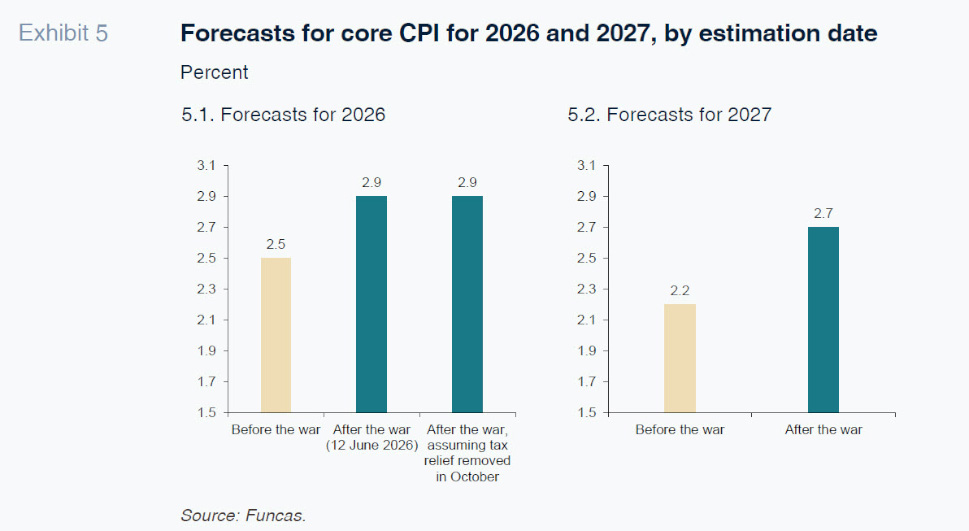
At any rate, in the coming months, some or all of the increase in production costs, which as we have noted are expected to remain above pre-conflict levels, is expected to trickle through to core inflation. This, coupled with more persistent pre-existing tensions than initially estimated, put our forecast for core inflation at 2.9% this year and 2.7% in 2027, both of which are above the eurozone equivalents.
In short, recent trends suggest that inflationary pressures will remain stronger in Spain than in the rest of the eurozone, making it unlikely that monetary policy will act as a mitigating factor. The source of the pressure is concentrated in the services sector, calling for measures focused on enhancing product market competition. Lastly, an acceleration in investment (Torres, 2026) and productivity would facilitate the convergence of core inflation and dissipate the risk of a loss of competitiveness foreshadowed by prevailing trends.
Notes
This article was written in the immediate aftermath of the June 2026 ceasefire agreement between the United States and Iran. Since then, hostilities have resumed and the ceasefire has effectively broken down. The analysis should therefore be read as reflecting the economic and policy outlook at the time the ceasefire was agreed.
For further analysis of the impact of the conflict, refer to Torres et al. (2026).
References
TORRES, R. (2026). Private investment: The weak link in Spain’s expansionary phase. SEFO Vol. 15(1), January 2026. Funcas.
TORRES, R., FERNÁNDEZ, M. J., and GÓMEZ, F. (2026). The impact of the Middle East conflict on the Spanish economy. SEFO Vol. 15(3), May 2026. Funcas.
Raymond Torres and María Jesús Fernández. Funcas