
Spain′s 2025 sector accounts: Strong household balances, weak business investment
Spanish households maintained sound balance sheets in 2025, continuing to generate a net lending surplus even as the savings rate declined and real purchasing power grew only modestly. Non-financial corporations again ran a surplus and saw financial asset revaluations, but business investment remained below pre-pandemic levels, widening a capital gap relative to the eurozone.
Abstract: Spain′s household and non-financial corporation accounts for 2025 reflect the defining traits of the current growth phase: robust nominal income growth, cautious balance sheet management, and persistent weakness in business investment. Household disposable income grew in nominal terms, driven mainly by employment expansion, but real per-capita gains were modest and purchasing power remains only marginally above 2019 levels. The savings rate declined as consumption growth outpaced income, with net household lending falling to 2.9% of GDP. However, debt leverage and debt service burdens continued to ease and financial wealth rose sharply on the back of equity and investment fund revaluations. For non-financial corporations, operating surpluses grew in nominal terms but the profit share in gross value added continued to compress, and real earnings have still not recovered to pre-pandemic levels. Both sectors nonetheless again generated net lending positions and saw significant asset revaluations, leaving them with meaningful buffers against an uncertain macroeconomic outlook.
General background
The Spanish economy remained dynamic throughout 2025, registering GDP growth of 2.8%, ahead of the figure estimated at the start of the year. The labour market also continued to create work at a remarkably vigorous and stable pace, with some growth in productivity per hour worked but not yet in productivity per employee. Inflation was very sticky, averaging 2.7%, which is just 0.1 percentage points below the 2024 figure, while core inflation actually tracked higher during the second half of the year. Spanish inflation continued to outpace the eurozone average, pointing to stronger demand and, possibly, second-round effects. Twelve-month interest rates were lower year-on-year, while long-term bond yields were very similar to those of 2024, not moving much other than a transient bump when the Trump administration announced its new tariff policy.
This paper analyses the trend in the household and non-financial corporation accounts for 2025, drawing from the institutional sector non-financial accounts, compiled by Spain’s national statistics office, the INE, using national accounting methodology and concepts.
Households continue to shore up their financial position
Before analysing the household accounts for 2025, we need to look at the adjustments to the 2024 figures, as discussed in Fernández (2025). Growth in gross disposable income (GDI) was a little lower than initially published (7.5% instead of 8.7%). Nominal household consumption also grew by a little less than first reported, as did household savings, whereas the sector’s gross capital formation (GCF) was a little stronger. As a result, the annual savings rate amounted to 12.7% of GDI (as opposed to the initially published 13.6%) and the household sector′s net lending position was equivalent to 3.9% of GDP, down 0.8 percentage points from the previous estimate. These are relatively minor adjustments that do not affect the conclusions or analyses conducted at the time.
Turning to the 2025 accounts (Table 1), growth in employee compensation slowed but remained high, at 7.2%, driven by growth in employment of 2.7% and an increase in average compensation per person of 4.3%. Property income contracted as a result of the downtrend in interest rates, offsetting the growth in dividend income. Interest paid by households also decreased, solely on account of the drop in the effective rate paid, as nominal borrowings actually increased.
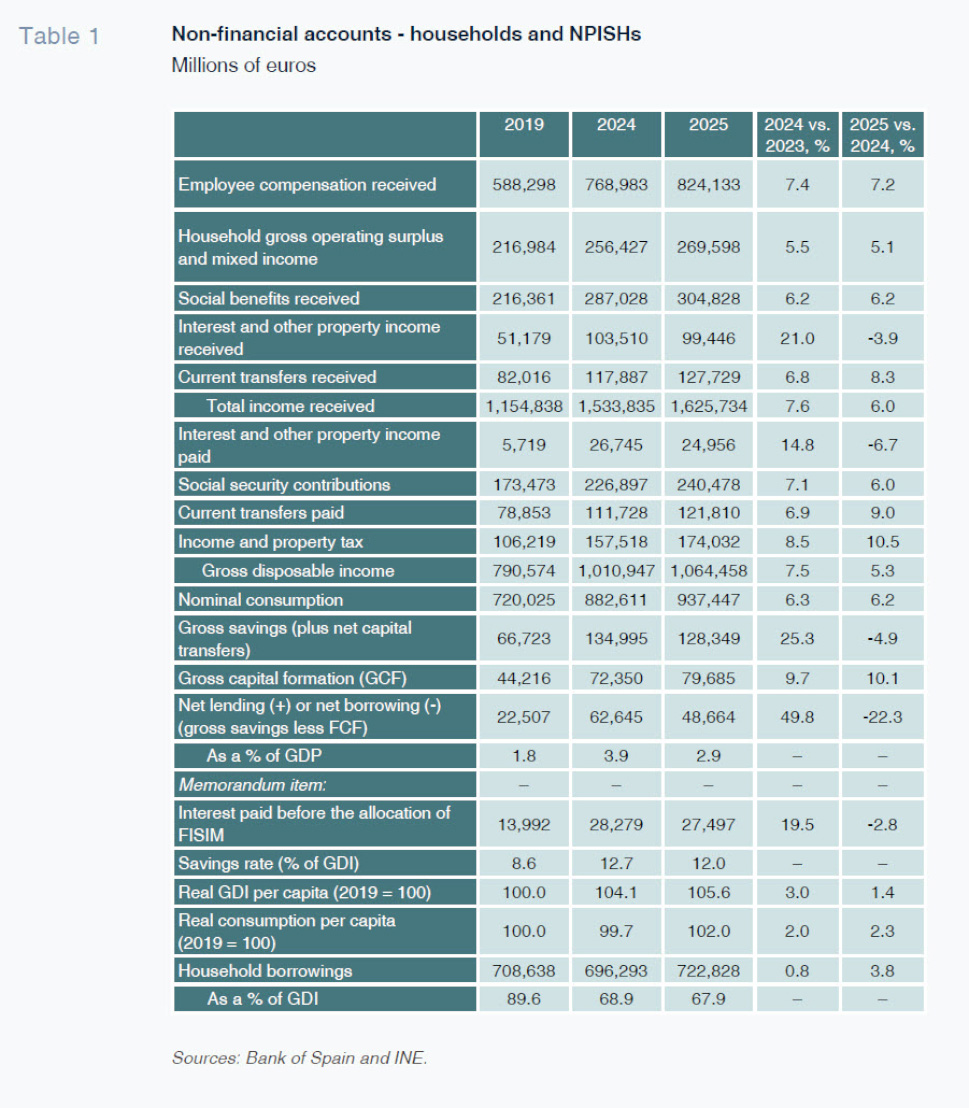
In short, the growth in total income collected by Spanish households slowed, whereas the pace of growth in income and wealth taxes paid accelerated, yielding a fresh increase in the effective tax rate, extending the trend of recent years. The slowdown in growth in income, coupled with a continued strong rate of growth in nominal consumption, triggered erosion of the savings rate to 12% of GDI, a level that nevertheless remains high by historic standards. Around two-thirds of those savings went into investments, which increased by 10.1%. The drop in savings and growth in investment yielded a reduction in the sector’s net lending position (i.e., the difference between savings and investment) to 2.9% of GDP.
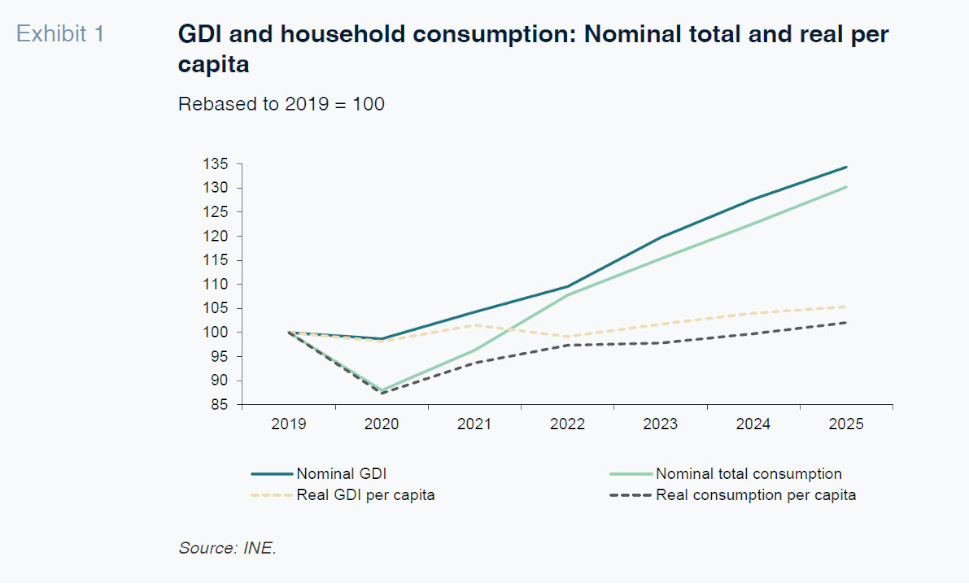
In real, per-capita terms, GDI increased by 1.4% to land 5.6% above 2019 levels, modest annual growth by historical standards, below that of recent years and below the average observed during the pre-pandemic growth period. Real consumption per capita increased by 2.3% in 2025, revisiting the 2019 level for the first time (Exhibit 1). The wide gap between the trend in these variables in total nominal and real per capita terms with respect to 2019 is attributable to the sharp inflation sustained during the period, along with high demographic growth.
As for household borrowings, despite growth in absolute terms, leverage came down as a percentage of GDI, to 67.9%. The downtrend in interest rates enabled a reduction in the debt service burden to 2.6% of GDI, which nevertheless remains above pre-2022 levels. According to the 2024 Survey of Household Finances (the most recent available), at the end of that year, the median indebted household had to earmark 13.4% of its gross income to debt servicing, a little below the figure of 13.9% observed in 2022. Elsewhere, the median volume of outstanding debt represented 69.7% of annual indebted household income in 2024, down from 77.4% in 2022. The share of households with debt-to-income ratios of over 3 times was 10.5% in 2024 compared to 14.1% in 2022.
Taken as a whole, therefore, Spain’s households remain in good financial health insofar as they continue to generate a surplus and their borrowings and debt service burdens are manageable and declining. However, purchasing power per capita has only registered modest growth since 2019. Around one-third of the growth in the real per-capita income received by households compared to 2019, which is 10% before deducting tax, social security and interest payments, comes from the growth In employment, whereas the growth in real average wages (measured in accordance with national accounting and deflated by the consumption deflator) explains around 15%, which is similar to the percentages explained by the real per-capita growth in benefits, property income and other transfers.
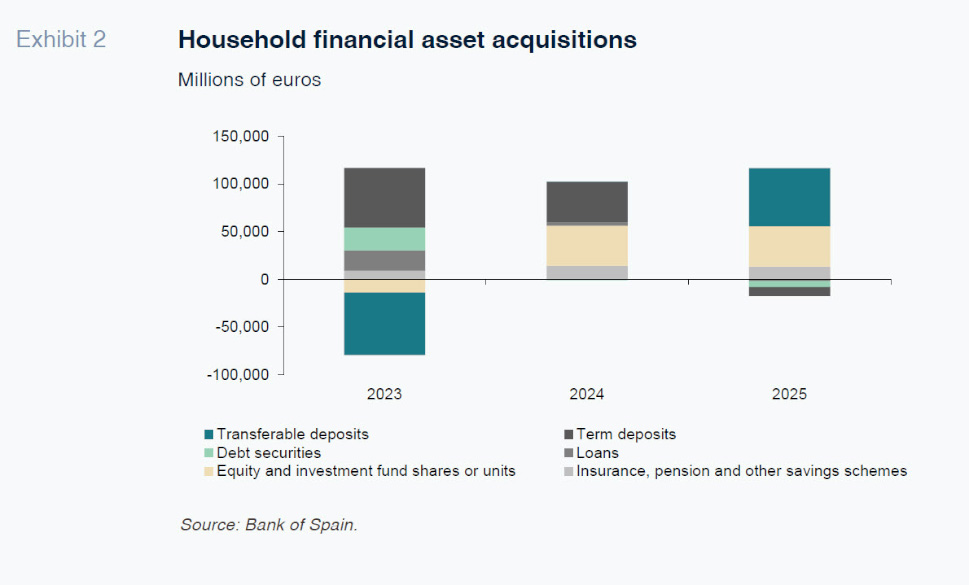
The net lending position generated allowed Spanish households to acquire 95 billion euros of financial assets. The breakdown of the assets acquired in 2025 was different to that of the previous two years: the volume of term deposits and debt securities decreased, while the amount of transferable deposits increased, possibly reflecting reduced incentives to hold short-term, interest-bearing assets on account of slim returns. Households also made relatively high investments in equity and investment fund shares by historical standards, in this instance in line with the 2024 figures (Exhibit 2).
The value of the financial assets on the household sector’s balance sheet increased by 9.3%, one of the highest rates in the series, which is substantially more than the value of the assets acquired that year. That performance was driven by the sharp increase in the value of the equity and investment fund shares in household portfolios, whose share of financial assets increased to a record level of 49%. The sharp growth in household financial wealth is significant for its capacity to create a wealth effect that could help prop up consumption in the context of an uncertain outlook for 2026.
The business investment deficit continues to accumulate
The accounts of the non-financial corporations (NFCs) for 2024 have also been revised, in this case suffering a more significant impact relative to the initially published and analysed figures (Fernández, 2025). The original figures pointed to a drop in the sector’s gross operating surplus (GOS) and entrepreneurial income, whereas the revised figures point to growth, albeit modest, in both aggregates. GFCF also increased by more than initially estimated and the sector’s net lending position was 1.6% of GDP, rather than 0.9%. The revised figures do not, however, alter the conclusion that the business profit share of the NFCs fell as a percentage of their GVA, to 39% in 2024, compared to 41.5% in 2019.
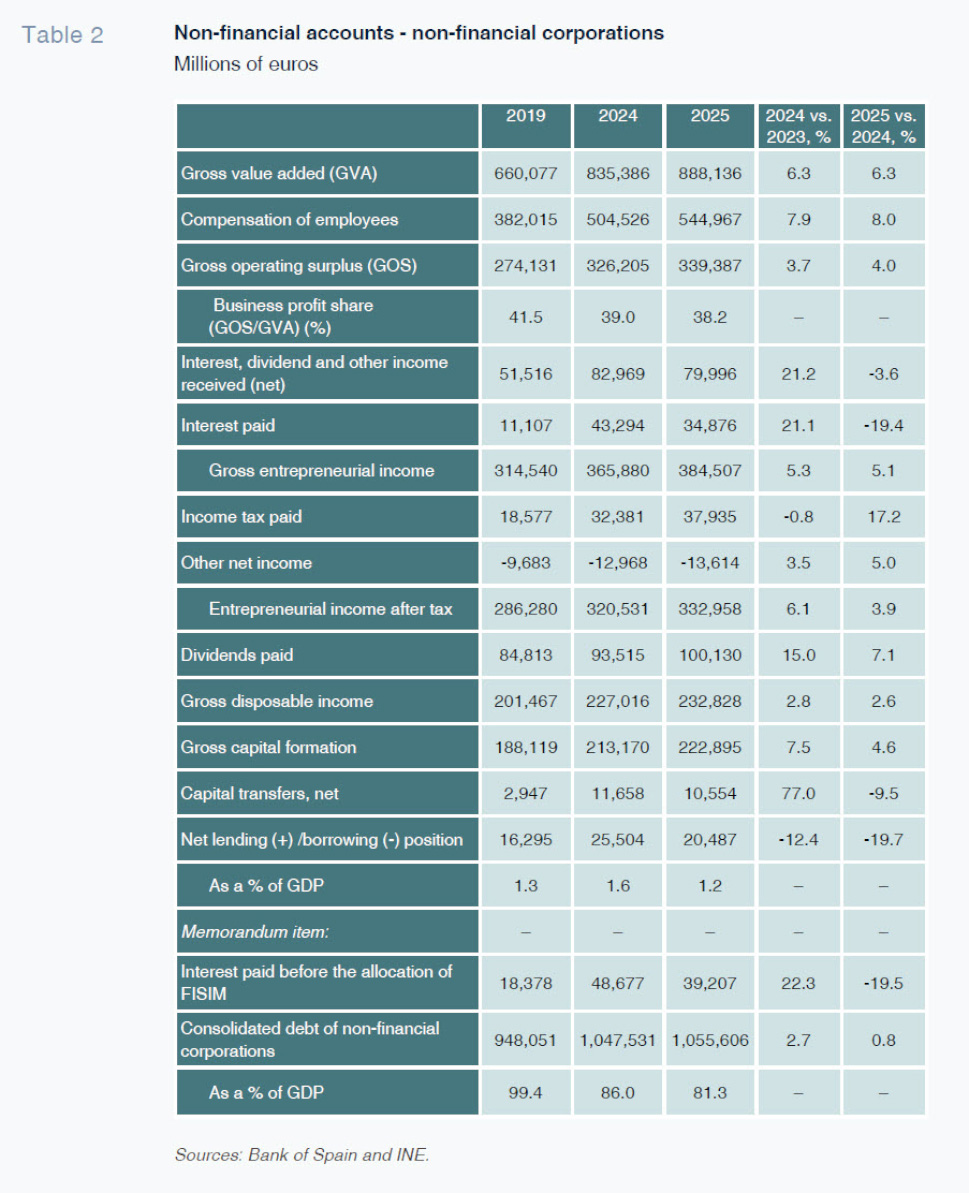
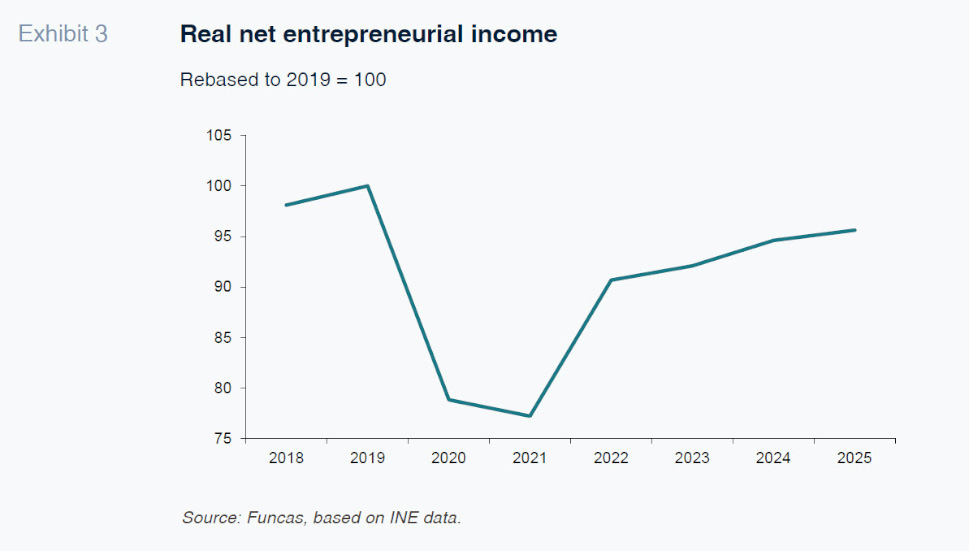
As for 2025, although the sector’s GOS increased by 4%, the business profit share (GOS/GVA ratio) continued to decrease, to 38.2% (Table 2). As we saw with the household sector, the NFCs’ interest payments decreased in 2025 on the back of lower interest rates. The growth in entrepreneurial income slowed, particularly in after-tax terms, extending the weak pattern witnessed ever since the pandemic in real terms and trailing the levels observed in previous periods of growth. Indeed, in real terms, the sector’s income has yet to revisit 2019 levels (Exhibit 3). As a result, the dividends paid out, which in 2024 surpassed pre-pandemic levels in nominal terms, continued to increase in 2025, albeit remaining below 2019 levels in real terms.
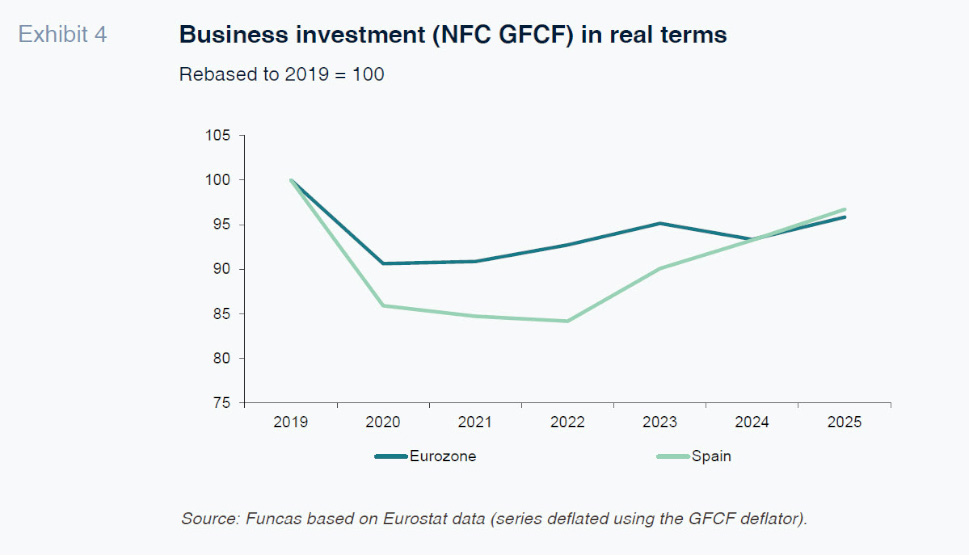
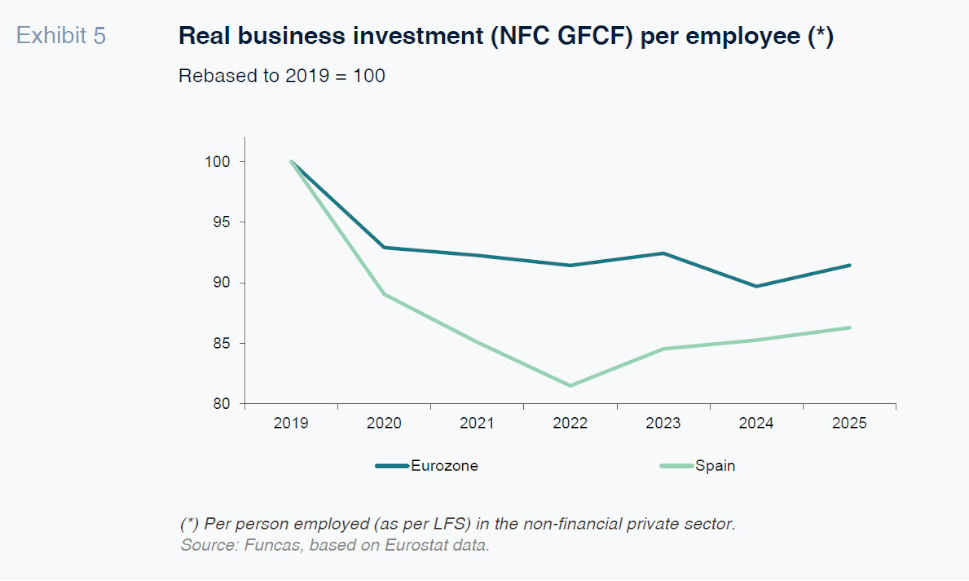
Despite growth in GFCF in 2025, business investment remained 3.3% below 2019 levels in real terms. The weakness in business investment ever since 2019, an issue analysed in Fernández (2025), is a pattern observed across the eurozone, where the comparison between 2025 and 2019 reveals a similar contraction. Nevertheless, between 2020 and 2023, business investment in the eurozone was higher than in Spain (Exhibit 4), implying a relatively bigger accumulation of capital during the period as a whole. Moreover, given the strong growth in employment in Spain, investment per employee, which has fallen in both geographies, has contracted more intensely in Spain (Exhibit 5), so that the accumulated investment deficit by comparison with the eurozone has continued to widen.
Lastly, the non-financial corporations once again generated a net lending position, saving more than they invested, extending an uninterrupted trend year observed since 2009. That surplus amounted to 20.5 billion euros in 2025, 1.2% of GDP. Spain’s firms used that surplus to acquire financial assets and while they also increased their liabilities, the ratios of consolidated debt to both GDP and GOS nevertheless declined. As we saw with the household sector, the value of this sector’s financial assets increased at the highest rate seen in 19 years (10.5%), shoring up its financial solidity and buffer in the event of unforeseen developments.
Conclusions
Since 2022, when its GDP revisited pre-pandemic levels, the Spanish economy has been registering stable and dynamic growth, despite a succession of shocks, and displaying a series of specific characteristics that differentiate this phase from previous periods of growth. Those characteristics notably include trends in the household and NFC sector accounts, where the key patterns barely changed in 2025. In the case of the household sector, those traits are: growth in disposable income, intense in nominal terms but modest in real and per-capita terms (driven mainly by the growth in employment); a high savings rate; the generation of a solid net lending position; growth in investment; a manageable and declining debt service burden; and low levels of financial vulnerability (in general and in macroeconomic terms).
As for the non-financial corporations, the defining traits have been: reduced growth in earnings, which has yet to revisit 2019 levels in real terms; a drop in the business profit ratio; accompanied, however, by the generation of a net lending position, which, coupled with deleveraging and, in 2025, financial asset revaluation, leave them with a buffer for absorbing shocks, even though business investment levels are worryingly low.
References
María Jesús Fernández. Senior Economist at Funcas