
Profitability and valuation risk in Spanish banks’ sovereign holdings
Spanish banks have steadily increased their holdings of public debt since 2021, drawn by the higher yields that followed the end of the negative interest rates cycle. Most of that portfolio sits in accounting categories shielded from interest rate movements, which limits the direct effect on earnings and capital if sovereign yields keep rising.
Abstract: The spike in interest rates has renewed concern around financial stability via their impact on the value of the banks’ securities portfolios, a risk flagged by both the IMF and the European Banking Authority. Public debt now accounts for 17.3% of Spanish banks’ consolidated assets, above the EU-27 average and the highest reading since 2021. The held-to-maturity category, carried at amortised cost, covers 69% of the portfolio, well above the European norm. The share measured at fair value has grown but is in line with the EU-27 average, so the sensitivity of earnings is comparable to that of peers. Maturities have shifted from long-dated towards medium-term paper, and portfolios show a marked home bias, with limited holdings of other EU issuers that point to room for deeper financial integration. Meanwhile, resident banks have absorbed part of the space left by the Eurosystem, and non-resident investors hold the largest share of Spanish debt, an indicator of confidence consistent with a low country risk premium.
Foreword
The nexus between public debt and the bank sector is a topic of interest when analysing financial stability, particularly in the current context. High borrowing levels in some of the leading advanced economies, including the U.S., France, Japan and the UK, coupled with governments’ ongoing funding needs and economic and geopolitical uncertainty, have reignited concerns about the sustainability of public finances. As a result of these tensions, investors are demanding higher returns for holding sovereign debt and, in some cases, a higher country risk premium, pushing up the cost of public borrowing. In its most recent Financial Stability Report, the International Monetary Fund (2026) warned of the risks that the pressure on the sovereign debt markets and a potential increase in interest rates could put on the banks’ balance sheets. Similarly, in its latest report the European Banking Authority (2026) wrote: “Potentially rising sovereign debt levels could weaken debt sustainability perceptions and negatively affect sovereign yields. This could feed directly into banks’ balance sheets via valuation losses on their sovereign holdings.”
Banks hold public bonds in their securities portfolios for several reasons, including as an investment (to generate a fixed income, one that is more attractive the higher rates are), liquidity management and compliance with regulatory requirements. When interest rates increase, debt instruments become more attractive in terms of the income they generate but the value of bonds already issued falls, potentially generating losses. The scale of those losses depends on how the securities are classified for accounting purposes and the scope for holding the securities until they mature. As a result, there is a clear connection between sovereign and bank risk and the potential for a so-called doom loop if problems in the banking sector spill over into public finances.
Against that backdrop, it is opportune to analyse the Spanish banks’ current exposure to sovereign risk and compare it with that of its neighbouring economies at a time when long-term rates are moving higher for three reasons: (i) contractionary monetary policies designed to curb inflation; (ii) a spike in country risk premiums across the more indebted countries; and (iii) a crowding-out effect caused by the competition between governments and AI firms, which are seeking to finance their billion-dollar investments by issuing debt.
It is important to analyse both the share of bank assets accounted for by public debt and the nature of that debt in terms of maturity and business model ("held for trading" versus "held to maturity"). The higher the share of debt that is held to maturity, the lower the impact of interest rate increases, which in this instance do not translate into any change in the amounts at which the debt is carried by the banks for accounting purposes. When sovereign bonds are held for trading, however, the banks are required to carry the securities at their fair value, recognising any price changes in profit or loss.
This paper analyses the recent trend in the banks’ sovereign risk exposure, from 2021 to June 2026 (the latest figures available), comparing Spain with the rest of the EU. Given the use of European Banking Authority statistics, the analysis relates to the consolidated banking groups. However, we also analyse the exposure of the banking sector in Spain (domestic business) using data provided by the Bank of Spain. Lastly, we look at the importance of the banking sector in terms of its take-up of the debt issued by Spain’s public authorities.
Bank exposure to sovereign risk: A European comparison
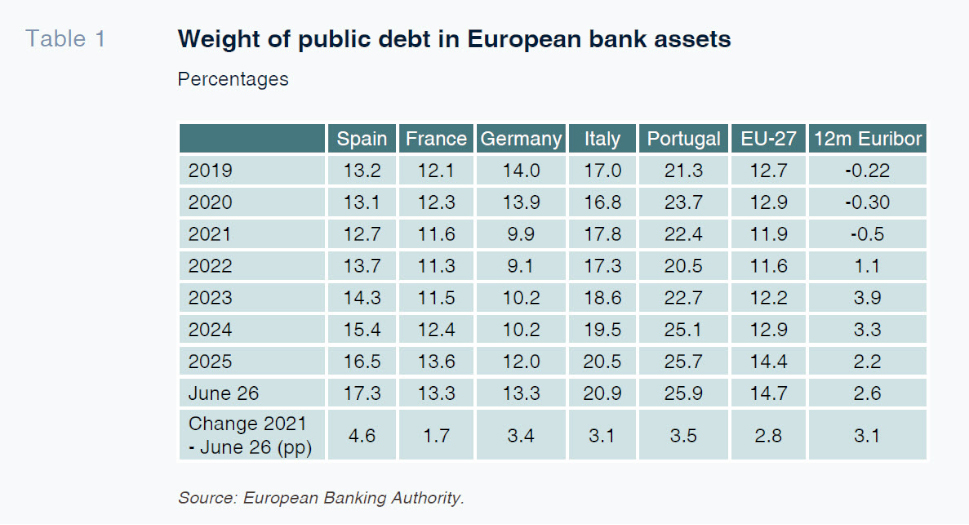
Since 2021, our base year and a year in which interest rates were abnormally negative (12-month Euribor averaged -0.5%), the Spanish banks’ exposure to public debt holdings has increased by 4.6 percentage points (pp) to 17.3%, the peak for the period under analysis. The increase is logical considering the growing appeal of these securities which remunerate their holders by more when interest rates rise.
For this same reason, the EU-27 banking sectors on average have similarly increased their exposure, albeit less intensely (+2.8pp). Indeed, the increase in exposure has been higher in Spain than in the main European banking sectors, including France (+1.7pp), Italy (+3.1pp), Germany (+3.4pp) and Portugal (+3.5pp).
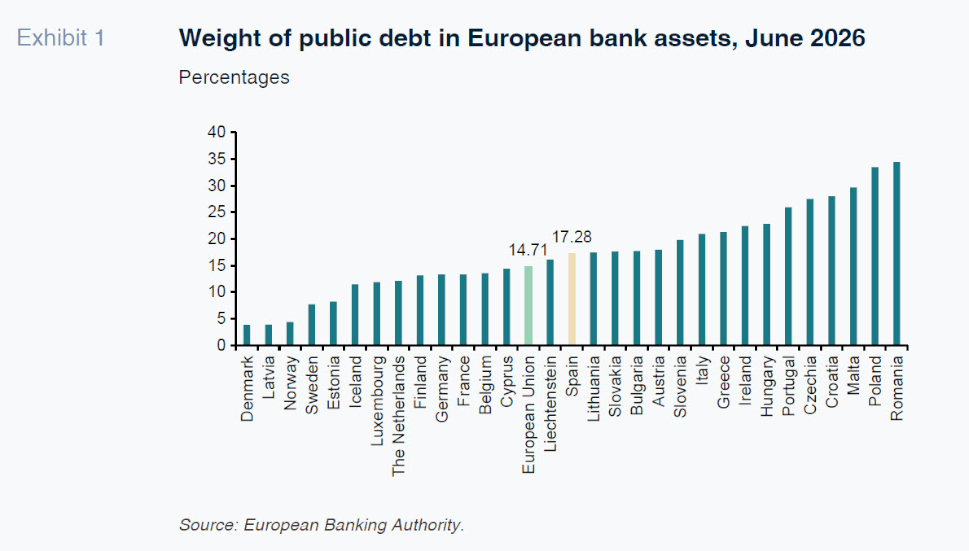
If we turn our attention to the most recent figures, which date to June 2026 (Exhibit 1), Spain ranks somewhere in the middle of the EU-27 banking sectors in terms of the share of public debt over total assets, at 17.3%, as noted earlier, above the European average of 14.7%. The range is broad, from a low of 3.8% in Denmark to a high of 34.4% in Romania. Among the main European economies, the Italian banks’ exposure to sovereign debt stands out (at 20.9%), compared to more moderate levels in Germany and France (13.3% in both countries).
In absolute terms, as of June 2026, for the sample of banks used by the European Banking Authority, EU bank exposure to sovereign risk stood at 4.6 trillion euros. The largest absolute exposure is held by the French banks (29.6% of the total | 1.3 trillion euros), followed by Spain (15.9% | 723 billion
euros), Germany (13% | 592 billion euros) and Italy (12.7% | 575 billion euros).
Characteristics of the banks’ public debt portfolios
Turning to the trend in interest rates over the last year, we see that 10-year bond yields have risen sharply, at a time in which short-term rates have also moved higher. To cite a few examples, 10-year bond yields in the U.S. have increased from 4.62% to 5.13%; in the UK, from 4.57% to 5.43%; in France, from 3.38% to 5%; in Japan, from 1.15% to 2.93%; and in Spain, from 3.25% to 4.07%. Country risk premiums have similarly moved higher, with France standing apart in the EU as a result of its high public debt and deficit levels. As of October 2026, France’s country risk premium stood at around 140 basis points, above that of Italy (around 110bp), Spain (~65bp) and Portugal (~48bp).
The impact of the increase in interest risks on the risk assumed by the banks via their exposure to public debt securities depends on the purpose for which the bonds were acquired, as their accounting treatment depends on the measurement category into which they are classified. Bonds held for trading are measured at their fair value and changes in that value are recognised in profit or loss. Available-for-sale debt securities are also measured at fair value but movements in their valuation are, in general, recognised in equity until they are sold. Lastly, securities classified as held to maturity are carried at amortised cost, so that their valuation is not altered by movements in interest rates. Therefore, the current increase in interest rates reduces the market or fair value of existing public debt securities, particularly longer-dated paper, but the impact of that increase on the banks’ earnings and equity depends on how the securities are classified for accounting purposes.
Exhibit 2 breaks down the public debt held by the banks into the three portfolios mentioned above (in percentages). The countries are ordered from left to right and smaller to bigger in terms of the relative size of their held-to-maturity portfolios,
i.e., the debt whose valuation is shielded from interest rate movements. In Spain, the majority of the banks’ debt is held to maturity, specifically 69.1% of the total, which is 10pp above the European average and favourable in the current climate of rising interest rates. There are very significant differences in the composition of the debt portfolios from one country to the next, with the share classified as held to maturity ranging from 7% in Norway to 99% in Finland.
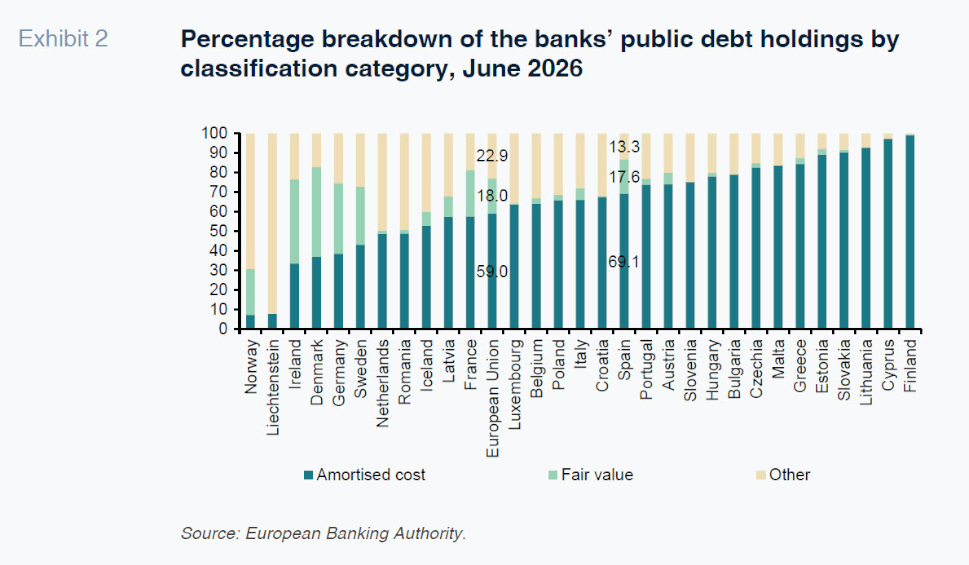
Analysing the trend in the share of held-to-maturity debt over time, we note that in Spain it has increased from 60.8% in 2021 (and 49% in 2019, the year before the pandemic) to 69.1% as of June 2026. While that share has also increased in the EU banking system in general, it has done so far less intensely (from 57.9% in 2021 to 59% by June 2026).
As for the debt carried at fair value for which valuation changes are recognised in earnings (the financial assets classified within the held for trading or fair value through profit or loss categories), in Spain that exposure accounts for 17.6% of the total, which is virtually in line with the European average. Denmark and Ireland have the highest shares of these categories of debt securities (45.9% and 43.2%, respectively), compared to virtually zero in several other countries. In France (23.9%) and Germany (36.2%) the share of this debt is much higher than in Spain, whereas Italy (5.9%) and Portugal (3%) present much lower exposures in this respect.
As for the trend in the share of debt carried at fair value and therefore implying earnings exposure, in Spain it has increased by almost 7pp, from 10.7% in 2021 to 17.6% as of June 2026, the highest reading in the series since June 2018. That same upward trend is mirrored in Europe, where it has increased from 14.4% to 18% on average. Therefore, although the share of the public debt holdings at risk of sustaining valuation losses as a result of rate movements has increased, the current level in Spain is similar to the European average (17.6% vs. 18%).
Another characteristic worth analysing is when these debt holdings mature. Short-term bonds (maturing within 12 months at most) account for 23.7% of the Spanish banks’ overall public debt holdings, which is similar to the EU-27 average. Sovereign bonds maturing in between one and five years represent 32.5% (2pp above the European average), with those maturing in between five and 10 years accounting for 32.3% (EU-27: 28.1%) and those due in more than 10 years accounting for the remaining 11.6% (EU-27: 18.3%). The Spanish banks have therefore reduced their relative exposure to longer-term debt (from 16% in 2021 to 11.6% in June 2026) and increased their exposure to medium-term paper.
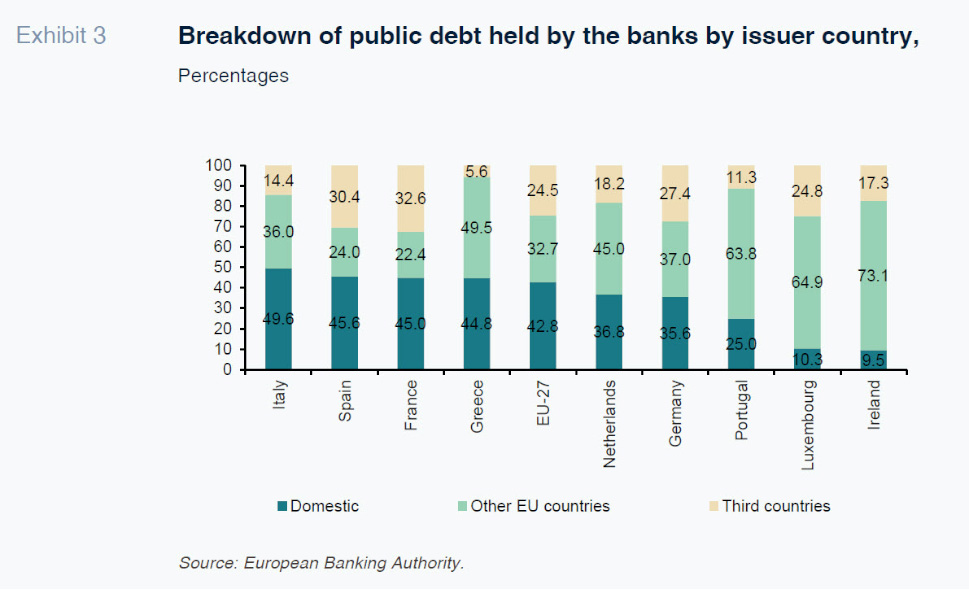
The last feature worth analysing is the geographic composition of the banks’ public securities portfolios as risk levels differ depending on the issuer. Although we do not have the statistics by individual issuer country, the European Banking Authority does provide data distinguishing between own country debt holdings, other EU country holdings and rest-of-world issuers. In the case of the Spanish banks, domestic debt predominates, accounting for 45.6% of the portfolio, above the EU-27 average of 42.8%. Securities issued by other EU countries account for 24% (below the EU-27 average of 32.7%), while that issued by third countries represents 30.4% (EU-27: 24.5%). There are considerable differences in the geographic composition of the banks’ public securities portfolios across the EU-27, with the countries with higher public debt-to-GDP ratios tending to present bigger exposures to home country debt. The significant differences in the relative sizes of holdings of other EU country debt suggest there is room for further progress on financial integration in Europe, as some countries are heavily exposed to domestic debt, with little exposure to that of other European economies. Nevertheless, the analysis needs to take into account the differences in the level of international activity of the various banking sectors and where those international businesses are concentrated. In the case of Spain, for example, the banks’ international subsidiaries, particularly their non-EU businesses, shape the higher weight of holdings of public debt issued by rest-of-world issuers.
The importance of public debt in the domestic banking business
The Bank of Spain publishes data conducive to analysing the significance of the public debt held on the balance sheets of the banks in Spain, i.e., in the domestic business (the balance sheets of the individual entities rather than their consolidated groups). Viewed through this lens, the share of public debt is smaller, at 7.9% of assets as of June 2026. As we saw with the consolidated groups, this exposure has been rising in recent years, from 6.7% in 2021 to 7.9% today. Although the share of total assets is small, these public debt holdings account for the vast majority of the domestic banks’ fixed-income securities, at 93.3% at present. In terms of the contribution made by public debt holdings to the banks’ interest income, that income stream increased from 1.7% in 2021 to 2.2% by June 2026.
Role of the banks in Spanish government funding
How important is the Spanish bank sector as a buyer of the public bonds issued by Spain? According to the information published by the Spanish Treasury, as of July 2026, 14.9% — or 223 billion euros — of Spain’s public debt is in the hands of resident banks. That percentage has been rising continuously since 2021, increasing from 12.2% to 14.9%. The opposite has happened in the case of the Bank of Spain (Eurosystem) as a buyer of Spanish public debt, with its share decreasing from 33.6% in 2021 to 20.4% in July 2026. Non-resident banks currently hold 50.9% of Spain’s public debt, up 8pp from 2021. Therefore, despite Spain’s high borrowing levels (101.5% of GDP), the rate of growth in GDP in recent years has allowed it to finance itself in the market at reasonable rates, earning foreign investor confidence and avoiding an increase in its country risk premium.
Conclusions
As the IMF warned in its last Financial Stability Report of Spring 2026, the increase being observed in interest rates and sovereign risk premiums constitutes a risk for financial stability via the banks’ exposure to public bonds. A correction in the market value of these securities can result in losses which are realised in earnings and/or equity, depending on how these securities are classified for accounting purposes. The Spanish banks’ exposure to sovereign debt has increased in recent years (driven by the fact that these securities have been providing increasing returns, so generating more interest income) and currently stands above the European average (17.3% vs. 14.7%). However, despite higher exposure, the good news for the Spanish banks is that most of that portfolio is not exposed to valuation changes as rates rise, as 69.1% of the public debt portfolio is classified as held to maturity (and therefore carried at amortised cost), which is 10pp above the average for the EU-27 banking sectors. The share of debt exposed to rate increases (that measured at fair value through profit or loss) is currently in line with the European average in Spain (18% vs. 17.6%, respectively) and has increased by almost 7pp since 2021.
In the case of the domestic banking business in Spain, the weight of public debt over assets is smaller (7.9%), although it has increased in recent years.
It is also worth noting that the decrease in the share of Spanish public debt held by the Eurosystem has been offset in part by higher holdings by the Spanish banking sector and, above all, by the increase in the share of Spanish public debt securities in the hands of non-residents, which is an indicator of international investor confidence in the Spanish economy, as borne out by its current low country risk premium.
Lastly, the analysis of the breakdown of the public debt portfolio by issuer country by comparison with the EU-27 reveals a domestic bias in the banks’ portfolios and low exposure to the debt issued by other European countries, indicating room for further financial integration in Europe. In the case of the Spanish banks, the higher share of non-European issuer debt holdings is consistent with the significance of their non-EU international banking business activities.
References
BANK OF SPAIN. (2026). Financial Stability Report. Spring 2026. 2026).
EUROPEAN BANKING AUTHORITY. (2026). Risk Assessment Report. June 2026.
INTERNATIONAL MONETARY FUND. (2026). Global Financial Stability Report. October 2026.
Joaquín Maudos. Professor of Economic Analysis at the University of Valencia, Deputy Director of Research at Ivie and collaborator with CUNEF