Housing market expectations and the risk of a new bubble in Spain
The sharp rise in house prices in 2024–2025 has renewed concerns about a new housing bubble. While macroeconomic indicators point to strong fundamentals and limited credit risk, household expectations about future price increases remain unusually high and may amplify market dynamics.
Abstract: [1] The sharp increase in house prices in 2024 and 2025 has reignited concerns about the possible emergence of a new housing bubble in Spain. A comparison with the early-2000s cycle shows that, despite strong price growth and high transaction volumes, the current macroeconomic context differs substantially from the period preceding the financial crisis. Credit expansion remains far more contained, and housing construction is well below the levels seen during the previous boom, resulting in a cumulative deficit of nearly 700,000 homes since 2020. However, household expectations about future house prices remain very strong. Evidence from the 2025
Home Price Expectations Survey indicates that buyers overestimate recent price increases by nearly double and anticipate substantial future revaluations. These beliefs play an important role in shaping purchasing decisions and can reinforce demand pressures in tight housing markets. The coexistence of relatively solid fundamentals with highly optimistic expectations highlights the importance of monitoring the latter as a potential source of market overheating. Incorporating expectations into housing market surveillance may therefore be crucial for anticipating emerging risks and designing effective housing policies.
The macroeconomic perspective
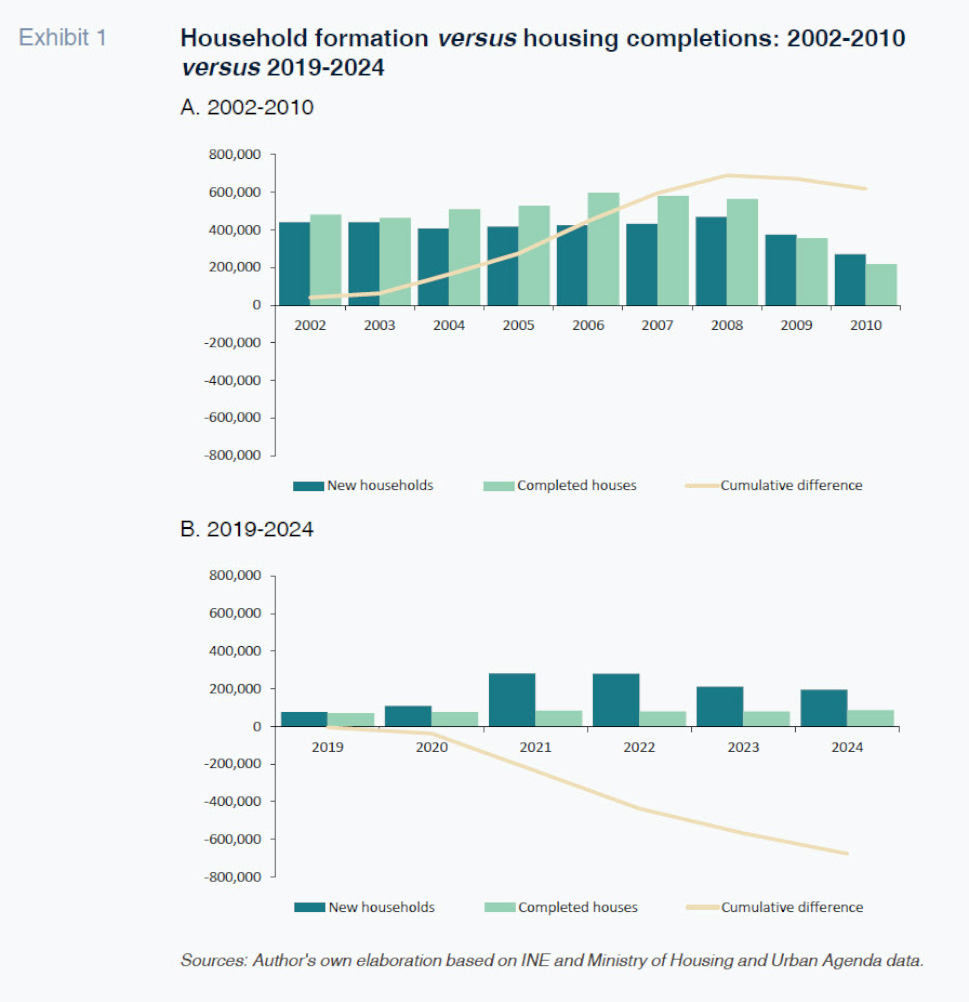
Comparing the current situation with the bubble of the noughties from the macroeconomic perspective, we see that some of the indicators are reminiscent of the past: double-digit growth in prices (12.7% year-on-year by mid-2025), annualised transaction volumes of close to 750,000 (similar to 2004) and very narrow discounts to asking prices (around 6%, close to the 5.7% observed in 2007). However, there are also crucial differences: during the last bubble, 60% of the homes sold were newly built homes, compared to just 22% at present. In addition, as shown in Exhibit 1, in this cycle, Spain is completing around 100,000 homes a year relative to 230,000 new households, implying a cumulative deficit since 2020 of nearly 700,000 homes. In the noughties, by contrast, there was a clear surplus of supply (household formations of around 350,000 per year compared to around 650,000 new builds) so that the growth in prices observed during that period had a different origin: excessive credit.
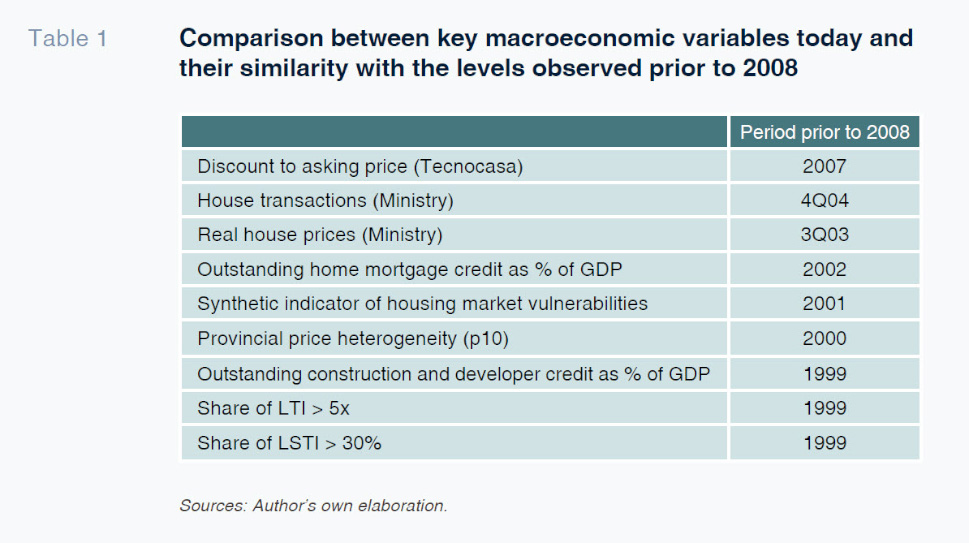
The credit statistics confirm this shift: in 2007, the outstanding balance of credit for construction and real estate activities was equivalent to 41.6% of GDP, and the balance of credit extended to finance the purchase of homes was equivalent to 62%; in 2025, those percentages were just 5.8% and 30.8% of GDP, respectively. Moreover, the average LTV ratio on home mortgages is currently around 65% with just 10.9% of mortgages extended with LTV ratios of over 80%, whereas the majority presented LTV ratios of over 100% before the last bubble burst. In addition, the Bank of Spain notes that macroprudential indicators (LTI, LSTI, the distribution of high ratios, price heterogeneity) are well below bubble thresholds and provincial heterogeneity is only increasing in the upper percentile of the price distribution, indicating discrimination between markets experiencing strong demand relative to those with weak fundamentals, in contrast to the indiscriminate growth observed at the beginning of the century. Using the standard definition of a macroeconomic bubble (prices not justified by fundamentals), at present, the growth in GDP, employment and population and the drop in rates explain a large part of the trend in prices, leaving a relatively small unexplained fraction (48% compared to 45% in the noughties). In addition, the Bank of Spain’s synthetic indicator of housing market vulnerabilities is very significantly below the levels observed in 2004-2008. Table 1 summarises the current “time position” of each indicator with respect to the last cycle: whereas the discount, number of transactions and real house prices are at levels comparable to those of 2007,2004, and 2003, the credit and risk indicators are still aligned with those of 1999-2002, indicating an advanced price cycle, lagged considerably by the credit and risk cycle.
The microeconomic perspective: Expectations around house prices
It is well known that expectations about future house prices condition individuals’ decisions around spending, saving, borrowing and the choice between renting or buying, transmitted via the wealth and collateral channels and potentially amplifying cycles in either direction. Expectations that house prices will rise increase anticipated property wealth, effectively ease credit constraints and increase borrowing and residential investment, generating synchronised positive movements in GDP, consumption, investment and hours worked that the models using extrapolative expectations and collateral constraints reproduce reasonably well. Previous surveys and experiments show there is a causal link between greater optimism about future prices and the probability of considering buying a home, higher exposure to real estate assets and fewer savings, so that shocks to expectations about credit and house prices can trigger significant fluctuations, even in the absence of major changes in fundamentals.
Expectations also play a central role in financial stability, as overly optimistic beliefs fuel self fulfilling increases in prices, borrowings and construction, followed by sharp corrections when expectations realign. Indicators tracking optimism around housing and credit are closely related with subsequent price growth.
At the micro level, expectations influence the decision whether to buy or rent and transaction timing, size and location and their interaction with income and credit conditions can intensify demand-side pressure in tight markets; by the same token, pessimistic or very uncertain expectations reduce investment in housing and durable consumer goods with effects that depend on household wealth and financial health. In economic policy, expectations around housing should be a key focus, as central bank messaging influences how these expectations are formed and because their monitoring provides a leading indicator of exuberance which complements other valuation and credit metrics, justifying their inclusion in stress tests and macroprudential rules.
Recently there has been talk of a possible “vibecession”, meaning a gap between the relatively solid macroeconomic indicators and very depressed consumer sentiment. Since 2020, the models that correlate confidence with GDP, unemployment and inflation have lost some of their ability to explain consumer sentiment in the U.S. and other countries. A number of explanations have been put forward for this: the impact of the total price hikes accumulated since 2020 rather than the current rate of inflation; the inequality of inflation, which penalises lower income households more; the role of mortgage and consumer loan rates, which consumers perceive as a form of “inflation”; growing political polarisation, amplified by the traditional and social media; and a perceived rapid rise in house prices that is not reflected in the official price indices but does affect citizens’ lived reality. In Spain, the ability of GDP, unemployment and inflation to explain the CIS consumer confidence index falls from a high correlation of 77% (2004 2019) to 57% when the figures out to 2025 are included. We can identify two episodes of “vibecession” when confidence was well below estimated levels, the second of which coincides with the acceleration in growth in house prices in the last two years and growing citizen concern about housing affordability. Individuals feel that official inflation is not adequately capturing their perception of the cost of living, which is heavily affected by the rapid rise in house prices.
There are different empirical approaches to measuring expectations around housing prices: household surveys (Fannie Mae’s NHS, the New York Fed’s SCE Housing Module, surveys conducted by the Bank of Italy, Bank of Spain, ELSA, DNB and the CES ECB), surveys of experts and professionals, approaches based on the lifetime experiences, indicators derived from online searches and structural models that infer expectations from statistics on prices, rents, vacant housing and sign restrictions. The aggregate results confirm a significant variability over time and across different individuals; a strong correlation between recent price trends and revised expectations; less fluctuation in expectations than in prices; and a tendency to overreact to market momentum in the long term, as is reasoned by extrapolative expectations models. Several studies show that subjective overvaluation of one’s own home affects portfolios and consumption, reducing risky assets and lifting spending and investment in risk-free assets, reinforcing the idea that perceptions and expectations have real effects.
Despite their importance, there is a scarcity of specific information about house price expectations. García Montalvo (2026) uses a survey to analyse the expectations of recent and future homebuyers as of the end of 2025 and compares the results with those obtained using an essentially identical instrument in 2005 (García Montalvo, 2006). The design follows the original proposed by Case and Shiller (2003).
[2] Unlike the Case and Shiller design, however, the Spanish survey focuses, in both 2005 and 2025, on recent and future buyers with the aim of capturing the expectations of those paying closest attention to the market and it follows CATI methodology rather than online surveys, in order to narrow the response time interval to control for respondent exposure to different pieces of news. The 2025 Survey was carried out in November 2025 by IMOP Insights, polling people who had either bought a house in the last five years or were planning to buy one within the next year in eight major metropolitan areas: Coruña, Barcelona, Bilbao, Madrid, Malaga, Murcia, Valencia and Zaragoza.
The description of the survey sample and the local markets reveals significant heterogeneity across cities in, for example, recent house price growth, cumulative revaluation since 2014, the presence of foreign buyers or purchases by legal entities. Asked about the use of housing, the survey reveals that around 73% of the buyers in 2025 plan to live in the houses as their primary residence, 10 points less than in 2005, offset by growth in purchases of second homes, houses for rental and for personal reasons, notably including gifting to children. The usage responses provided by the future buyers participating in the 2025 Survey bear more of a resemblance to the 2005 buyers than the 2025 buyers in terms of the percentage use as primary residence. Analysing use by socio-economic level, we find that the higher that level, the lower the share of use as primary residence and the higher its use as second home. This pattern was already observed in the 2005 Survey. The importance of viewing housing as a profitable investment, which was very strong in 2005 (45.3% said this was important), fell in 2025, with 10.4% considering it a key factor, although 40.6% agreed it was somewhat important. The importance attached to housing as a profitable investment is highest in Madrid, Malaga, Murcia and Valencia and, in terms of year of purchase, increased from 2021, peaking in 2024 and falling in 2025. The importance of the investment aspect is higher in the upper and medium upper socio-economic levels, reproducing the pattern observed 20 years ago, albeit less intensely.
The perception of the risk of buying a home has barely changed since 2005: around 41% of participants believe the purchase implies significant risk, which is virtually identical to the 2005 figure, while just 22% identified the risk as very low. Perceived risk is higher in Malaga and Murcia. By year of purchase, perceived risk was trending lower until 2024 but increased sharply in 2025, coinciding with the acceleration in price growth. The increase is even higher among those who have not yet bought but are planning to do so within the next year. By socio-economic level, the perception that buying a home carries high risk is more common among the lower classes, decreasing as income and education levels increase, a pattern that is similar to that of 2005.
In the block of questions related to reasons for purchase, the belief that now is a good time to buy because houses will be more expensive in the future was the most important factor identified in 2025, as was the case in 2005, followed by difficulties in finding rental housing and the fear of not being able to afford to buy later on. This pattern is similar in all cities except for Barcelona, where the difficulty in finding somewhere to rent is a much bigger driver of the purchase decision, which makes sense in light of how tight the local rental market is. The trend by year of purchase shows that until 2025, the predominant driver was the expectation of future price increases; however, among future buyers, the main factor, by a wide margin, is the difficulty in finding rental housing. By socio-economic level, in the upper and medium upper classes, the main reason remains the expectation of higher prices, whereas in the middle classes, the difficulty in finding somewhere to rent is practically as much of a driver and in the medium low categories, the difficulty in finding rental housing is the main reason for
the decision to buy.
As for the reasons given for the growth in prices, in 2025, the participants mainly signalled the growth in land prices, citing the role of foreign buyers with deep pockets in second place and higher construction costs in third place. Other factors such as low interest rates, slim stock market returns, illicit funds and increased purchasing power are considered less important. This hierarchy contrasts with 2005, when the reasons most cited after land prices were low rates and illicit funds, suggesting a shift in the narrative from demand and financing to supply issues and pressure from foreign buyers with lots of funds. There are geographical differences: in Barcelona, Coruña, Madrid and Murcia, the participants attached more importance to the role of foreign buyers, whereas in Bilbao, Malaga, Valencia and Zaragoza, land prices were cited as the key factor.
The analysis of the participants’ quantitative perceptions and expectations around house prices shows that they substantially overestimate the recent increase in prices and are expecting very significant revaluations in the medium term. Their perception is that house prices in Spain have increased by 26.6% in the last 12 months, which is roughly twice the official figure. They expect house prices in the cities they live in to increase by around 16% in 2026, whereas the expectation for average house price revaluation in Spain over the next 10 years is close to 27%, figures which are both much higher than those of 2005. By socio-economic level, both the current perceptions and expectations for future growth increase clearly and systematically as those levels drop. This pattern also held in 2005 but is now more intense, with the lower socio-economic classes reporting much higher price growth perceptions and expectations in 2025.
Another interesting aspect relates to the perception of house price overvaluation. Nearly 89% of those polled believe that housing is overvalued, which is a very high figure and not too far from the 94.5% observed in 2005. However, in 2025, around 30% of those who perceive overvaluation think housing is overvalued by more than 50%, compared to 40% in 2005. The perception that housing is overvalued is more pronounced in Malaga and Valencia, compared to Barcelona and Madrid back in 2005, indicating a shift in the perceived tight market focal points. The 2025 Survey also collected information about mortgage burdens, the form of purchase and family assistance. Around 25% of the participants said they had received or expect to receive family help with the purchase, up five points from 2005, with higher percentages of assistance in the upper and medium upper echelons. Forty-eight percent said they will have to repay that money.
The econometric analysis of the perception of growth in house prices reveals that demographic factors (age, gender and level of education) are statistically significant. The younger participants believe prices have increased by more than the older participants, while the men and individuals with university studies perceive smaller increases in house prices. Actual price growth, as measured in the official statistics, is not significantly informing price growth perceptions. On the other hand, demographic characteristics are not significant in explaining future expectations for house prices once the perception of house price growth during the past year, or the gap between perceived and actual price growth, is included. This suggests the existence of a clearly extrapolative mechanism underlying current expectations for future prices irrespective of real price growth.
In sum, in 2005, both the macroeconomic indicators and buyer expectations pointed to the formation of a major credit bubble. Today’s macroeconomic indicators show no signs of a credit bubble in the residential property sector. However, household expectations around house prices are running high; they believe that prices are growing at twice the pace they actually are and are extrapolating those expectations to the future. Households expect house prices to rise very strongly in the future and underestimate the risk of a price correction. These beliefs generate extrapolative and FOMO patterns that affect purchase decisions, reduce negotiation intensity and potentially fuel a self-fulfilling price dynamic similar to that of 2007. The difference is that today, the criteria for extending mortgages remain stringent, in contrast to the period that culminated in the financial crisis of 2007, and that situation is unlikely to change going forward. This time, therefore, credit will act as a constraint, mitigating the impact of house price growth expectations. The combination of “no bubble” in macroeconomic terms and very high price expectations underscores the need to monitor the latter, incorporate them into macroprudential policy design and communication, and focus housing policy on expanding supply—particularly rental housing—to prevent further price increases and the associated “vibecession” from ultimately affecting financial stability and social cohesion.
Notes
This paper is a synthesis of the study titled ¿Existe una burbuja en el mercado inmobiliario español?; El papel de las expectativas del precio de la vivienda en España, published in Investigaciones de Funcas, 26/2026.
The need to formulate a questionnaire that would lend itself to a precise comparison implied limitations in terms of modifying the original instrument to include other characteristics such as probabilistic elicitation, changes in the definition of the socio-economic groupings, etc.
References
CASE, K. and SHILLER, R. (2003). Is there a bubble in the housing market? Brooking Panel on Economic Activity, 2, 299–362.
GARCÍA MONTALVO, J. (2006). Deconstruyendo la burbuja inmobiliaria. Papeles de Economía Española, 109, 44-75.
GARCÍA MONTALVO, J. (2026). ¿Existe una burbuja en el mercado inmobiliario español?; El papel de las expectativas del precio de la vivienda en España. Investigaciones, 26/2026.
José García Montalvo. Professor of Economics at Pompeu Fabra University (UPF) and Research Professor at BSE and IVIE