Growth in 2026 [1]
Consensus 2026 GDP estimate raised by 0.2pp to 2.5%
According to provisional INE data, Spain’s GDP grew by 0.7% during the second quarter, which is 0.2pp more than the analysts were forecasting. Domestic demand accounted for 0.6pp, with foreign trade adding 0.1pp.
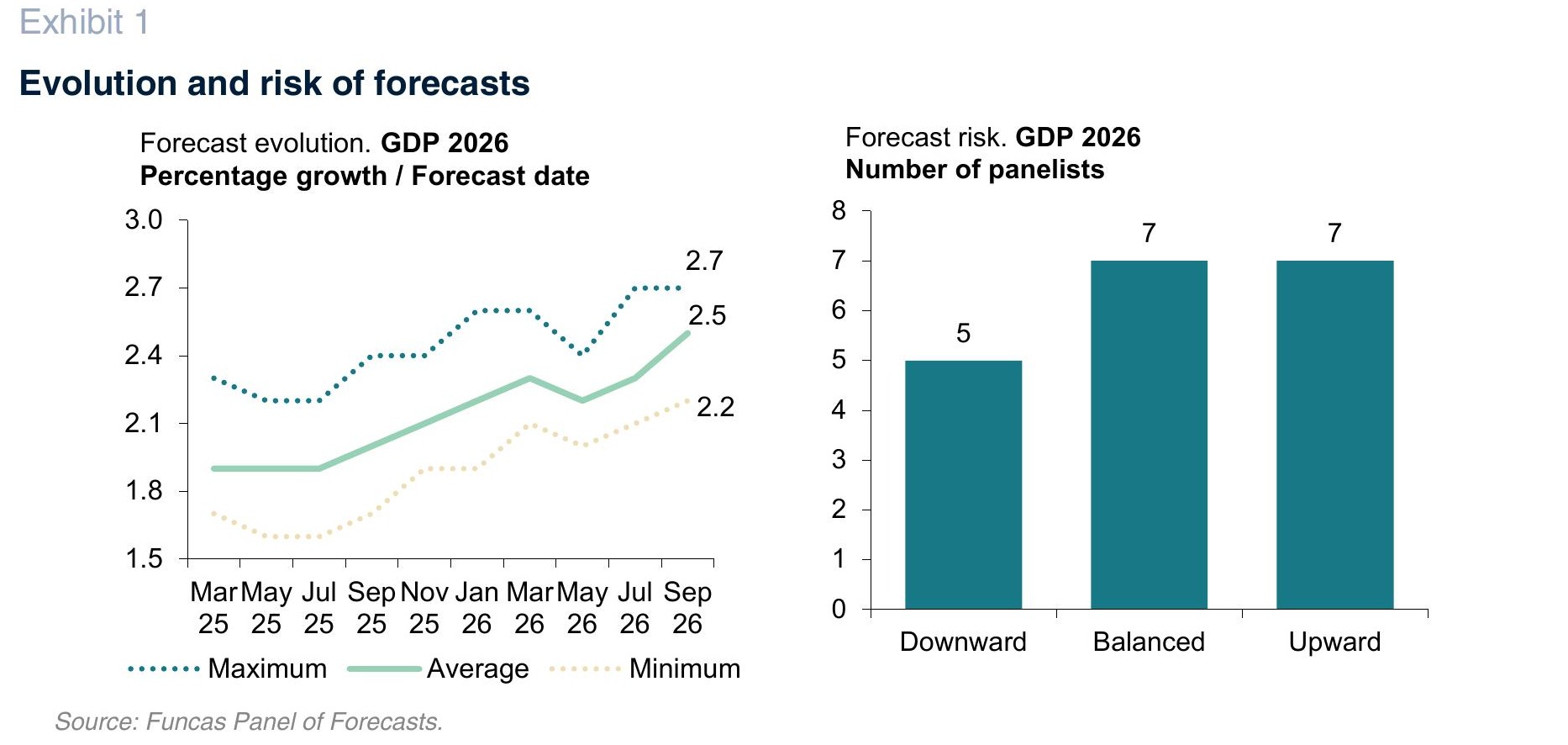
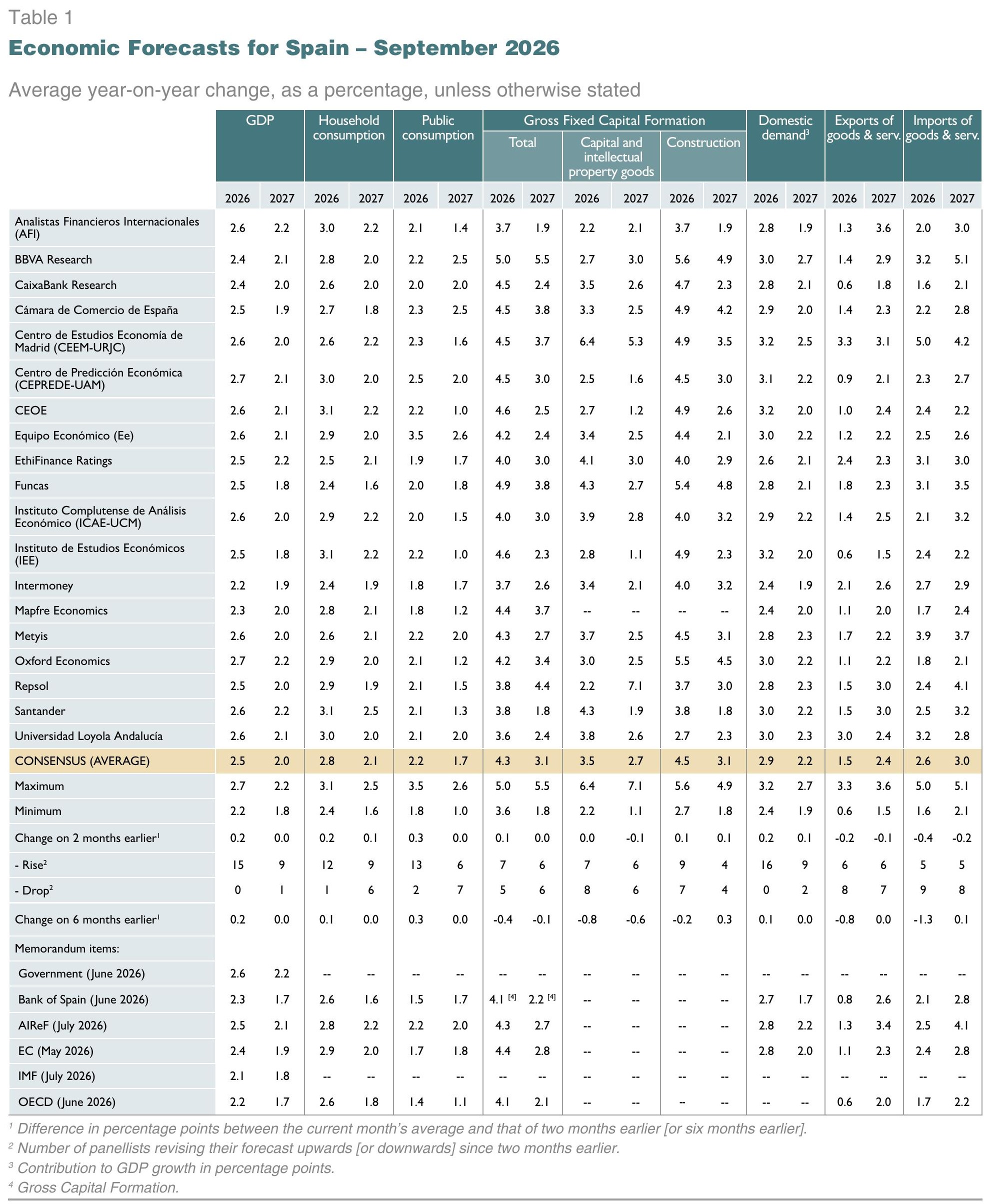
[2]The consensus estimate for growth this year has been revised upwards by 0.2pp to 2.5%. Fifteen analysts have raised their estimates and none has trimmed them (Table 1). The upward revisions reflect the better-than-forecast second-quarter growth figure and, to a lesser degree, a slightly higher forecast for the third quarter, of 0.5% (Table 2).
As for the make-up of the GDP growth forecast for this year, domestic demand is expected to contribute 2.9pp (up 0.2pp from the last survey), with foreign demand detracting by 0.4pp (unchanged from our July survey). The forecasts for public consumption, private consumption and investment have all been raised. Analysts are now looking for growth in exports and imports of 1.5% and 2.6%, respectively, down from the July estimates (Table 1).
The number of analysts who perceive more downside risk than upside to their estimates has increased since July but the majority continues to see either more upside or a balance of risks.
Growth in 2027
The projection for 2027 is unchanged at 2%
The consensus forecast for GDP growth in 2027 is unchanged from July, at 2%. This is slightly higher than the projections of leading national and international organisations, except for the Spanish government and AIReF (Table 1).
The growth forecast for 2027 is expected to come entirely from domestic demand, with an estimated contribution of 2.2pp (up 0.1pp from the last survey), with external demand detracting by 0.2pp (compared to an estimated negative contribution of 0.1pp last July). Growth in all components of domestic demand (private consumption, public consumption and investment) is expected to slow from 2026 (Table 1).
Projections are for quarterly GDP growth of around 0.5% for the first three quarters of 2027 and a slight slowdown to 0.4% in the last quarter (Table 2).
Inflation
Geopolitical tensions translating into higher inflation forecasts
Having settled at 3.2% in the second quarter, headline inflation headed back up to 3.6% in July and climbed to 4.3% in August, fuelled by intensification of geopolitical tensions. Core inflation, meanwhile, continues to move in the range of 2.8%-3%, where it remains very sticky, due mainly to persistent pressures in service prices. Processed food prices, on the other hand, have eased in recent months.
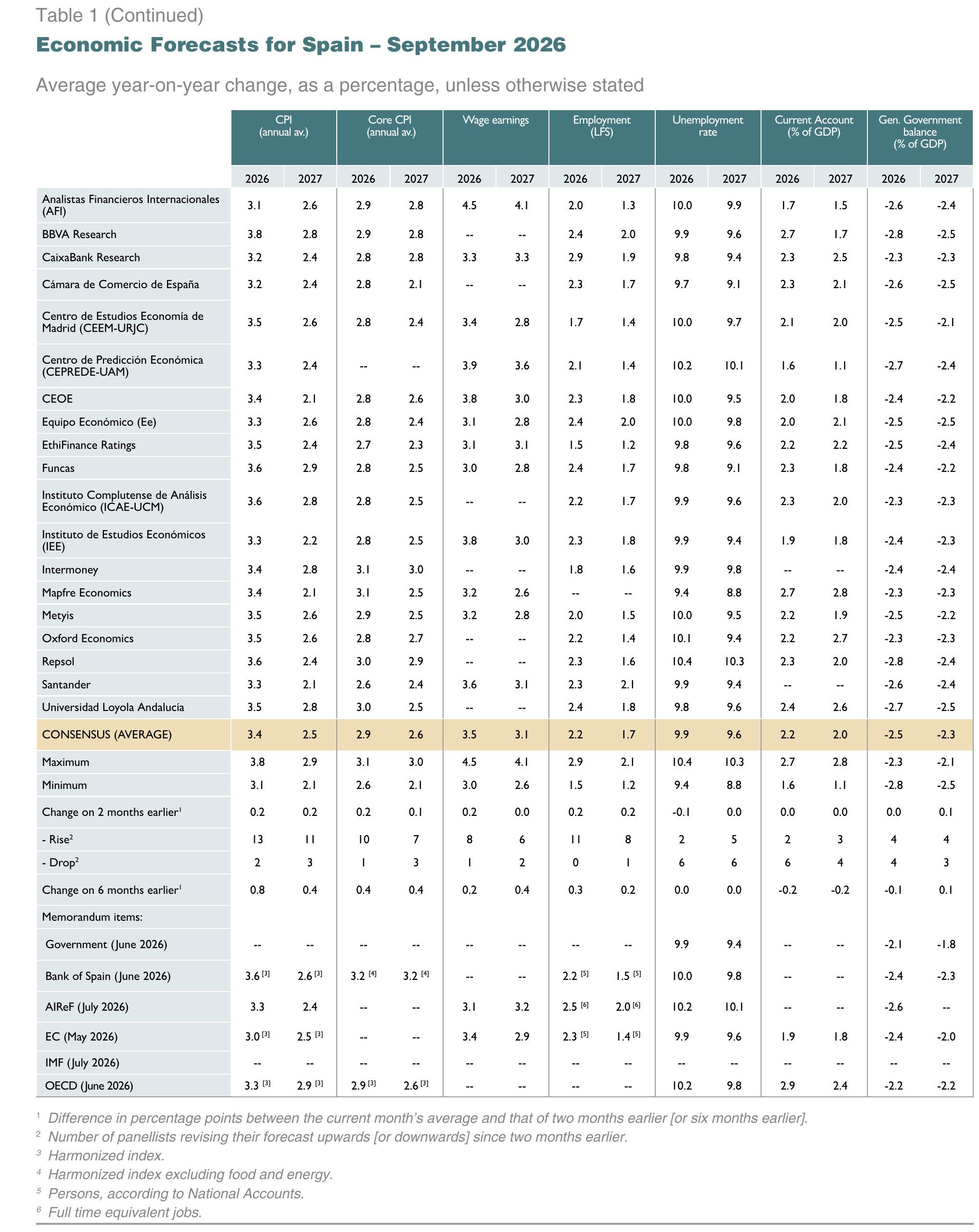
The analysts, expressing due caution on account of the level of uncertainty derived from the geopolitical tensions with a direct impact on inflation via energy prices, believe that headline inflation may have peaked in August and should start to come down during the months to come to end the year at a year-on-year rate of 3.5%. The consensus forecasts for the average annual headline and core inflation rates in 2026 are 3.4% and 2.9%, respectively, both of which are 0.2pp higher than the July forecasts. For 2027, the consensus forecasts have similarly increased, to 2.5% in the case of headline inflation with core inflation projected at 2.6%. The analysts are forecasting headline inflation of 2.2% year-on-year in December 2027 (Tables 1 and 3).
Labour marketGrowth in social security contributors accelerating, shaped by legalisation of foreign nationals
Since April, growth in the number of social security contributors has accelerated sharply to year-on-year rates that are well above those of the past two years. The trend, which reflects mainly the incorporation of foreign workers, is tied to the ongoing process of regularisation of undocumented immigrants (which had translated into over 330,000 new contributors as of the end of August). In the meantime, growth in national contributors has been gradually easing.
For 2026 as a whole, the analysts are forecasting year-on-year growth in employment of 2.2%, slipping back to 1.7% in 2027 (both figures are 0.2pp above the July forecasts). Average annual unemployment is forecast at 9.9% this year (down 0.1pp from the last survey), dipping to 9.6% in 2027 (Table 1).
As for productivity and unit labour costs (ULCs), which are estimated based on the forecasts for GDP growth, employee compensation and employment as per the labour force survey, the former is expected to increase by 0.3% this year and the latter, by 3.2% (up 0.2pp from July). In 2027, growth in productivity and ULCs is forecast at 0.3% and 2.8%, respectively.
Balance of payments
Shrinking current account surplusThe current account surplus amounted to 15.1 billion euros in the first half of 2026, which is equivalent to 1.7% of GDP. This is 9 billion euros below the first-half 2025 surplus and the lowest figure on record since 2022. Underlying the erosion is the fact that the improvement in the surplus in travel services was more than offset by the increase in the goods trade deficit and, to a larger extent, the increase in the primary and secondary income deficit, which hit its highest level since 2012, shaped by the run-up in interest rates.
The analysts are looking for a current account surplus of 2.2% of GDP in 2026 and 2% in 2027, unchanged from the July survey (Table 1).
Public deficit
Deficit projections for 2026 and 2027 unchanged
Despite the economic momentum, as of June, Spain’s public deficit was largely unchanged from last year’s levels. Although tax receipts are benefitting from the economic boom, public expenditure is rising in tandem with revenue.
As was the case in July, the analysts are expecting the deficit to increase to 2.5% of GDP this year, although eight of them believe the deficit will come in below or in line with the 2025 figure. For 2027, the consensus forecast is for a deficit of 2.3% of GDP (down 0.1pp from the July round of forecasting). There is a significant disconnect between the figures reported by national and international organisations (Table 1).
International context
Deteriorating international environmentThe international situation has deteriorated, chiefly as a result of the resurgence of hostilities in the Middle East. In addition to the closure of the Strait of Hormuz, passage through the Bab el-Mandeb Strait, which provides access to the Suez Canal, has been affected by the spread of the conflict in Yemen. The most tangible result is the surge in Brent oil prices, which have jumped from under $70/barrel in July to nearly $110. The gas market has also come under strain, particularly in Europe, partly due to the conflicts but also to the demand generated by the need to store this prized commodity ahead of the winter.
The survey respondents echo the deterioration in the international context, with a majority describing it as unfavourable and expecting it to remain so over the coming months, both in the EU and globally (Table 4). Moreover, the number of analysts who expect a prompt improvement has dropped from 5 to 3 in the case of the EU assessments, and from 6 to 1 in the case of the global economic assessments.
Interest rates
Interest rates are rising on the back of the uptick in inflation and accumulation of public deficits
The blockade of the Strait of Hormuz, together with the threats looming over shipping through the Red Sea, have triggered a fresh bout of energy-induced inflation, complicating central banks’ efforts to maintain monetary stability. The ECB recently tweaked its interest rates again, raising the deposit facility rate to 2.5%, having increased its forecasts for inflation for the next two years in parallel. The Federal Reserve could follow suit, starting from higher interest rate levels than in the eurozone.
This shift in monetary policy is also underpinned by the resilience the economy is showing in the face of the energy shock and geopolitical tensions. In Germany, economic indicators point to a slight recovery (which is not, however, evident in France), while in the U.S., investment in technology continues to underpin growth and job creation, potentially allowing the central banks to focus on tackling inflation. The analysts expect the ECB’s deposit facility rate to remain anchored at 2.5% until mid-2027, which is a quarter of a point higher than the last consensus forecast (Table 2).
Given the uptick in inflation and prospect of monetary tightening, 12-month Euribor has been trending higher and is currently trading above 3.2%, up more than half a point from July. The analysts expect that benchmark rate to ease a little over the coming months, ending next year at around 2.7%, which is nevertheless 0.2pp above the July forecast (Table 2).
In tandem, the return required by the markets for purchasing Spanish 10-year treasury bonds has increased, evidencing market concern about the public deficits being piled up by the major advanced economies. The analysts expect these tensions to persist: they are now forecasting a yield of close to 3.5% at the end of the projection horizon, which is nearly 0.2pp higher than they were predicting in July.
Currency market
Dollar appreciationThe dollar has been appreciating against the euro in recent days due to the growth differential on either side of the Atlantic and the prospect of a Federal Reserve rate hike. However, the consensus forecast is that the euro will regain a little of the ground lost between now and the end of 2027 (Table 2).
Fiscal and monetary policy considerations
Fiscal policy should be less expansionary
There has been little change in the analysts’ assessment of macroeconomic policy. The analysts generally believe that the Spanish economic cycle is sufficiently robust as to not need additional stimulus via fiscal policy. According to a majority of analysts, the budget remains expansionary when it should be neutral, meaning it should not provide additional stimulus. As for monetary policy, the perception is one of a better fit with the cycle: the consensus is that monetary policy is neutral, which is what the Spanish economy currently requires (Table 4).