
Spain′s fiscal consolidation: Falling short of its economic momentum
Spain comfortably outperformed its 2025 deficit and debt targets under the Medium-Term Fiscal-Structural Plan, supported by stronger-than-expected nominal growth; however, the fiscal adjustment linked to the committed expenditure path does not adjust to stronger economic performance, resulting in a structural consolidation effort that fell short of what would have been warranted by the improved macroeconomic environment. With spending pressures set to increase, a more ambitious adjustment will be needed in the years ahead.
Abstract [1]: Net primary expenditure growth reached the upper limit permitted under the new EU fiscal framework in 2025, after taking into account the additional flexibility provided by the national escape clause for higher defence spending. Recalculating the fiscal adjustment using the updated potential growth and GDP deflator estimates contained in Spain’s Annual Progress Report suggests that the structural primary deficit should have been reduced by around 0.72% of GDP, more than twice the 0.3% adjustment actually achieved. This discrepancy highlights an asymmetry in the new fiscal framework: while adverse economic developments are accommodated through stress scenarios and escape clauses, stronger-than-expected economic performance does not result in a corresponding tightening of the expenditure path. Although the government envisages a larger structural adjustment in 2026, projections from the Independent Authority for Fiscal Responsibility (AIReF) and the European Commission point to significant implementation challenges, particularly given spending pressures at the regional, local and Social Security levels. These challenges are compounded by the absence of an approved 2026 budget, a draft budgetary plan submitted to Brussels or binding fiscal discipline agreements with subnational governments. Against this backdrop, Spain’s current economic momentum provides an opportunity to accelerate structural fiscal consolidation and build greater fiscal space ahead of a future slowdown and mounting expenditure pressures.
Fiscal target outperformance: When economic momentum masks the issue at heartFiscal consolidation processes need to be sensitive, among other things, to where in the cycle an economy finds itself. The escape clauses in the fiscal rules tackle this issue in the event of unforeseen developments or sharp economic downturns. If, however, the situation is the other way around,
i.e., the economy performs better than initially forecast, the fiscal path does not undergo a commensurate update.
Spain’s public finances illustrate this matter. 2025 was the first year of application of the Medium-Term Fiscal-Structural Plan (MTFSP) (Government of Spain, 2024), which sets down the fiscal commitments for all levels of government in the context of the new European economic governance framework.
Thanks to healthy nominal growth, the Spanish government outperformed its public deficit and debt targets in 2025. Both figures came in below the initial estimates, despite a weaker consolidation effort than assumed under the MTFSP, fully using up the permitted room for deviation in net primary expenditure (without cyclical grounds for doing so) and triggering the national escape clause which allows an increase in defence spending without penalisation.
This paper questions the fact that Spain’s fiscal consolidation requirements were not recalibrated in light of the upward revisions to its potential growth rate and GDP deflator. We do so by calculating by how much the structural primary deficit should have been corrected to take stock of the momentum provided by the current cycle and higher potential output. We make those calculations in a manner consistent with the methodology prescribed under the new European economic governance framework.
Brief introduction to the expenditure path conceptIn this section we summarise the process followed to determine the net primary expenditure path, the new fiscal framework’s core operational indicator. Targets are set around an adjusted public expenditure concept which excludes discretionary revenue measures, interest expenditure, cyclical unemployment expenditure, national expenditure on the co-financing of programmes funded by the EU, and expenditure on EU programmes fully matched by revenue from EU funds. That metric is known as net primary expenditure.
A maximum net expenditure path is established for a period of five years, seven if associated with the launch of certain structural reforms, as is the case in Spain (2025-2031), which must be met by the country over the entire term of effectiveness of its fiscal plan. Temporary deviations from the limits are allowed: 0.3% of GDP in any given year and no more than 0.6% of GDP on a cumulative basis. Excess spending in one year can be offset against below-ceiling expenditure another year.
The precise definition of the maximum rates of growth in net primary expenditure is the result of merging two analytical methodologies. The first is a debt sustainability analysis (DSA), based on forward-looking macroeconomic scenarios and certain fiscal assumptions. Here the aim is to simulate the fiscal adjustment, measured in terms of the structural primary balance, needed for the public debt-to-GDP ratio to embark on a sustained downward trajectory. That trajectory must be sustainable beyond the end of the fiscal plan (2031) even in situations of financial stress derived from adverse interest and/or GDP growth rates.
That fiscal adjustment is then used to obtain the permitted ceiling for growth in net primary expenditure. It is arrived at by summing the growth in potential GDP, estimated using a standardised methodology at the European level, and the rate of change in the GDP deflator. For the earlier years of the plan, the potential GDP and the deflator rely on estimates and for the latter years, they are calculated so as to ensure convergence with the targets yielded by the DSA. That sum is then reduced by the fiscal consolidation effort, understood as the change in the structural primary balance as determined by the above-mentioned DSA, and expressed in terms of net primary expenditure.
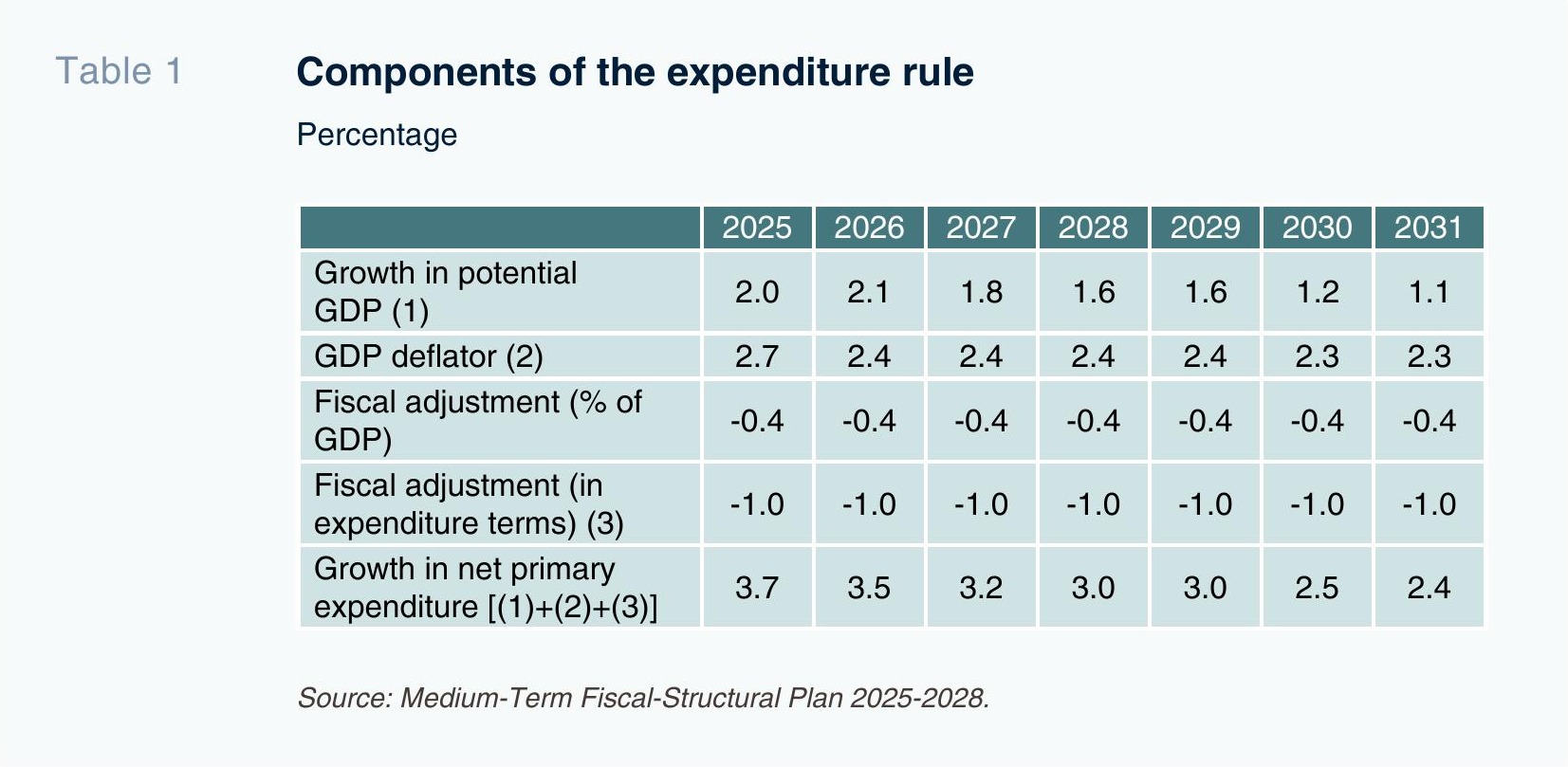
The result of this process for the Spanish public sector (all levels of government) throughout the plan horizon is shown in Table 1. The last row of the table indicates the maximum permitted rate of growth in net primary expenditure for each year.
This new fiscal approach coexists with the older thresholds for triggering the Excessive Deficit Procedure (EDP): a deficit of over 3% of GDP or a public debt ratio of over 60% of GDP or an unsatisfactory pace of deleveraging, which in the case of Spain is at least one percentage point per annum. On 12 June 2026, the European Council authorised Spain to deviate from the MTFSP to spend more on defence
[2]. The magnitude of the deviation is capped at a cumulative 1.5% of GDP between 2025 and 2028.
What happened in 2025?Framed by these institutional coordinates, this section outlines the paradox implicit in Spain’s performance with respect to the MTFSP in 2025, its first year of application. Specifically, we highlight how Spain managed to comfortably meet (in reality, surpass) its public deficit and debt reduction targets while making a smaller fiscal consolidation effort than agreed in the plan. In fact, that effort was right at the limit of the permitted deviation, after activating the national escape clause to allow higher spending on defence.
Table 2 illustrates the sequence for determining the net primary expenditure growth rate for 2025 and 2026 according to the Annual Progress Report (Government of Spain, 2026). In 2025, the starting point is the rate of growth after the above-mentioned adjustments of 4.8%.
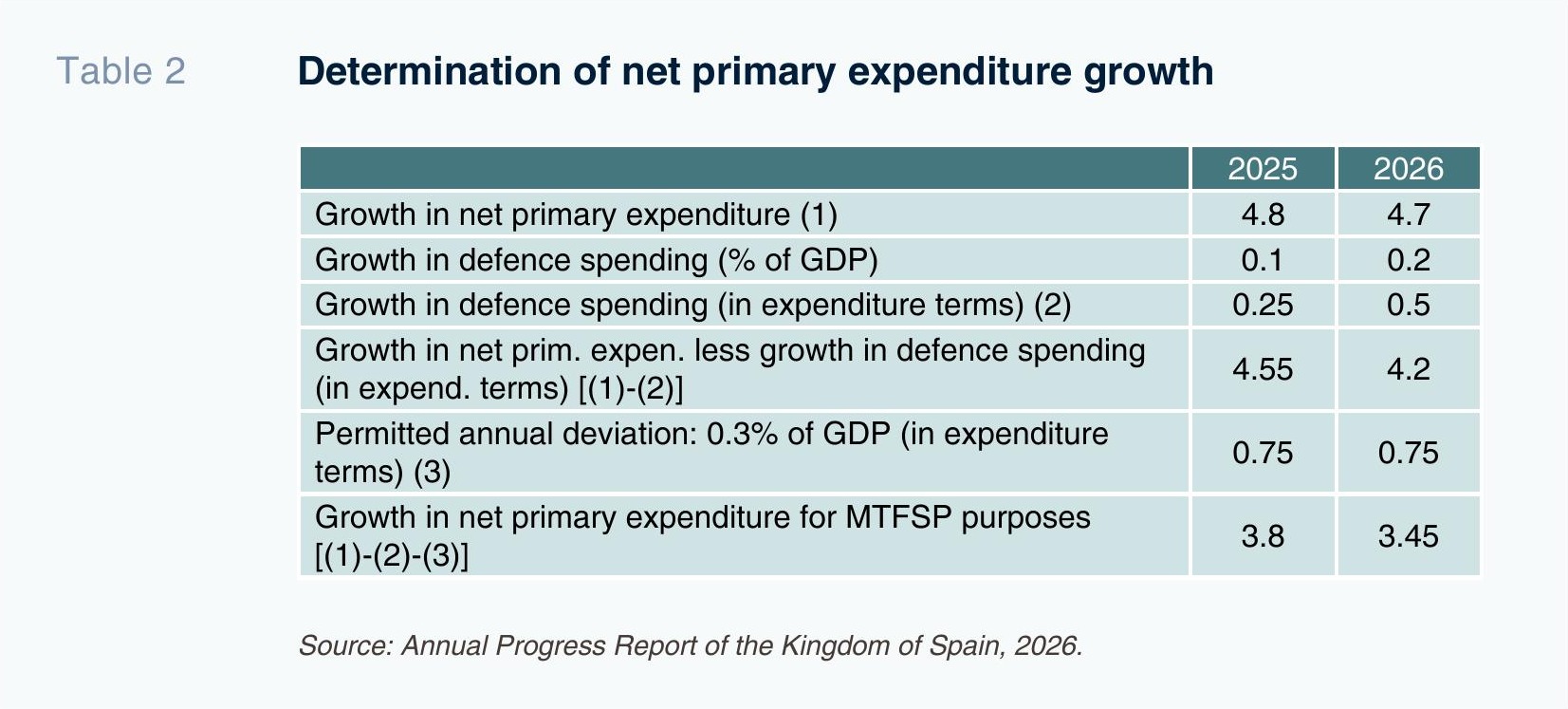
Expenditure on defence (according to the Classification of the Functions of Government —COFOG) amounted to 1% of GDP in 2025, up 0.1 percentage points from 2024. That additional tenth of a point of GDP of defence spending, according to the recently activated national escape clause, can be deducted from the growth in public expenditure for expenditure rule purposes. To map that percentage of GDP onto a public expenditure scale, it is assumed that the latter accounts for around 40% of GDP, which implies a discount of 0.25 percentage points.
[3] That brings us to the government’s figure for the growth in net primary expenditure of 4.55%, which it rounds to 4.5%, given as the outcome for the year. The new European fiscal governance framework allows a maximum annual deviation of 0.3% of GDP, which is equivalent in expenditure terms to room for manoeuvre of 0.75 percentage points over the ceiling committed to in the MTFSP, which is 3.7% (Table 1). Once again resorting to rounding, Spain meets that upper limit, just about.
Nevertheless, Spain comfortably met its MTFSP public deficit and debt targets in 2025. The deficit commitment was 2.5% of GDP and Spain delivered a deficit of 2%, excluding one-offs. The public debt target was 101.4% of GDP and the actual figure was 100.7%.
The fiscal consolidation effort, however, fell short of the MTFSP commitment: 0.3%
vs. 0.4% of GDP. Although Spain only missed that target by a tenth of a point, considering the fact that it activated the national escape clause for defence spending and used up all the permitted deviation in expenditure, that miss stands out by comparison with its ample outperformance in terms of the deficit and debt.
This paradox is explained by the growth in potential GDP in nominal terms. The forecasts contemplated in the MTFSP for 2025 called for growth in potential GDP and a GDP deflator of 2% and 2.7%, respectively, implying growth in nominal potential GDP of 4.7% (Table 1). The reality, however, is that those metrics came in higher, at 2.6% and 2.9%, respectively, equivalent to nominal potential GDP growth of 5.5%.
The government is aware of the situation, but its interpretation is pro-cyclical, which goes against fiscal orthodoxy. Indeed, the Progress Report itself states that “if the expenditure rule for 2025 were calculated today, it would have been 4.5% instead of the 3.7% contemplated in the Structural Fiscal Plan. That suggests that the growth in eligible net expenditure of 4.5% registered in 2025 would be in line with that rule calculated as of today”.
Both the letter and spirit of the new European economic governance framework stipulate that the reference spending path is fixed. There is a small amount of room for revising the MTFSP, but it is not applicable in the case of Spain (Article 15 of Regulation (EU) 2024/1263 of the European Parliament and of the Council
[4]). As a result, the above-mentioned governmental narrative regarding what would happen if everything were recalculated is completely misguided.
The problem lies more with the fact that there is an asymmetric pro-cyclical design flaw in the new European fiscal rules. In other words, the rules anticipate adverse or unforeseen developments sufficiently well. The stressed scenarios, contemplation of potential one-offs and general or national escape clauses accommodate the negative impact of a host of developments on the region′s public finances.
But what happens if an economy performs better than contemplated in the MTFSP? The established net primary expenditure path is not modified. Think about an increase in the rate of potential GDP growth, widening the output gap,
[5] and, by extension, the cyclical component of the public balance, reducing the estimated weight of the structural component. Or imagine a higher-than-initially estimated rate of growth in the GDP deflator, which could stimulate growth in public spending via supply-side costs.
In light of both circumstances, the effort to reduce the structural primary deficit loses power as an adjustment variable just as the need to do so potentially becomes more pressing, given foreseeably upward slippage in budgeted public expenditure (as per inherited budgets in the case of Spain). Both factors played out in this manner in Spain’s public finances in 2025.
What happens next?Given what happened in Spain in 2025, the consolidation effort should be recalibrated to preserve, in the wake of the considerable upward revision to potential GDP and/or the GDP deflator, the degree of fiscal adjustment originally envisaged in the MTFSP. Below we set out a simple alternative that would factor in this chain of events. Table 1 showed the contribution by the three dynamics in play in defining the maximum permitted ceiling for growth in net primary expenditure. Those weights remain constant in the event of fluctuations in the macroeconomic variables.
Table 3 illustrates how, leaving the expenditure growth ceilings unaltered, the mix of the three ingredients would shift if the new potential GDP growth and deflator figures set out in the Annual Progress Report for 2025 and 2026 were used, modelling the AIReF forecasts for 2027-2030 (AIReF, 2026).
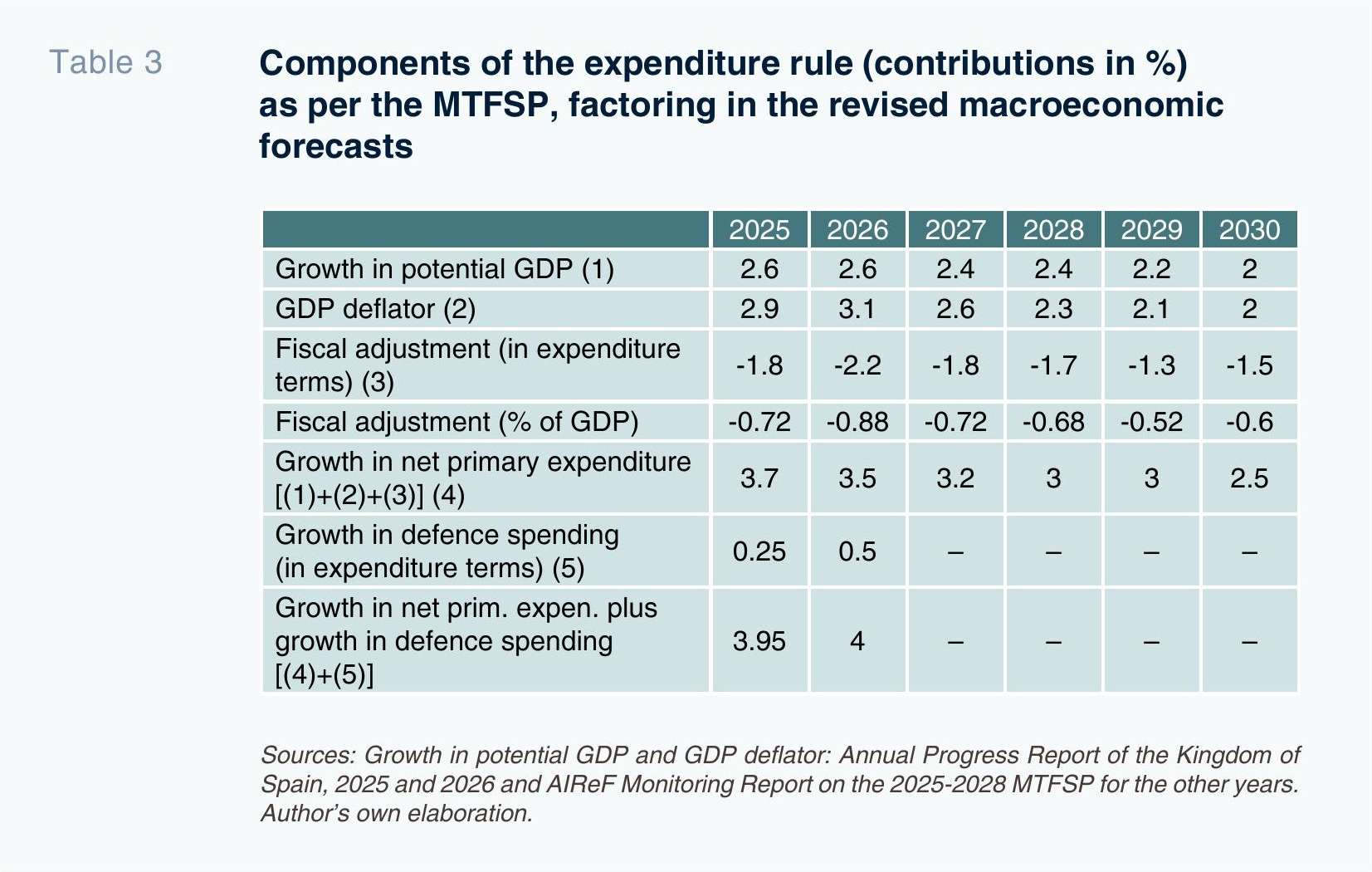
For 2025, the fiscal adjustment requirement should not have been the 0.4% of GDP set down in the MTFSP (Table 1) (and which Spain missed by 0.1pp), but rather 0.72%. That would have made it possible to comply with the MTFSP’s restrictive path from the outset, while allocating the room freed up by the national escape clause to defence spending.
[6] For 2026, the government’s response is aligned with this approach. Although the MTFSP agreed with Brussels calls for a consolidation effort of 0.4% of GDP, the forecasts provided in the Annual Progress Report contemplate an improvement in the structural primary deficit of 0.8% of GDP, which is very close to our simulation.
The issue here, and with the government′s fiscal strategy as a whole, lies not so much with the aim of delivering this figure as much as how it will be achieved. Without a state budget for 2026, not having sent a draft budgetary plan to Brussels and in the absence of binding and operational fiscal discipline agreements with either the regional or local governments (which between them account for over 40% of total public expenditure), it is unclear how the announced deficit reduction will be achieved.
Indeed, the AIReF believes that the government will miss this target as it is forecasting growth in net primary expenditure of 5.8% this year, which is considerably above the government’s estimate of 4.7% (AIReF, 2026). The figure committed to in the MTFSP is 3.5%. The European Semester also expects the fiscal adjustment to be in line with the original figure set down in the MTFSP (0.4% of GDP), which is half of the target announced by the Spanish government (European Commission, 2026b).
In sum, given the substantial improvement in the forecasts for the Spanish economy’s potential growth, fiscal policy should be more contractionary. Logically, this extends beyond the state to all levels of government, notably including the Social Security, which needs to be at the heart of this debate, and the regional governments.
Conclusions
In an environment of mounting pressure on public expenditure, fiscal consolidation during periods of growth is more important than ever. Even though the impact of some of the new spending requirements (such as defence) on the fiscal rules will be cushioned in the near term, in the longer term (after 2028), they will require additional adjustments (Marín
et al., 2024). As shown in this paper, however, the economic momentum currently being enjoyed in Spain is not being leveraged with the intensity it should be to further reduce the public debt ratio.
This situation could be described as an institutional flaw in the European fiscal rules, which are not tightened sufficiently when things turn out better than forecast. This laxity could fuel governments’ fiscal egos by allowing them to outperform in variables that are heavily influenced by the economic cycle, such as the public deficit and debt, while neglecting the real adjustment needed in their structural public deficits.
This phenomenon is particularly significant in the case of Spain, where a substantial portion of the adjustment stems from the fiscal drag in personal income tax, so that its fiscal consolidation is overly dependent on the growth portion of the cycle.
Added to this is the absence of any formal, institutional guidance on the direction Spanish fiscal policy will take in the coming quarters. It is entirely likely that Spain will ring in 2027 without a formal budget for the fourth year in a row. The country has yet to send Brussels the draft budgetary plan required under European legislation.
According to the simulation carried out in this paper, the structural primary deficit should have been cut by more than twice as much as it was in 2025: by up to 0.7% of GDP instead of the acknowledged 0.3%, or around 6.7 billion euros on top of the 5 billion euros reduced. This estimate is not out of sync with others referring to 2026 and beyond. For example, AIReF believes that the adjustments needed to comply with the European expenditure rule will require a consolidation effort of 0.6% of GDP in 2027; by the national expenditure rule, the estimated adjustment would be required in 2026 and would be in the order of 0.5% of GDP (AIReF, 2026).
The reasoning we have expounded here is that the extra adjustment should have already been made in 2025, in line with the counter-cyclical approach the new framework is supposed to inspire. And that reinforced effort should continue in the years to come judging by the forecasts for potential GDP growth and the deflator. In sum, the idea is to adjust the structural deficit by more when the economy is growing faster than expected. This would both satisfy the prevailing counter-cyclical thinking and mitigate the consolidation effort needed in future years.
Notes
The author would like to thank Santiago Lago for his valuable feedback. The author nevertheless assumes sole responsibility for all views expressed, as well as for any errors or omissions.
Spain’s Annual Progress Report uses this very methodology.
Indeed, that is what happened in Spain. The MTFSP contemplated an output gap of 0.8% of GDP for 2025, whereas the recent Annual Progress Report cites that metric at 1.2%. Spain’s independent fiscal institute, the AIReF, puts it at 1.9% (AIReF, 2026), with the European Commission estimating an even higher 2% (European Commission, 2026a).
The impact of the one-offs related to the flash floods and other circumstances can be accommodated perfectly well within this reasoning. The calculations are available upon request.
References
AIREF. (2026). 2026 Monitoring Report on the 2025-2028 Medium-Term Fiscal Structural Plan. Report 24/26.
https://www.airef.es/wp-content/uploads/2026/05/Informe_Progreso_PFEMP/AIReF.-Monitoring-Report-of-the-Medium-Term-Fiscal-Structural-Plan-2025-2028.pdfEUROPEAN COMMISSION. (2026a). Country report Spain. Commission Staff Working Document, SWD 209.
https://op.europa.eu/en/publication-detail/-/publication/bff819a6-5f61-11f1-9af0-01aa75ed71a1/language-enEUROPEAN COMMISSION. (2026b). Recommendation for a COUNCIL RECOMMENDATION on the economic, social, employment, structural and budgetary policies of Spain.
https://ec.europa.eu/transparency/documents-register/api/files/COM(2026)209_0/090166e52e74da26GOVERNMENT OF SPAIN. (2024). Medium-Term Fiscal-Structural Plan (MTFSP).
https://portal.mineco.gob.es/es-es/economiayempresa/EconomiaInformesMacro/Documents/HistoricoInformes/
Planes%20fiscales%20estructurales%20de%20medio%20plazo/
Planes-fiscales-estructurales-de%20medio-plazo-2025-2028.pdfGOVERNMENT OF SPAIN. (2026). Annual Progress Report.
https://portal.mineco.gob.es/RecursosArticulo/mineco/economia/ficheros/
20260612_InformeProgresoAnual_2026.pdfMARÍN, C., MARTÍNEZ, D. and PÉREZ, J. J. (2024). ¿Es posible la estabilidad presupuestaria en el actual contexto de crecientes necesidades de gasto público? [Is budget stability feasible in the current context of mounting pressure on public expenditure?]
Papeles de Economía Española, 182, 36-48.
https://www.funcas.es/wp-content/uploads/2024/12/PEE_182_Marin-Gonzalez_et-al.pdf
Diego Martínez-López. Pablo Olavide University in Seville and FEDEA