
Spain’s expenditure overshoot raises adjustment pressures for 2027
Net primary expenditure grew 4.8% in 2025 and is on track for 4.7% in 2026, both well above the pathway Spain committed to under its Medium-Term Fiscal-Structural Plan. The defence and energy-crisis escape clauses keep Spain within its 2026 deficit limit by a narrow margin, but a 0.3% of GDP adjustment, worth around 5.3 billion euros, still remains for 2027.
Abstract: In 2025, Spain cut its public deficit to 2.4% and brought debt down to 100.7% of GDP, continuing compliance with its European targets. Underneath those headline numbers, net primary expenditure, the control variable under the new EU fiscal framework, has grown faster than promised in every year but 2024, eroding the buffer Spain had built through strong post-pandemic growth. A defence spending escape clause and a pending energy-crisis exemption keep 2026 growth within bounds, but both are accounting adjustments that leave the underlying spending trajectory unchanged, and AIReF projects Spain breaching its permitted deviation from 2027 onward. Compounding the problem, the government has not passed a budget since 2023, governing instead through budgetary modifications that have grown to an unusually large share of total state spending, with the draft 2027 budget setting a record spending ceiling. As expenditure still outruns the fiscal plan′s pathway, the 2027 adjustment is expected to fall on the revenue side, driven overwhelmingly by personal income tax and social security contributions. That reliance on labour taxation runs against the European Commission′s repeated recommendation that Spain shift its tax base toward consumption, property and environmental levies.
Fiscal plan 2025-2031: Where are we? Where are we headed?
Under the Medium-Term Fiscal-Structural Plan (MTFSP), Spain committed to keeping growth in primary expenditure at an annual average of 3% between 2025 and 2031. For the first three years of the plan, growth in expenditure was capped at 3.7% (2025), 3.5% (2026) and 3.2% (2027). Those limits become gradually more stringent from 2028, landing at 2.4% in 2031. Framed by those assumptions, Spain is on a trajectory towards achieving a balanced budget by 2031 (deficit of 0.8%). That is clearly an ambitious objective in light of the country’s recent fiscal track record.
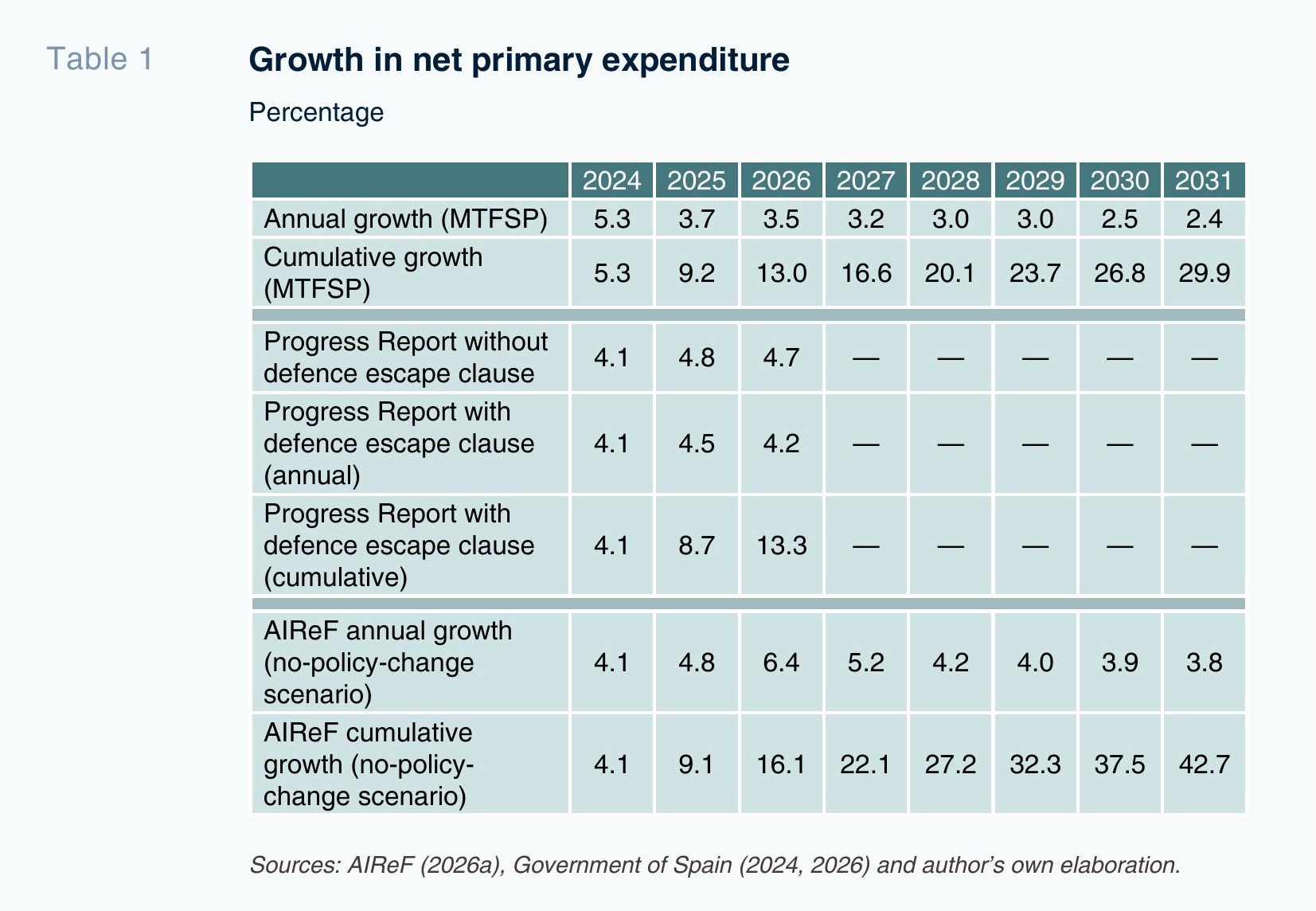
The first years under the new fiscal rules have had a clearly positive effect in terms of the public deficit. Spain brought its deficit to 2.4% in 2025, down from 3.3% in 2023 and 3.2% in 2024. Its public debt ended 2025 at 100.7% of GDP, down from 105.2% in 2023 (Eurostat, 2026). However, as shown in Table 1, the growth trajectory in net primary expenditure, the control variable in the new fiscal framework, is exhibiting signs of deterioration. A strong performance in 2024, when Spain kept growth in public spending 1.2 points below the MTFSP pathway (4.1%
versus 5.3%), was almost entirely wiped out in 2025, when spending increased by 1.1 points more than that benchmark (4.8%
versus 3.7%). The government′s forecasts for 2026 confirm the deterioration, with spending expected to outstrip the MTFSP benchmark by 1.2 points (4.7%
versus 3.5%). The AIReF’s outlook is considerably worse: Spain’s independent fiscal institution is forecasting growth in primary expenditure of 6.4%, which is nearly three points above the fiscal plan pathway. In cumulative terms, the AIReF’s no-policy-change scenario has growth in primary spending at 16.1% in 2026 compared to 13.0% in the MTFSP. Looking further ahead, the gap is expected to widen over the 2024-2031 horizon: AIReF is forecasting cumulative growth in expenditure of 42.7%, which is significantly above the 29.9% forecast set down in the fiscal plan.
The trend in the control account, shown in Table 2, highlights the deviations accumulated in expenditure relative to the pathway contemplated in the MTFSP. Those deviations are mitigated by two mechanisms. The first is the escape clause for defence spending, in place since 2025, whereby the calculation excludes the growth in military spending relative to the volume registered in 2024. Application of that clause in 2026 has the effect of reducing the growth in primary expenditure from 4.7% to 4.2%. The second clause relates to the temporary measures introduced in February 2026 in response to the energy crisis unleashed by the war in Iran. Use of this second mechanism has yet to be endorsed by the European Commission. It should be noted that both clauses are simple accounting manoeuvres and do not correct excessive growth in spending. Indeed, they do not eliminate the need to make structural adjustments in order to correct potential imbalances.
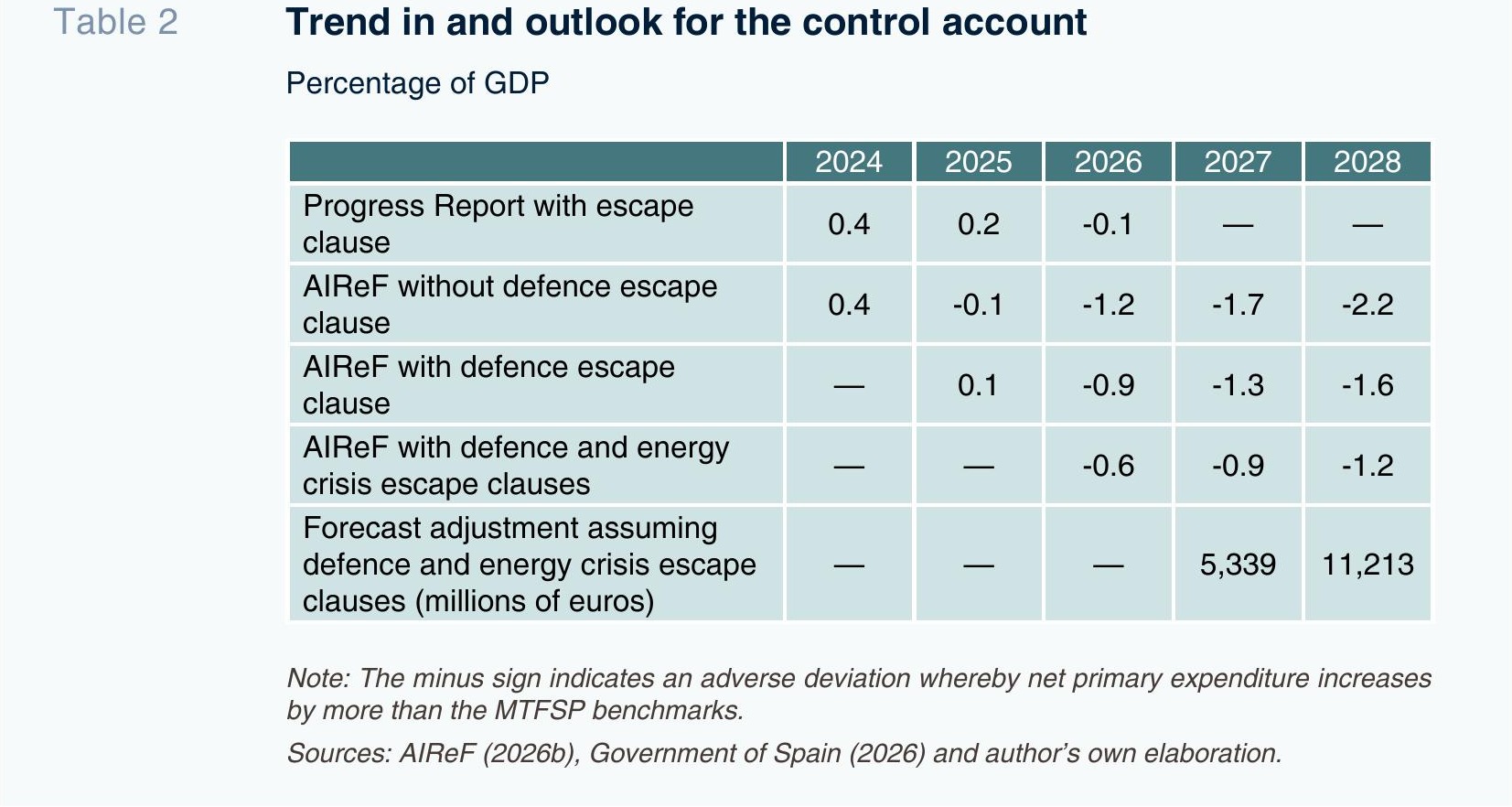
In the best case scenario, combined application of the two clauses could put the cumulative control account deviation at 0.6% of GDP in 2026. That is the maximum deviation allowed under the European fiscal rules. However, growth in expenditure is projected to increase the cumulative deviation to 0.9% in 2027 and to a further 1.2% in 2028. In 2027 and 2028, Spain would breach the maximum permitted threshold by 0.3 and 0.6 percentage points of GDP, respectively. The adjustments needed to return the control account to within the permitted limit amount to 5.34 billion euros in 2027 and 11.21 billion euros in 2028. Nevertheless, implementation of fiscal consolidation measures, particularly on the public spending side, can be expected to come up against considerable difficulties in the current context of parliamentary fragmentation and political uncertainty in Spain.
Draft budget for 2027: Ongoing growth in expenditure
The general state budget for 2023 has been rolled over for three years in a row. The government has failed to uphold its constitutional obligation to present a budget since
2023. For public activity to continue, it has had to resort to a number of budgetary modifications contemplated in Spanish legislation. What is exceptional about the current situation is that the repeated carryover of the 2023 budget has led to abusive use of those modifications: 52.34 billion euros in 2024, 76.94 billion euros in 2025 and 33.49 billion euros up to May 2026 (IGAE, 2024, 2025, 2026a).
[1] Those figures represent a significant portion of total state expenditure, specifically, 16.8% in 2025, which is three times the figure for 2023 (5.2%), the last year Spain had a proper budget (IGAE, 2024). A considerable part of those modifications stems from spending commitments, some of which are very significant, such as the cost of servicing the country’s debt and paying its pensioners. In fact, in 2025, those two items of expenditure accounted for 53% of the total volume of modifications approved (IGAE, 2026).
The modifications make it hard to track the changes made, in terms of both items of expenditure where the changes materialise and their amount. Moreover, depending on the circumstances, the modifications only have to be approved by the Ministry of Finance or the Cabinet, without the need for prior parliamentary oversight. This combination of reduced transparency and approval leniency may have contributed to the growth in net primary expenditure observed since 2024. In any case, this dynamic has been enabled by the sharp growth in revenue from the main taxes –personal income tax, VAT, corporate tax and excise duties– which, taken together since 2021, have grown by an average of 11.4% per annum (AEAT, 2026).
Despite still lacking sufficient support, the government has taken steps to present a new budget in 2027. At the time of writing, the risk that the draft 2027 budget will not be approved is very high. The Catalan political agenda, the government’s internal problems and posturing by its coalition partners ahead of the end of the current political cycle make a fourth budget extension in 2027 a plausible prospect. Given those circumstances, the key aspect of the draft budget for our purposes is the thrust of the spending policies that the government is expected to implement in 2027, whether or not the new budget is passed. Note that Spain’s prime minister has stated his intention to serve out his full term, which runs to July 2027.
The forecasts for the country′s public finances are underpinned by real GDP growth estimates of 2.2% in 2027, 2.1% in 2028 and 2% in 2029. Those figures have been endorsed by AIReF. The draft budget is clearly expansionary, setting a record ceiling for spending of 226.03 billion euros for 2027. If approved, it would mark an annual increase of around 14 billion euros, which is equivalent to 0.8 points of 2026 GDP. For now, we lack detailed information about where the increases will go and how they will be funded. The government has merely announced more spending in certain policy areas such as housing, grants and R&D. We would, however, highlight two key aspects. Firstly, the spending ceiling is forecast to increase by 6.6% in nominal terms, which is higher than the forecast growth of 5.5% in nominal GDP. Secondly, as per the MTFSP, the deficit target for 2027 is 1.8% of GDP. As outlined in the previous section, Spain would need an adjustment of 0.3 points of GDP (5.3 billion euros) to keep its control account within the limits allowed under the European fiscal rules. The adjustments in 2027 will, accordingly, necessarily have to come on the public revenue side.
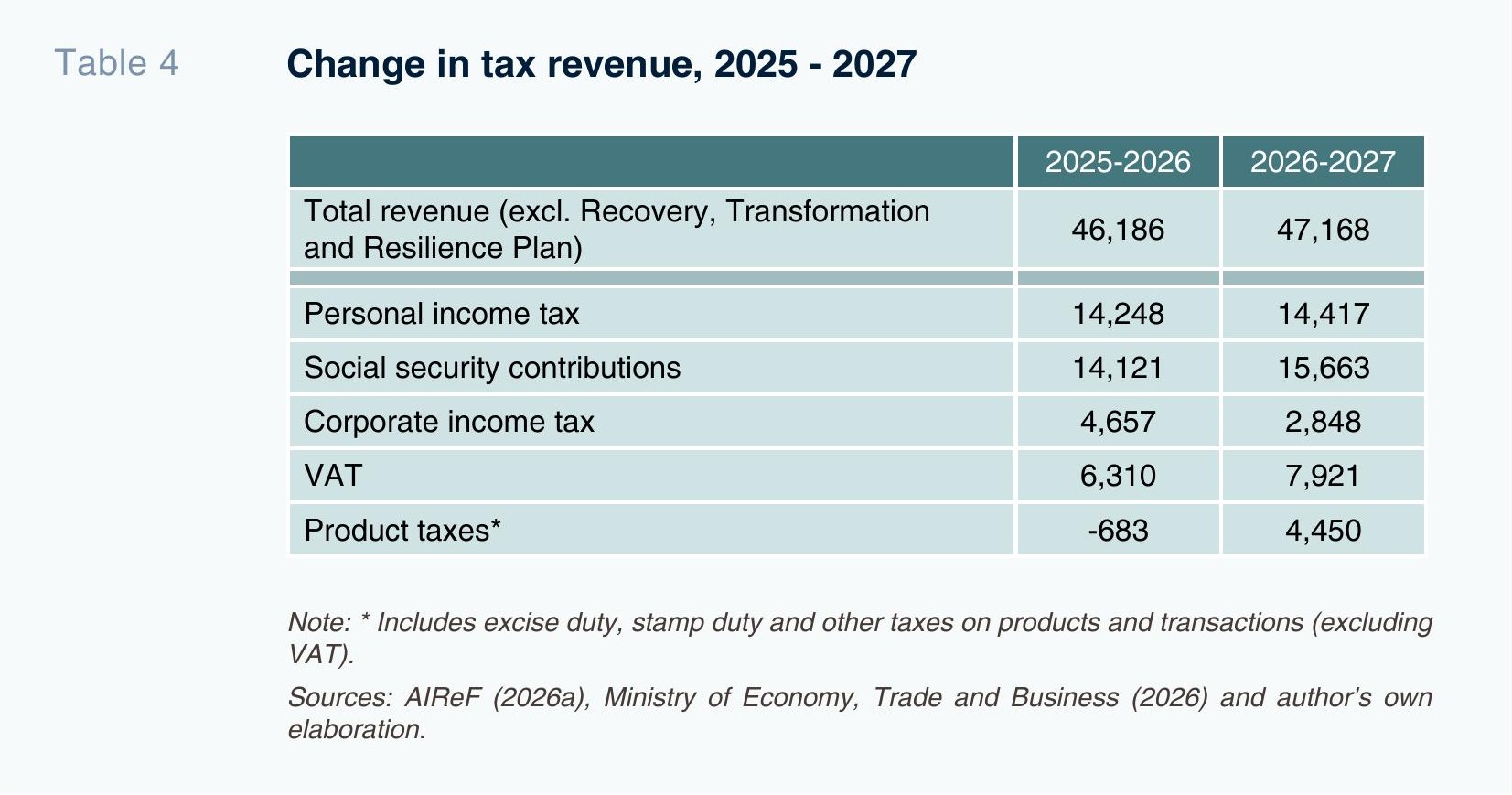
Public revenue in 2026 and 2027: What can we expect?As shown in Table 3, total revenue is expected to increase from 42.5% of GDP in 2026 to 43.0% in 2027. The rate of growth in total funding those years is forecast at 6.5% and 6.2%, respectively. Both rates are above the forecasts for nominal GDP growth, of 5.5% and 5.0%, respectively (Government of Spain, 2026). The government will benefit from forecast increases in revenue, which are estimated at 46.2 billion euros and 47.2 billion euros in 2026 and 2027, respectively. Table 4 reveals that the bulk of that increase stems from labour taxation. Specifically, receipts from personal income tax are expected to increase by 14.3 billion euros in 2026 and 14.4 billion euros in 2027, with revenue from social security contributions projected to increase by 14.1 billion euros and 15.6 billion euros, respectively. Personal income tax and social security contributions are expected to contribute, combined, 61.3% of the increase in public revenue in 2026 and an even higher 63.7% in 2027.
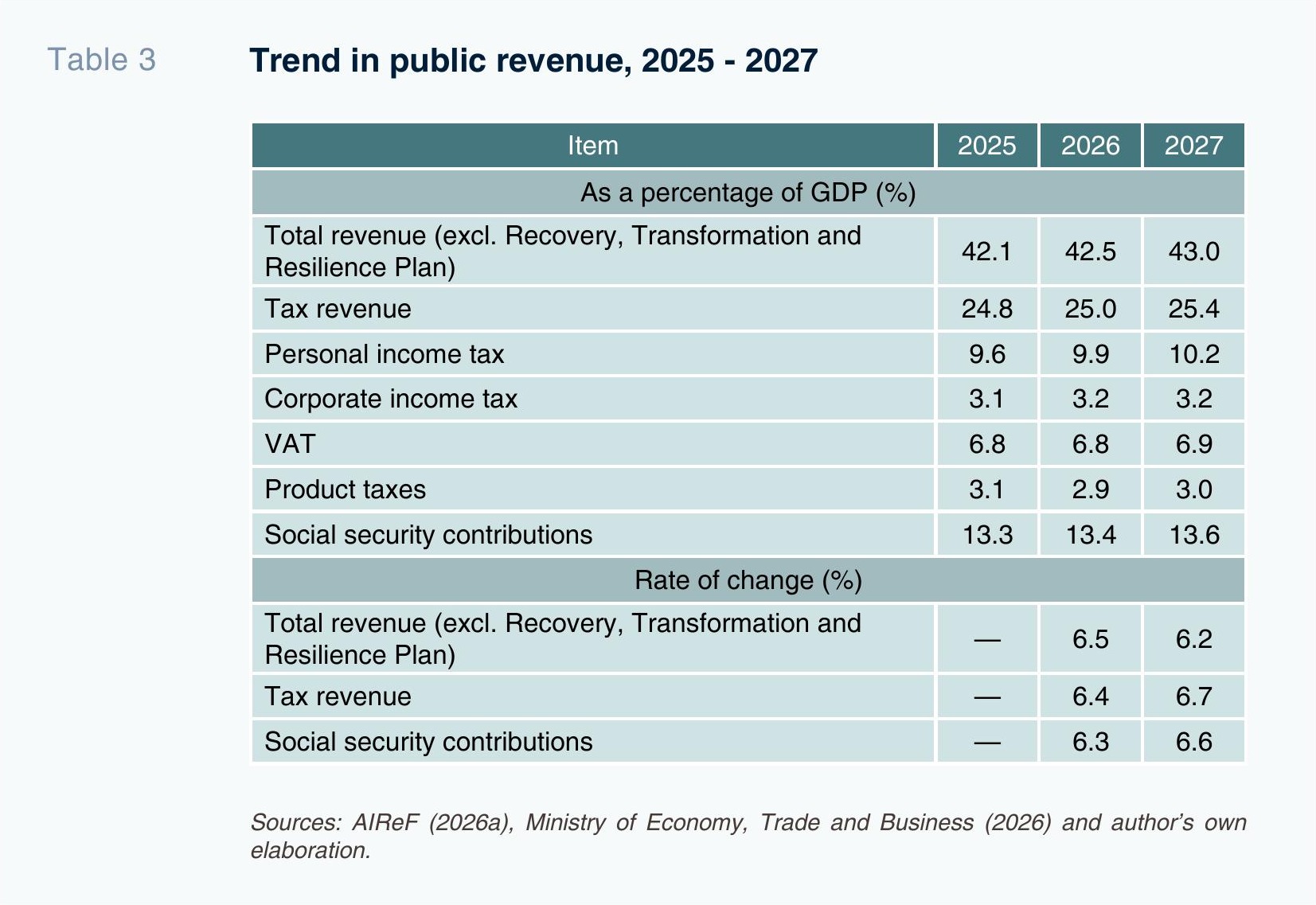
This revenue growth pattern is not aligned with the recommendations the European Commission has been making repeatedly for several years now. The Commission has been urging Spain to shift some of the tax burden away from labour to environmental taxes and taxes on consumption and property ownership in order to foster growth and employment. In contrast, as is shown in Table 3, reliance on labour taxes is expected to continue to increase in Spain over the coming years due to: (i) increases in social security rates designed to fund pension expenditure (via the so-called intergenerational equity mechanism and the solidarity payment); and (ii) the failure to index the personal income tax brackets.
In light of the growth in spending, the government agreed a fiscal plan with the European Commission last May designed to increase tax revenue by 8.51 billion euros in 2026, so as to comply with the European tax rules (Ministry of Economy, Trade and Business, 2026b). The most important measure in that plan is the government’s express decision not to deflate personal income tax, a move expected to unlock 2.29 billion euros of revenue. The government has opted not to address the fiscal drag issue ever since 2020, despite its adverse impact on real household income (Romero-Jordán, 2025). The remainder, 6.21 billion euros, stems from measures that have already been approved and, therefore, with a limited impact on the public debate. Such is the case of the rollover of the tax on high net worth individuals, the extension of the deduction limits imposed on corporate groups and earlier corporate and savings tax and tobacco excise duty reforms. The temporary measures contained in this plan, such as the decision not to index personal income tax, are discounted from net primary expenditure, such that they lower the growth in eligible spending (AIReF, 2026b). Even factoring in that discount, growth in expenditure in Spain is expected to remain above the pathway set down in the MTFSP.
Notes
For illustrative purposes, that figure is 3.7 times the 2023 equivalent.
References
AEAT. (2026). Monthly tax collection reports.
https://sede.agenciatributaria.gob.es/Sede/datosabiertos/catalogo/hacienda/
Informe_mensual_de_Recaudacion_Tributaria.shtmlAIREF. (2026a). Report on the Medium-Term Fiscal-Structural Plan 2025-2028 (Report 24/26).
AIREF. (2026b). Report on Budgetary Execution, Public Debt and the Expenditure Rule 2026 (Report 43/26).
EUROSTAT. (2026). Public deficit statistics for the EU member states.
https://ec.europa.eu/eurostat/databrowser/view/gov_10dd_edpt1/default/table?lang=en&category=gov.gov_gfs10.gov_10ddGOVERNMENT OF SPAIN. (2024). Medium-Term Fiscal-Structural Plan 2025-2028. Government of Spain.
GOVERNMENT OF SPAIN. (2026). Annual Progress Report. Government of Spain.
IGAE. (2024). Extract from the monthly budget execution statistics. December 2023. Ministry of Finance.
IGAE. (2025). Extract from the monthly budget execution statistics. December 2024. Ministry of Finance.
IGAE. (2026a). Extract from the monthly budget execution statistics. December 2025. Ministry of Finance.
IGAE. (2026b). Extract from the monthly budget execution statistics. May 2026. Ministry of Finance.
MINISTRY OF ECONOMY, TRADE AND BUSINESS. (2026a). Informe de situación de la economía española 2026 [Report on the state of the Spanish economy, 2026]. Government of Spain.
MINISTRY OF ECONOMY, TRADE AND BUSINESS. (2026b). Annual Progress Report 2026.
ROMERO-JORDÁN, D. (2025). Spain’s rising tax burden: Personal income tax under scrutiny.
SEFO Vol. 14, No. 3, May 2025.
www.funcas.es/wp-content/uploads/2025/06/Romero-14-3.pdf
Desiderio Romero-Jordán. Rey Juan Carlos University and Funcas