
Defence spending and debt sustainability: The euro area′s fiscal rules post 2024
The EU′s new fiscal rules, in force since 2024, are already being tested by the need to finance higher defence spending and by a sharp rise in interest rates. The National Escape Clause carries a modest fiscal cost, but the framework′s debt sustainability analysis still rests on interest-rate assumptions that market developments have already overtaken.
Abstract: Euro area countries entered the COVID-19 crisis with markedly more fiscal restraint than the United States or United Kingdom. Since 2022, the bloc′s average deficit has stabilized near 3% of GDP even as deficits diverge sharply while the gulf in debt levels between Germany and the region′s more indebted members remains. Against this backdrop, the 2025 decision to accommodate rearmament through the National Escape Clause allows countries to raise spending by up to 1.5% of GDP a year for four years without breaching their agreed adjustment paths. A synthesis of the official debt sustainability framework demonstrates that full use of this flexibility would raise debt ratios only marginally and require a correspondingly small additional improvement in primary balances once the adjustment period ends in 2031. The greater vulnerability lies in the interest-rate projections set in 2024 that remain the baseline for the Commission’s debt sustainability analysis; but that have already been overtaken by market developments, with French borrowing costs now close to two percentage points higher. Because the rules keep this baseline fixed unless a government formally requests a recalculation, the gap between assumed and actual financing costs is likely to persist rather than correct itself. The fiscal cost of accommodating defence spending appears manageable, but the framework′s credibility will depend on how it is enforced once interest-rate assumptions catch up with reality.
IntroductionThe euro was born with fiscal rules attached because its creators realised that fiscal problems in one country could have system wide implications (Gros and Thygesen 1998). The focus of the rules was initially mostly on deficits, hence the canonical “reference value” of 3% of GDP. The sovereign debt crisis of 2010-2012 then showed that markets tended to focus on debt levels. This prompted a change of emphasis, with the adoption of a new rule regarding the minimum reduction in debt countries should aim at in order to reach 60% of GDP, the other reference value of the Maastricht Treaty that had until then been mostly ignored. The debt reduction rule was simple, but also mechanic. The debt ratio should be reduced each year by 1/20
th of the excess of the ratio over 60% of GDP.
However, this debt reduction rule was perceived as too strict and too mechanical. The Commission thus proposed a new approach that was considered state of the art in economics. Each country would be subject to debt sustainability analysis based on the specific national circumstances. The aim of this DSA would be to identify the surplus or deficit the country could run in order to first stabilize and then gradually reduce the debt ratio –even under stress conditions.
The new rules entered into force in 2024. But at that time most member countries had deficits considerably above the levels that would stabilize debt ratios. This had been foreseen. A core element of the new rules was that countries were given an initial adjustment period of 4-7 years during which they were supposed to bring down their deficits to the level that would permit debt stabilization.
Most member countries thus agreed with the Commission on a 7-year plan to reduce deficits so that they would reach by 2031 the level needed to put their debt levels on a downward path.
But in 2025 Europe realized that it needed to reinforce its own defense spending. The NATO target for defense spending was increased from 2% to 3.5% of GDP. This created a conundrum for the EU institutions. It would have been politically very awkward to insist that countries adhere to the deficit reduction path already agreed.
[1] That would have required cutting expenditure elsewhere at a time when most political leaders promised that there would be no cut in social spending because of defense needs.
But just adding defense expenditure without any cuts elsewhere would have been incompatible with the central aim of the new rules, namely, to bring debt under control. The compromise was to allow countries to exceed their agreed deficit and spending path by 1.5% of GDP for 4 years, but to insist that their deficits should still be reduced to the level needed to put their debt ratio on a downward path. This is the essence of the National Escape Clause whose consequences will be analyzed below.
But before delving into the European details, it is useful to consider the broader, global background.
Recent developments in fiscal policy: A transatlantic comparison
The urgency to increase defense spending comes on the heels of another major fiscal emergency, the COVID-19 pandemic. Countries everywhere ran massive deficits to stabilize economy during this period.
The COVID era
While the fiscal pressure from COVID was roughly similar everywhere, the data in Table 1 below show that on average euro area countries have been much more prudent than their Anglo-Saxon peers. The cumulated deficits of the euro area since 2020 were below 30 percentage points of GDP only one half of the US value of close to 60% (first column). The UK also cumulated deficits of over 45 percentage points, one half higher than the euro area average.
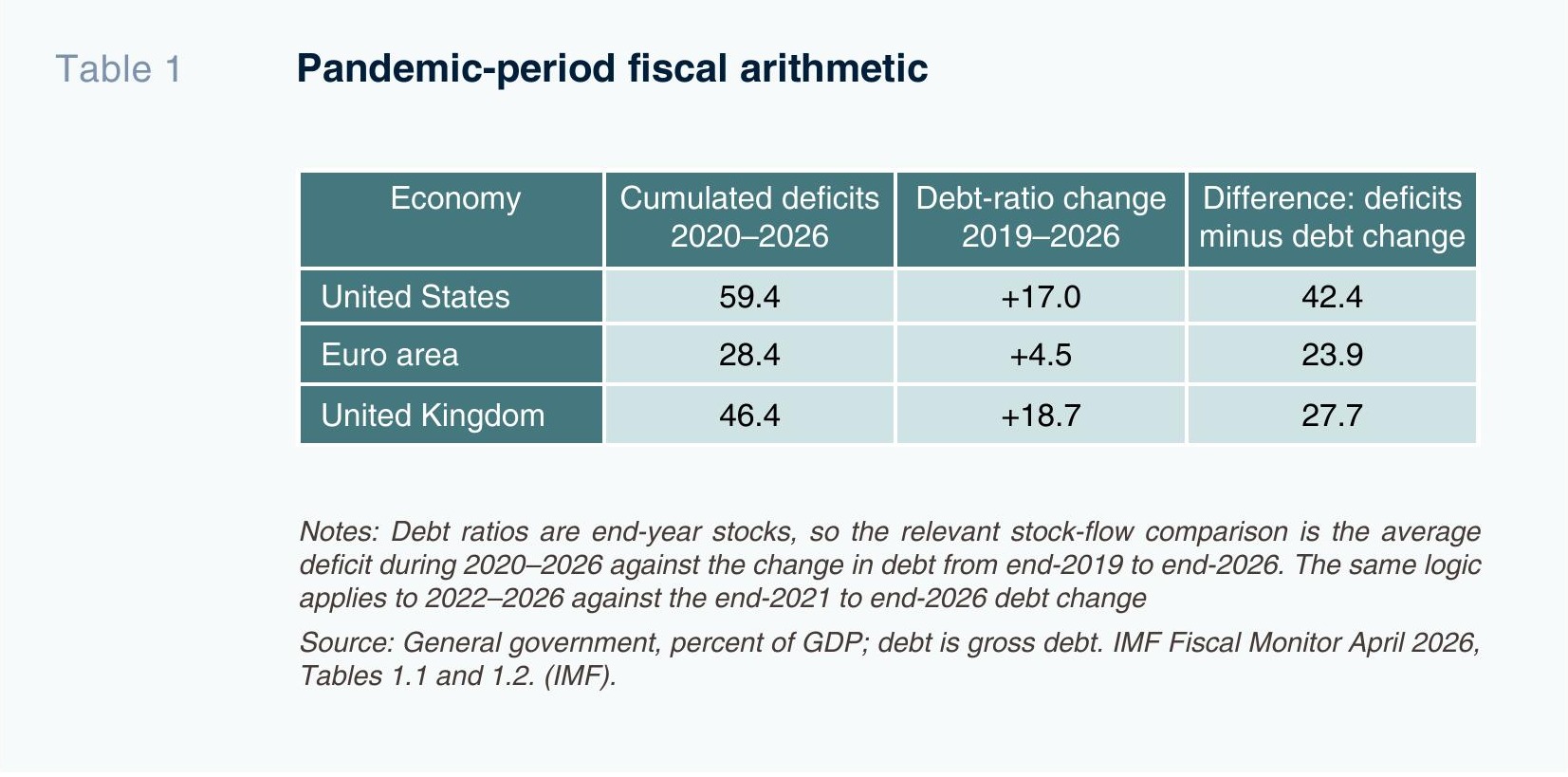
The euro area’s fiscal rules were suspended during the COVID era, but it seems that they did have a moderating impact. This can also be seen in the small increase in the debt level, which was only 4.5 percentage points of GDP over this period, one fourth of the US or UK level (second column).
The third column in Table 1 shows large gaps between cumulated deficits and debt-ratio. The difference reflects nominal GDP growth, which had been quite different during the Covid period across these three economies. Growth (both real and nominal) has been strongest in the US and the discrepancy between deficits and the increase in the debt ratio is correspondingly large for the US whose cumulated deficits since the Covid crisis amounted to almost 60% of GDP while the debt ratio increased by only 17 points, 42 percentage points less. For the euro area and the UK, one observes somewhat smaller differences between cumulated deficits and the increase in the debt ratio.
The UK has run smaller deficits than the US over this period. But its debt ratio increased more. This illustrates the tight constraint a low growth economy puts on fiscal policy.
Post-COVID consolidation?
The striking result from the COVID era was that very large cumulative deficits translated into much smaller increases in debt ratios, mainly because nominal GDP also rose strongly. This changed from 2022 onwards, in the sense that debt levels have been fairly constant over the last 4 years as shown in column two of Table 2, and deficits have somewhat come down.
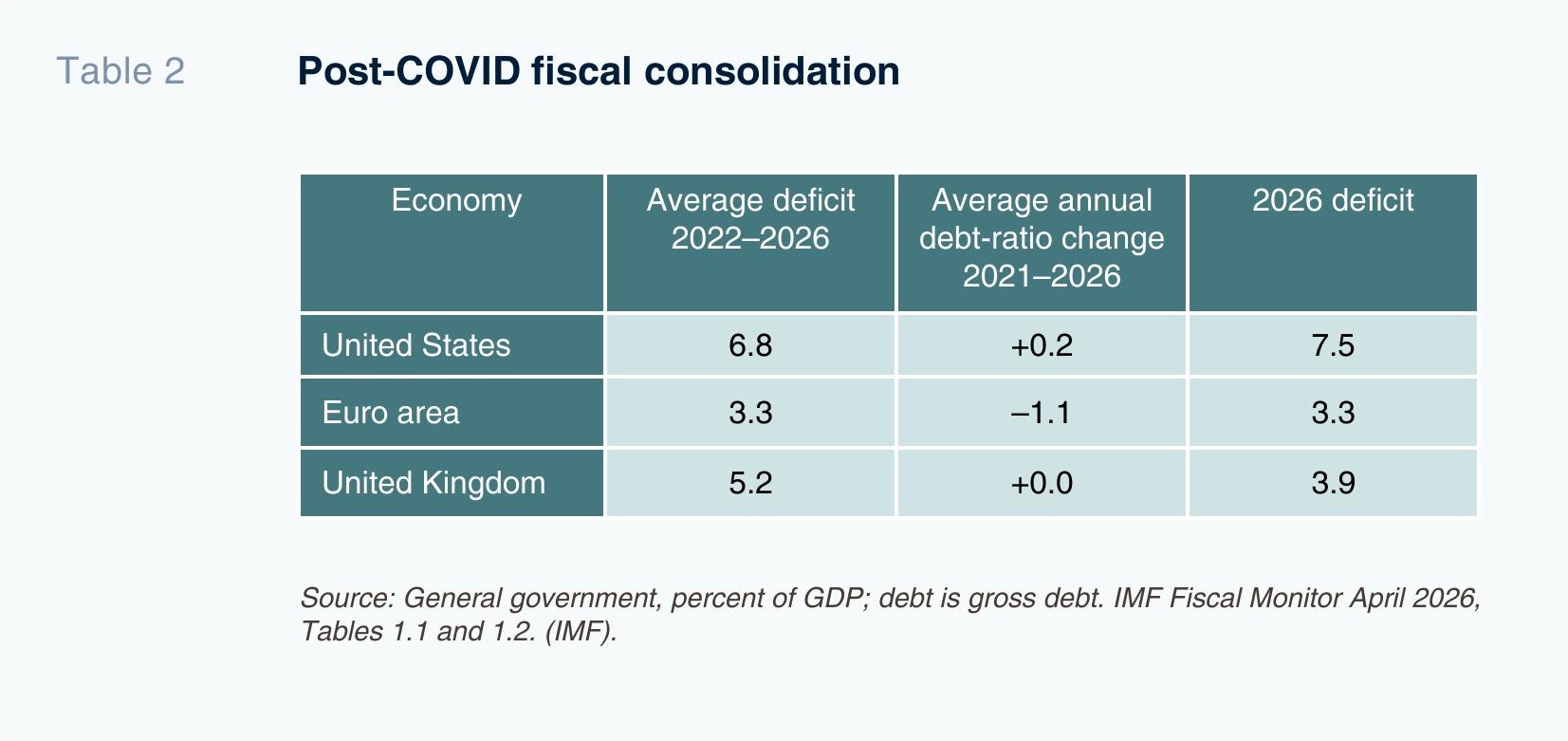
Since 2022, there has been some consolidation in the euro area deficit, stabilizing around 3% of GDP, while the UK’s deficit has somewhat fallen to close to the euro area value.
By contrast, the US the deficit has even increased to now 7.5% of GDP, 4 percentage points more than the euro area. However, the US-EA difference in deficits exaggerates the difference in the sustainability of their fiscal position.
A key implication of Table 2 is that a euro-area deficit near 3% of GDP roughly stabilizes its debt ratio of close to 90% of GDP when nominal GDP grows around 3% (1% real plus 2% inflation). In the US, nominal growth of 5% can stabilize debt near 120% of GDP with a deficit around 6%. This is why one sees little increase in the US debt ratio since 2021 despite deficits above 6% of GDP. However, the present deficit of 7.5% of GDP would lead to further increases in the US debt ratio until it reaches 150% of GDP.
These numbers illustrate a key issue for any debt sustainability analysis: given the growth rate of nominal GDP, it is easier to stabilize a high debt level. But experience has shown that a high debt level, even if stabilized, increases the vulnerability to financial stress. This is why the euro area fiscal rules aim not only at stabilizing debt but putting it on a downwards path even under stressed scenarios.
Interest payments and primary deficits
The deficit figures discussed so far hide one underlying problem, namely the increase in interest payments on public debt resulting from higher rates. Policy discussions usually concentrate on headline deficits. But the government cannot control interest expenditure. To gauge political pressure on the budget one should look at the so-called primary balance,
i.e. the balance between revenues and non-interest expenditure. This is the key variable under the fiscal rules as discussed below.
While interest rates have considerably increased since 2024, the interest burden for most euro area governments has increased only moderately because most public debt is long-term which means that each year only a fraction of public debt must be refinanced at higher market rates. This delayed pass-through is one of the key reasons why European governments will face budget pressure just to keep overall deficit constant, even without considering the need to increase defense expenditure.
Recent differentiation inside the euro area
The euro area average hides large differences across member states. In 2024 Germany had by far the smallest deficit (2.7% GDP) compared to over 3% for Italy and Spain and close to 6% for France. In 2026 Germany’s deficit has increased to almost 4% of GDP, whereas Italy and Spain dropped below the 3% benchmark. Even France has slightly reduced its deficit to just around 5% of GDP. There has thus been some convergence with Germany deteriorating while the remainder of the large countries slightly improved.
While there has been some convergence in deficits, there remains a very large difference in debt levels between Germany (close to 60%) and Italy, France and Spain, all with debt levels above 100% of GDP. Spain is the only highly indebted country for which the debt ratio is declining because of its higher growth.
Dealing with rearmament expenditure: The National Escape Clause
In early 2025 the Commission invited member states to activate the National Escape Clause (NEC) (European Commission, 2025). The NEC allows a country to exclude increases in defense spending of up to 1.5% of GDP for four years from the fiscal rules, thus allowing rearmament spending without immediately imposing large cuts elsewhere (AIREF, 2026). A country that uses this room fully ends the adjustment period with a debt level up to 1.5% of GDP higher than under its baseline plan. This implies that it will then have to run a lower deficit than under the original plan.
[2]Among the largest euro area countries, only Germany has asked for the full flexibility allowed under the NEC. France has declined to use it. Italy and Spain have asked to use the NEC only for very small amounts (and Italy has even been allowed to use the NEC for some energy subsidies).
The key role of interest rate forecasts in the DSA
While the high debt countries have so far been reluctant to use the NEC it is still worthwhile asking how much expenditure restraint would be required by a higher debt level of 6 percentage points of GDP. Since the only variable a government can control is its primary balance, the core question of the DSA is: “what primary balance is required for debt sustainability?” Assumptions about future interest rates play a key role here because they determine how much the government must spend on debt service.
There are thus two key variables in the DSA, the overall deficit and the primary balance. Interest costs play a key role in determining both.
Moreover, the DSA also tries to model carefully how the economy evolves in the short run in order to determine the starting point for the 10-year period following the end of the adjustment (
i.e. 2031-2040). Modeling the shorter-term evolution requires taking into account dozens of relationships, like the demand effect of higher expenditure on GDP, the impact of ageing on public finances, how the evolution of interest rates determines government debt service,
etc. This in turn is based on dozens of parameters and complex feedback loops. Bruegel’s publicly available implementation (Darvas
et al., 2024) takes up more than three thousand lines of code and requires information that is not always publicly available. It seems thus impossible to determine the fiscal effort required by the increase in the debt ratio of 6 percentage points that would result from using the NEC.
Standard debt sustainability analysis is usually based on the idea that debt is sustainable if it stabilizes as a ratio of GDP. For a standard DSA, it does not make any difference whether the debt is stabilized at 60 or 120% of GDP as shown in the example above. But the DSA of the new fiscal rules has a more ambitious target. Debt is deemed sustainable if the debt-to-GDP ratio is on a “plausibly downwards” path which is defined as the condition that the debt ratio must decline even under a set of different pre-defined shock scenarios during a ten-year period, following the initial adjustment period,
i.e. over 2031 to 2041. The DSA thus requires assumptions or projections for interest and growth rates far into the future.
Debt stabilization requires that the primary surplus be at least equal to the debt ratio multiplied by the difference between the interest rate and the growth rate (the famous “r-g”. As Blanchard (2019) emphasizes, very high debt levels become sustainable with low interest rates and “public debt may have no fiscal cost” when growth rates are higher than the interest rate.
The DSA of the Commission does not incorporate this scenario of growth rates higher than interest rates. Instead, (long-term) interest rates are assumed to converge towards 4% in the very long run, while the growth rate is roughly 3% for most countries, especially those with high debt. This implies that under the DSA, the r-g factor should converge towards 1(%) in the very long run. This might have appeared to be overly conservative when it was chosen in 2022 because until then the growth rate had been higher than the interest rate, leading to the conclusion of Blanchard 2019. However, the recent worldwide increase in interest rates has vindicated this caution. It remains an open question whether the interest rate –growth rate could further deteriorate.
A key point about the DSA is that different countries have different values of r-g depending on the exact path of their growth rates and the interest cost of their debt.
A first source of differences in r-g across countries is differences in national growth rates. The growth potential of most euro area countries is low, usually somewhat around 1%, limited by low productivity growth combined with a falling workforce. As a result, differences in potential growth rates among euro area member countries are small (fractions of a percentage point), (European Commission, 2026).
A more important source of differences in the r-g factor comes from differences in interest rates. The DSA is based on the rates expected in 2031,
i.e. at the end of the adjustment period. A key assumption of the DSA is that future interest rates can be calculated from the implicit forwards incorporated in very long-term interest rates. For example, the difference between 5-year and 15-year rates as of 2026 allows one to calculate the 10-year rate the market expects in 2031.
This use of forward rates to determine future expected interest rates is controversial because longer term rates incorporate a term premium. This effect seems particularly important for highly indebted countries that pay a risk premium. Galvão and Rush (2026) claim that using the difference between very long rates and medium-term ones could lead to an over-estimate of future rates by up to 2 percentage points.
The baseline for the DSA was established by the Commission in 2024. At the time interest rates were generally much lower than today. But the risk premia (“spreads”) of the other large euro area member countries also changed, improving for Spain and Italy, but deteriorating for France.
Table 3 below thus shows in column 2 the interest rates for the 2030s period as calculated by the Commission in 2024 and in column 3 how these rates would be if they were recalculated based on today’s (mid-2026) data. It is apparent that German rates have increased by about 100 basis points (1.0 percentage point). French rates have increased even more (almost 1.5 percentage points) because the spread on French bonds has increased, whereas the rates have increased much less for Spain and Italy because in these two cases the spread has fallen.
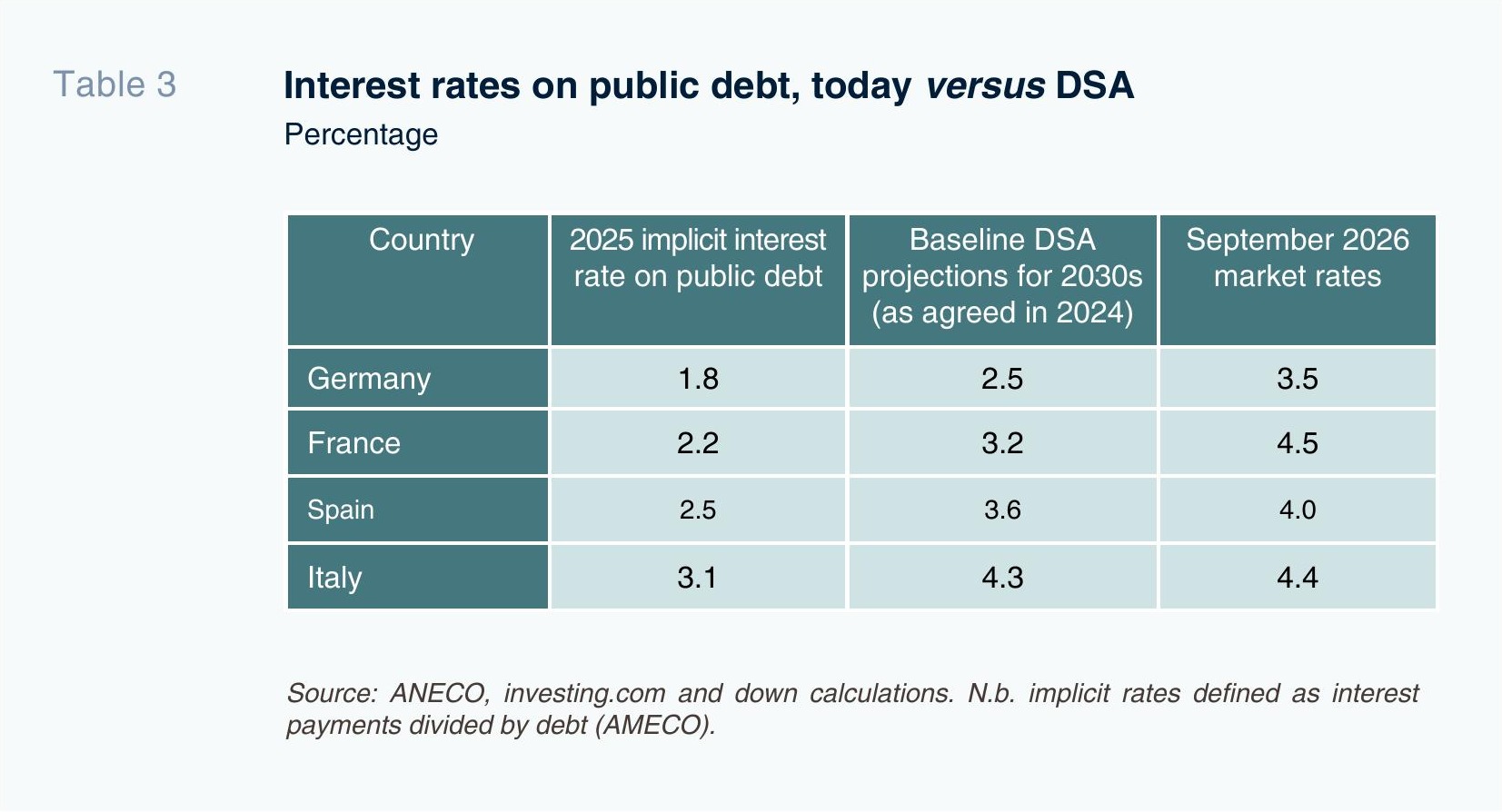
The first column in Table 3 also shows that the rates government paid in 2025 are still much lower than present market rates shown in column 3 because the average cost of debt adjusts slowly: most outstanding debt was issued earlier at lower rates, and only the maturing portion is refinanced each year at current market rates. This implies that the interest cost is bound to increase as governments have to refinance their debts. The increase will be particularly steep for France for which the current market rate is now over 2 percentage points higher than the average cost it was paying as recently as 2025.
The 2030s rates projected under the 2024 baseline of the Commission were higher than the cost of debt measured by the implicit rates then. This had led to the criticism mentioned above that using simple forward rates would over-predict future interest burden. However, the prudence of the Commission seems to have been vindicated ex post in that market rates are already now higher than predicted for 2031 as one can see by comparing columns 2 and 3.
Using the DSA methodology and 2026 market rates to extract the forward rates from 2031 onwards would result in significantly higher expected rate for all countries. However, the DSA regulation keeps the baseline input constant unless a government demands a recalculation. Given the circumstances no government is likely to make such a formal demand. Even for Italy it is unlikely that a new calculation would lead to lower rates even if the Commission were to change the way in which these future rates are computed by considering the upwards bias resulting from high-risk premia. This implies that the current baseline values will remain the official guide for the fiscal rules. This is likely to create additional adjustment needs when the transition periods end in 2031.
Keeping in mind the trend nominal growth rate for most euro area countries, this implies that the r-g as calculated by the Commission in 2024 is slightly negative for Germany, about zero for France, but close to 1% for Spain and Italy. If one were to use 2026 market data, the r-g factor would be much higher, especially for Germany. But, at least for the time being, the rules will be applied based on the favorable 2024 baseline.
Buffers for a ‘plausible downward’ path
The euro area fiscal rules require more than mere debt stabilization. The primary balance must be sufficient to put the debt ratio on a ‘plausibly downward’ path. This means in practice that debt will be on a declining path after the adjustment period, even under adverse scenarios, i.e., the primary balance has to incorporate buffers relative to the one required just to stabilize the debt ratio.
Gros and Hofer (2026a and 2026b) provide a detailed analysis for the different adverse scenarios and show that they can be approximately summarized in a simple formula: to bring debt on a ‘plausibly downwards path’ the debt-stabilising primary balance must be augmented by a buffer equal to roughly 1% of the debt ratio. While this simplification cannot replace the full calculations, it helps provide an order of magnitude for assessing the additional fiscal effort resulting from higher debt.
Under this hypothesis, the increase in the debt ratio of 6 percentage points allowed under the NEC would eventually require an improvement in the primary balance of only 0.06% of GDP for France (given that r-g is zero the total additional adjustment need is just 1 times the increase in the debt/GDP ratio) to remain within the fiscal rules. For Spain and Italy, for which r-g is close to 1 the required increase in the primary balance would only be at most 0.12% of GDP.
The total adjustment in the primary balance required from these countries is of course much larger, in the order of 2 percentage points of GDP. The calculation made here refers only to the additional adjustment need coming from using the NEC, which is an order of magnitude lower.
These low values should not be surprising. An increase in the debt ratio of 6 percentage points of GDP amounts only to about 1/20th of the existing debt of France or Italy. Almost all of the huge existing debt was accumulated in times of low military spending. Financing a few years of additional defense spending with debt adds very little to the existing mountain of public debt.
Conclusions
The new fiscal rules introduced in 2024 are facing already a double-barreled stress test. The need to strengthen defense risks derailing the expenditure plans agreed very recently. Moreover, interest rates have moved sharply higher.
This analysis suggests two conclusions.
First, the new fiscal framework is less demanding than the previous debt reduction rule, but it has a limit to flexibility. It gives governments time to adjust and now allows temporary deviations for defence spending (National Escape Clause), yet it ultimately requires primary balances strong enough to put debt on a plausibly declining path by 2031. This is a more demanding standard than the mere debt stabilization of a conventional debt sustainability analysis.
Second, the fiscal cost of the National Escape Clause seems limited. Even full use of the clause would add only about 6 percentage points of GDP to debt, a small increment relative to the existing debt stocks of France, Italy and Spain. The additional primary adjustment required after 2031 would therefore be modest compared with the adjustment already embedded in the fiscal-structural plans.
The larger risk lies elsewhere. Higher market interest rates will eventually lead to higher costs than foreseen in the Commission’s debt-sustainability calculations. For now, the official baseline remains anchored in the more favourable 2024 assumptions. This buys time, but it also creates a potential cliff after the adjustment period. The real test of the new rules will thus not be whether they can accommodate a few years of extra defence spending, but whether they will be enforced if the interest-rate environment shifts permanently.
Notes
As an aside, one should reflect on the fact that the need for higher defense spending in Europe had been already evident by 2024. It should thus have been factored in the first adjustment plans. But it took repeated threats from Donald Trump to leave NATO to force the Europeans to agree on this increase in defense spending.
The details on how countries might ramp up their defense expenditure and then gradually adjust their overall expenditure to become compliant with the debt reduction path is left out here. See the analysis by the European Parliament (2025 and 2026).
References
AIREF. (2026). Monitoring Report on the 2025-2028 Medium-Term Fiscal-Structural Plan.
https://www.airef.es/wp-content/uploads/2026/
05/Informe_Progreso_PFEMP/AIReF.-BOX-1.-National-Escape-Clausure-for-Defence-Spending.pdfBLANCHARD, OLIVIER, (2019) Public debt and low interest rates, Presidential address, American Economic Association, January 5, 2019.
https://www.aeaweb.org/webcasts/2019/
aea-presidential-address-public-debt-and-low-interest-ratesEUROPEAN COMMISSION. (2025). Debt Sustainability Monitor 2025.
https://economy-finance.ec.europa.eu/document/
download/39b3b61d-42c1-46d7-8088-0aad82e8731e_en?filename=ip332_en.pdfEUROPEAN COMMISSION. (2026). 2024 Ageing Report. Economic and Budgetary Projections for the EU Member States (2022-2070).
https://economy-finance.ec.europa.eu/publications/
2024-ageing-report-economic-and-budgetary-projections-eu-member-states-2022-2070_enEUROPEAN PARLIAMENT. (2025). Implementing defence financing and spending under the Economic Governance Framework.
https://www.europarl.europa.eu/
RegData/etudes/IDAN/2025/
764381/ECTI_IDA(2025)764381_EN.pdfEUROPEAN PARLIAMENT. (2026). The National Escape Clause in practice: Early evidence from the 2025 European Semester, EGOV Unit.
https://www.europarl.europa.eu/
RegData/etudes/BRIE/2025/779841/
ECTI_BRI(2025)779841_EN.pdfGALVÃO, A. B., and RUSH, A. (2026).
Scrubbing the Excess Forward Premium From Market Expectations.
https://www.dt.mef.gov.it/export/sites/
sitodt/modules/documenti_en/
analisi_progammazione/brown_bag/
Galvao_Rush_Policy_Paper_
une_2026.pdfGROS, D. (1995).
Excessive Deficits and Debts. Centre for European Policy Studies (CEPS).
https://www.ceps.eu/ceps-publications/excessive-deficits-and-debts/GROS, D., and HOFER, S. (2026a). Readiness 2030 and the New Fiscal Framework.
IEP University of Bocconi Working Paper.
https://iep.unibocconi.eu/readiness-2030-and-new-fiscal-frameworkGROS, D., and HOFER, S. (2026b).
Opening the black box of Europe’s new fiscal rules. Voxeu.org, 15 Jul. 2026.
https://cepr.org/voxeu/columns/opening-black-box-europes-new-fiscal-rulesGROS, D., and THYGESEN, N. (1998).
European Monetary Integration: From the EMS to EMU (2
nd ed.). Longman.
Daniel Gros. IEP/Bocconi