
The roots of Europe′s housing crisis: Why good intentions so often produce bad outcomes
Across Europe, real house prices have risen sharply since 1970 while housing completions per capita have fallen substantially in every major economy, reflecting a growing mismatch between demand and increasingly inelastic supply. The evidence points to restrictive planning systems and political incentives that constrain new housing supply, while showing that demand-side subsidies often raise prices rather than improve affordability.
Abstract: Europe′s housing affordability crisis reflects a fundamental mismatch between growing demand and increasingly inelastic supply, particularly in economically dynamic cities where planning constraints have become progressively more binding. Despite continued population growth, housing completions per capita have fallen substantially across the continent. As outward urban expansion has been curtailed, housing expansion has become increasingly dependent on redevelopment, a process that is slower, costlier, and more politically contentious than greenfield construction, and which often replaces affordable older stock without meaningfully expanding the total housing stock. Demand-side interventions such as mortgage subsidies and first-time buyer schemes tend to be capitalised into higher land values where supply is constrained, benefiting existing owners and developers rather than prospective buyers. The political economy of homeownership further reinforces these dynamics. Homeowners, whose wealth is tied to property values, have incentives to lobby for more restrictive land use regulation. The resulting reduction in housing supply responsiveness amplifies house price and rent growth, benefiting incumbent — particularly older — homeowners while imposing welfare losses on renters, younger households, and future generations. Lasting improvement in affordability requires evaluating policies by their long-run general equilibrium effects and reforming planning and tax systems to align political incentives with the objective of expanding housing supply.
Europe′s housing affordability puzzle
Housing affordability has become one of Europe′s defining economic and social challenges. Across much of the continent, households with ordinary incomes struggle to find affordable housing close to jobs and opportunities, while homelessness is rising in many countries. Young adults postpone leaving the parental home, are forced to live in shared accommodation, and find homeownership increasingly out of reach. What was once perceived as a problem affecting low-income households has become a broader concern for the middle class, with implications not only for inequality but also for labor mobility, productivity, and long-run economic growth.
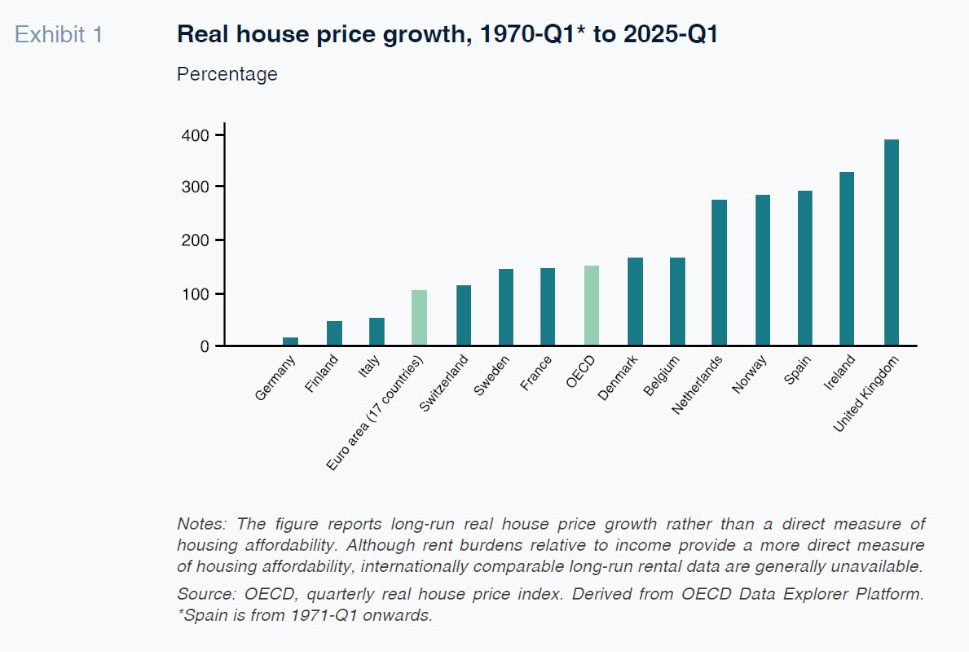
The European picture is far from uniform. As Exhibit 1 illustrates, since 1970 real house prices have risen dramatically in countries such as the United Kingdom, Ireland, and Spain, while remaining comparatively stable in Germany, Finland, Italy, and Switzerland.
Yet house prices tell only part of the story. An equally striking — but often overlooked — development is the dramatic decline in housing construction relative to population. Table 1 compares housing completions per 1,000 inhabitants in 1970 and the latest available year for Spain, the United Kingdom, Germany, and Switzerland. Despite continued population growth, all four countries have experienced substantial declines in housing construction per capita.
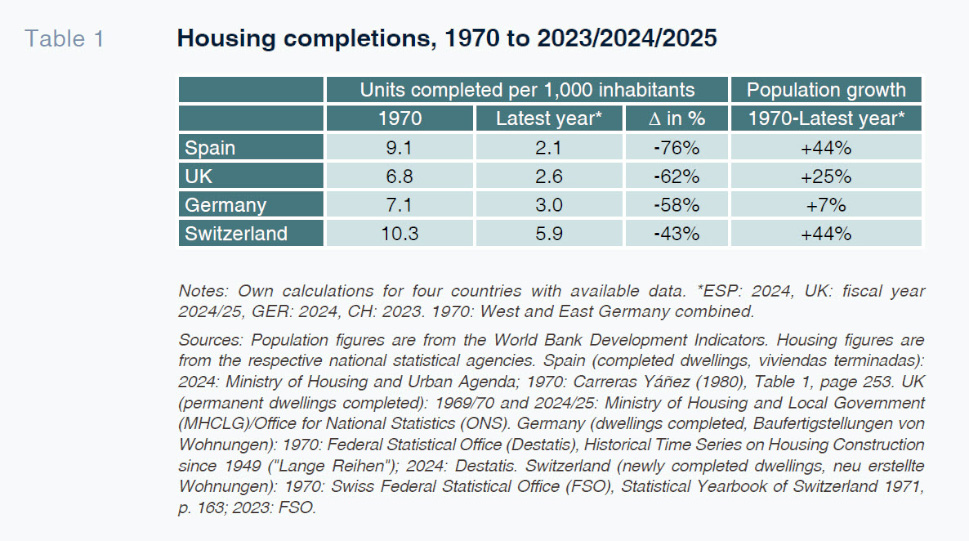
New housing is needed not only to accommodate population growth and newly formed households, but also to replace dwellings that become obsolete through aging, demolition, or conversion to other uses. Even in countries with little or no population growth, substantial ongoing construction is therefore required simply to maintain and renew the housing stock. For example, England′s long-standing target of around 300,000 new homes annually broadly reflects these replacement needs in addition to projected household formation. Yet, during the past two years, only around 140,000-150,000 new homes were completed each year.
Taken together, Exhibit 1 and Table 1 suggest that deteriorating affordability cannot be explained by rising demand alone. Europe has become more populous and more prosperous and demand for housing has continued to grow. Yet housing construction relative to population has declined markedly across many countries. The central puzzle is therefore why housing supply has become progressively less responsive to growing demand. This commentary argues that Europe′s affordability crisis arises because growing demand collides with increasingly inelastic housing supply in economically successful places, especially superstar cities and tourist destinations. Many popular housing policies address the consequences of housing scarcity rather than the institutional and political factors that make housing supply so unresponsive in the first place. Explaining why requires understanding not only the economics of housing supply but also the political incentives that shape housing policy.
The causes of the affordability crisis
Demand for housing has grown especially strongly in Europe′s most productive metropolitan areas. As households’ real incomes rise, they demand disproportionately more housing services, reflecting the relatively high income elasticity of housing demand (Cheshire and Sheppard, 2001). Population growth, immigration, tourism, international investment, and the prolonged period of exceptionally low interest rates following the Global Financial Crisis have further strengthened these demand pressures.
Whether these demand pressures translate into additional housing or higher prices depends on the responsiveness of housing supply. A large body of empirical evidence shows that long-run housing supply elasticities differ substantially across cities and countries because of physical (natural and development-induced) and regulatory constraints (Saiz, 2010, for the U.S.; Hilber and Vermeulen, 2016, for England).
Physical constraints include natural features such as topography (e.g., steep slopes), geography (e.g., water bodies), and geology (e.g., poor soil conditions), as well as development-induced constraints. In high-demand metropolitan areas, where much of the land has already been developed, expanding the housing stock requires redevelopment rather than greenfield construction. Redevelopment is more complex, financially riskier, slower, and more politically contentious, making housing supply less responsive to growing demand (Hilber and Vermeulen, 2016; Baum-Snow and Han, 2024).
In high-demand cities, regulatory constraints are typically the most binding. They have become progressively more binding for two distinct reasons. First, many European countries have deliberately tightened restrictions on outward urban expansion to limit sprawl, protect agricultural land, and preserve environmental amenities. As a result, future housing growth increasingly depends on inward densification and redevelopment, which are inherently more difficult than greenfield development. Second, even unchanged planning regulations become more restrictive as demand intensifies and cities expand upward and outward. Height limits, urban growth boundaries, and green belts that initially impose little constraint can become increasingly binding over time as demand grows. England′s Green Belt illustrates this dynamic: introduced in the 1950s to contain urban sprawl, it became progressively more restrictive as cities expanded, contributing to a less responsive housing supply.
An important implication is frequently overlooked in the public debate. Inward densification often generates only modest increases in the housing stock, if any. In many European cities, aging buildings are demolished and replaced by modern, higher-quality housing. If redevelopment occurs at broadly similar densities, housing quality improves but the number of dwellings changes little. Because new construction reflects current land values, stricter building standards, and rising construction costs, the new units are inevitably more expensive than those they replace. This helps explain a common paradox: residents observe cranes and intensive construction activity, yet housing affordability continues to deteriorate. What ultimately matters is whether the effective housing stock expands sufficiently to accommodate growing demand.
Switzerland provides a particularly instructive example. The 2013 revision of the Spatial Planning Act substantially tightened restrictions on outward expansion while promoting inward development. As housing growth increasingly relies on redevelopment rather than greenfield construction, adding new housing becomes more costly, slower, and more politically contentious. In cities such as Zurich, Geneva, and Basel, inexpensive older housing has been replaced by modern dwellings commanding substantially higher rents, even where the number of housing units increases. Because existing tenancies in Switzerland are subject to rent regulation, while newly let dwellings can generally be rented at prevailing market rates, redevelopment often substantially increases observed rents. Thus, whereas political attention during the 2000s and 2010s focused primarily on limiting urban sprawl, today housing affordability dominates the public debate. The widespread use of the term Dichtestress ("density stress") and the recent, narrowly defeated 10-million initiative illustrate how rapidly political priorities have shifted.
The political economy of housing policy failure
If the fundamental causes of the housing affordability crisis are broadly understood, why do governments continue to adopt policies that often fail to improve affordability? The answer lies partly in the nature of housing markets and partly in political incentives.
Housing markets are characterized by powerful general equilibrium effects. Policies rarely affect only their intended beneficiaries. They also trigger broader market adjustments, and these market-wide responses often dominate a policy′s direct effects.
Mortgage subsidies, tax advantages for owner-occupation, and first-time buyer assistance schemes, for example, are politically popular because they appear to make housing more affordable. Yet where housing supply is constrained, demand-side subsidies are largely capitalized into higher land values and house prices, offsetting their intended effects. Evidence from the UK′s Help to Buy equity loan program for new builds illustrates this mechanism. Carozzi et al. (2024) show that in the highly supply-constrained London market, the program increased house prices and developers′ profits while generating no additional construction. In fact, house prices increased by twice the present value of the subsidy, presumably because the subsidy was fully capitalized and the relaxation of credit constraints further increased demand for housing. Similar results emerge for the U.S. mortgage interest deduction. Hilber and Turner (2014) show that in metropolitan areas with tight land use regulation the subsidy failed to increase — and in fact reduced — homeownership because higher house prices made it harder for prospective buyers to satisfy down-payment and mortgage qualification requirements. A policy intended to promote homeownership can therefore end up making homeownership less attainable for the very households it is designed to help.
General equilibrium effects help explain why many housing policies fail economically. Political incentives help explain why such policies nevertheless persist. Governments operate within relatively short electoral cycles, whereas housing is highly durable and housing markets adjust over decades. Policies that generate immediate, visible benefits for identifiable groups are naturally attractive politically. Their long-run costs, by contrast, are often diffuse, emerge only gradually, and are borne disproportionately by future generations and other groups with little or no political voice today. By contrast, reforms that tackle the underlying causes of the housing crisis — such as rationalizing land use regulation and reforming property taxation to strengthen incentives for local governments to permit new housing (Cheshire and Hilber, 2021) — typically impose visible short-run costs on well-organized interest groups while delivering benefits only gradually and less visibly. This political asymmetry helps explain why many housing policies persist even when they ultimately make housing less affordable.
Rent control illustrates this logic particularly well. Stricter rent controls can protect incumbent tenants against rising rents and displacement. These benefits are immediate and highly visible. However, a substantial body of empirical evidence suggests that stricter rent regulation has several well-documented adverse long-run effects. Diamond et al. (2019), for example, find that the expansion of rent control in San Francisco benefited protected tenants but discouraged investment in the rental stock, reduced long-run rental supply, and ultimately contributed to higher market rents for those seeking ccommodation. Policies designed to improve affordability for today′s tenants may therefore worsen affordability for tomorrow′s tenants. Moreover, the stricter the rent control, the greater the insider-outsider divide, with incumbent tenants benefiting as insiders while young people, migrants, workers who need to relocate for employment, and others unable to access rent-controlled housing — including the homeless —bear the costs as outsiders.
Political incentives become even more powerful when homeowners themselves shape land use regulation. Homeownership has traditionally been promoted because it is associated with wealth accumulation, neighborhood stability, and civic engagement. Yet it may also create incentives that unintentionally reinforce housing scarcity.
The homevoter hypothesis, first articulated by Fischel (2001), argues that homeowners oppose new residential development to protect the value of their homes – often their largest financial asset. Such NIMBY ("Not In My Back Yard") behavior may reflect concerns about congestion, obstructed views, changes to neighborhood character, or, at least in homeowners′ perceptions, slower future house price appreciation.
Recent work by Greaney et al. (2026) provides causal evidence for this mechanism. Exploiting the exogenous increase in local homeownership generated by England′s Right to Buy reforms, the authors show that higher homeownership causes local planning authorities to become more restrictive, leading to significantly fewer new homes being built.
The authors further show that higher homeownership can generate a self-reinforcing political equilibrium. Rising house prices strengthen homeowners′ incentives to resist new development, leading to tighter land use regulation, lower housing supply elasticities, and ultimately even faster house price growth. While this dynamic benefits incumbent — particularly older — homeowners, it comes at the expense of renters, younger households, and, above all, future generations, who bear the largest welfare losses despite having no influence over today′s planning decisions.
The broader lesson extends well beyond these examples. Housing policies should be judged not by their short-run intentions but by their long-run general equilibrium effects. Policies that stimulate housing demand without enabling supply to respond rarely improve affordability in the long run. Equally, policies that make development more difficult — even when motivated by legitimate environmental, heritage, or social objectives — may unintentionally exacerbate housing shortages if they fail to facilitate sufficient new supply elsewhere. Existing homeowners are numerous, politically well organized, and highly engaged in local planning decisions, whereas prospective residents and future generations are essentially unrepresented. The resulting political economy creates a powerful bias toward restrictive land use regulation, even when such policies reduce housing affordability, limit economic opportunity for younger households, and impose growing welfare losses on future generations.
The politics of blame: Look beyond the usual scapegoats
Housing affordability crises invariably generate scapegoats. Developers, institutional investors, foreign buyers, landlords, second-home owners, and short-term rental platforms such as Airbnb are frequently blamed for rising housing costs. In some locations these factors undoubtedly contribute to local affordability pressures. Tourist destinations, for example, may lose long-term rental housing to short-term accommodation, driving up rents (Garcia-López et al., 2020), while foreign investment may affect prices in selected neighborhoods of superstar cities (Badarinza and Ramadorai, 2018).
However, focusing on these groups risks confusing amplifying factors with the underlying cause of the problem. Whether strong demand translates into additional housing or higher prices and rents depends fundamentally on the responsiveness of housing supply. If developers operate in competitive markets and can readily build additional homes, stronger demand — whether from domestic households, migrants, tourists, or investors — will largely translate into more construction. Where supply is constrained, the same demand shocks are instead capitalized into higher prices and rents.
Developers do not create housing shortages by building homes; on the contrary, they are among the few actors capable of alleviating them. Likewise, restricting Airbnb or foreign investment may provide some local relief but cannot resolve a structural housing shortage. As long as economically successful cities remain unable to expand their housing supply, pressures on prices and rents will persist.
The temptation to search for scapegoats is politically understandable. Blaming developers or foreign buyers is easier than reforming planning institutions or confronting local opposition to development. Yet focusing policy on targeting these groups risks diverting attention from the deeper structural constraints that drive housing scarcity.
The role of institutions: Lessons from England and Switzerland
England and Switzerland lie at opposite ends of the European spectrum, illustrating how planning systems and fiscal incentives shape housing supply.
England provides one of the clearest examples of a highly supply-constrained housing market. Since the post-war period, residential development has increasingly been governed by a discretionary planning system that creates considerable uncertainty for developers and gives substantial influence to local political opposition. At the same time, local authorities bear much of the cost of development while capturing little of its long-term fiscal benefit. These institutional arrangements restrict housing supply, amplifying the impact of demand shocks on prices and rents (Hilber and Vermeulen, 2016; Hilber and Mense, 2025) and contributing to one of Europe′s most persistent housing affordability crises.
Historically, Switzerland offered the opposite incentives. Municipalities retained considerable planning autonomy while collecting local income and wealth tax revenues, creating strong incentives to attract more affluent residents and businesses. Combined with a rules-based planning system, this encouraged residential construction and helped maintain comparatively favorable housing affordability, albeit at the cost of substantial urban sprawl.
Growing concern about urban sprawl eventually shifted political priorities, culminating in the Second Homes Initiative of 2012 (Hilber and Schöni, 2020) and the revision of the Spatial Planning Act in 2013. The revision sought to curb outward expansion and promote inward development. While this reform addressed legitimate concerns, it also made housing growth increasingly dependent on the more difficult process of urban redevelopment discussed earlier. Housing construction — and especially net additions to the housing stock — began to weaken despite continued population growth, while affordability concerns steadily climbed the political agenda. Switzerland illustrates an important lesson: when cities can no longer expand outward yet fail to accommodate sufficient housing through upward and inward growth, declining affordability becomes inevitable.
Despite their stark institutional differences, both countries illustrate the same fundamental lesson. Housing affordability worsens when demand grows faster than housing supply can respond. Institutions matter because they determine whether stronger demand is accommodated through additional housing or capitalized into higher prices and rents.
Toward a more effective housing policy
What follows from this analysis? First, housing policy should focus on increasing the responsiveness of housing supply rather than stimulating demand. Where supply is constrained, demand-side subsidies merely raise housing costs.
Second, policymakers should evaluate housing policies according to their long-run general equilibrium effects rather than their immediate political appeal. Policies that benefit incumbent homeowners or tenants today may reduce housing supply and worsen affordability for future households.
Third, planning systems need to facilitate meaningful increases in housing supply where demand is strongest. This does not imply abandoning environmental protection or heritage preservation. Rather, it requires recognizing the trade-offs involved and creating incentives that reward rather than penalize local governments and residents for accommodating housing growth. In essence, policy should align incentives so that local communities benefit from development—in other words, by turning NIMBYs into YIMBYs (“Yes In My Back Yard” residents). Replacing aging buildings with expensive new developments at similar densities will improve the quality of the housing stock and may over time improve affordability through filtering, but meaningful improvements in affordability require substantial expansion of the housing stock. This, in turn, requires rewarding higher-density housing where demand is strongest.
Finally, policymakers should recognize that housing affordability is fundamentally a long-run challenge. Institutional reforms are often politically difficult because their benefits emerge only gradually while their costs are immediate and concentrated. Yet without such reforms, affordability is unlikely to improve in a lasting way.
Conclusion
Housing affordability has become one of Europe′s defining public policy challenges. Yet many governments continue to rely on policies that alleviate symptoms while leaving the underlying causes largely untouched.
The central lesson of recent research is straightforward. Housing affordability deteriorates when strong demand collides with increasingly inelastic housing supply. Many popular housing policies fail because they ignore long-run market adjustments and political incentives. Institutions matter because they determine whether successful cities can expand in line with growing demand or whether demand is instead capitalized into higher prices and rents.
Europe therefore faces a choice. It can continue to respond to affordability crises with ever more interventionist policies that treat the symptoms while leaving housing scarcity largely intact. Or it can address the institutional and political barriers that prevent housing supply from responding. Good intentions are not enough. Only by aligning political incentives with the long-run objective of expanding housing supply can Europe make housing more affordable for both current and future generations.
References
BADARINZA, C. and RAMADORAI, T.
(2018). Home Away from Home? Foreign Demand and London House Prices.
Journal of Financial Economics, 130(30), 532-555.
BAUM-SNOW
, N., and HAN, L. (2024). The Microgeography of Housing Supply.
Journal of Political Economy, 132, 1897-1946.
CAROZZI, F., HILBER, C. A. L. and YU, X. (2024). On the Economic Impacts of Mortgage Credit Expansion Policies: Evidence from Help to Buy. Journal of Urban Economics, 139, 103611.
CARRERAS YÁÑEZ, J. L. (1980). La crisis de los 70 en el sector vivienda. Papeles de Economía Española, No. 5, 252-263.
CHESHIRE, P., and HILBER, C. A. L. (2021). Home Truths – Options for Reforming Residential Property Taxes in England. London: Bright Blue.
CHESHIRE, P., and SHEPPARD, S. (2001). Estimating the Demand for Housing, Land and Neighbourhood Characteristics. Oxford Bulletin of Economics and Statistics, 60(3), 357-382.
DIAMOND, R., MCQUADE, T., and QIAN, F. (2019). The Effects of Rent Control Expansion on Tenants, Landlords, and Inequality: Evidence from San Francisco. American Economic Review, 109(9), 3365–3394.
FISCHEL, W. A. (2001). The Homevoter Hypothesis. Harvard University Press.
GARCIA-LÓPEZ, M.-A., JOFRE-MONSENY, J., MARTÍNEZ-MAZZAzza, R., and Segú, M. (2020). Do Short-Term Rental Platforms Affect Housing Markets? Evidence from AirBnB in Barcelona. Journal of Urban Economics, 119, #103278.
GREANEY, B., HILBER, C. A. L., KOSTER, H. R. A., LOUMEAU, G., and PARKHOMENKO, A. (2026). Land Use Regulation, Homeownership, and the Cost of NIMBYism. LSE, mimeo, June.
HILBER, C. A. L., and MENSE, A. (2025). The Rise and Fall of the Price-to-Rent Ratio: Why Are Superstar Cities Different? Economic Journal, forthcoming.
HILBER, C. A. L., and SCHÖNI, O. (2020). On the Economic Impacts of Constraining Second Home Investments. Journal of Urban Economics, 118, #103266.
HILBER, C. A. L., and TURNER, T. M. (2014). The Mortgage Interest Deduction and Its Impact on Homeownership Decisions. Review of Economics and Statistics, 96(4), 618–637.
HILBER, C. A. L., and VERMEULEN, W. (2016). The Impact of Supply Constraints on House Prices in England. Economic Journal, 126(591), 358–405.
SAIZ, A. (2010). The Geographic Determinants of Housing Supply. Quarterly Journal of Economics, 125(3), 1253–1296.
Christian A. L. Hilber. London School of Economics & University of Zurich