Spanish economic forecasts panel: July 2026*
Funcas Economic Trends and Statistics Department
Growth in 2026
The consensus forecast for GDP growth in 2026 has risen to 2.3%, while perceived downside risks have lessened
The latest economic indicators suggest that the Spanish economy recorded healthy growth in the second quarter. While consumption shows signs of stagnation or retreat, construction, industry and tourism seem to have gathered momentum. In line with those indicators, the consensus forecast for second-quarter GDP growth has risen by 0.1pp to 0.5%, which is still 0.1pp below the 1Q26 figure. Growth is expected to slow in the third quarter, to 0.4%, with a similar rate forecast for the fourth quarter (Table 2).
As a result, Spanish GDP is now predicted to register growth of 2.3% this year, up 0.1pp from the last survey. The upward revision stems from a higher expected contribution from domestic demand. The foreign sector, meanwhile, is expected to detract from growth by 0.4pp, unchanged from the last Panel (Table 1).
Lastly, the perception of risk has improved. Whereas in the last survey the large majority of analysts believed that there was more downside risk to delivery of their forecasts (i.e., most thought that growth could come in below expectations), now more than half see either upside risks (they believe growth could come in above their current forecasts) or a balance between downside and upside risks.
Growth in 2027
2027 GDP growth forecast unchanged at 2%
The consensus projection for GDP growth in 2027 is unchanged at 2%. This is above the forecasts of organisations such as the Bank of Spain, European Commission, IMF and OECD, in line with AIReF current projections and below those of the Spanish government (Table 1).
The slowdown next year is expected to be driven by a let-up in investment and consumption, both public and private, reducing the contribution of domestic demand to 2.1 percentage points (unchanged from the last Panel). The foreign sector is expected to detract from growth by just 0.1pp (unchanged). The quarter-on-quarter rates of GDP growth are forecast at around 0.5% throughout 2027 (Table 2).
Inflation
Outlook for inflation largely unchanged
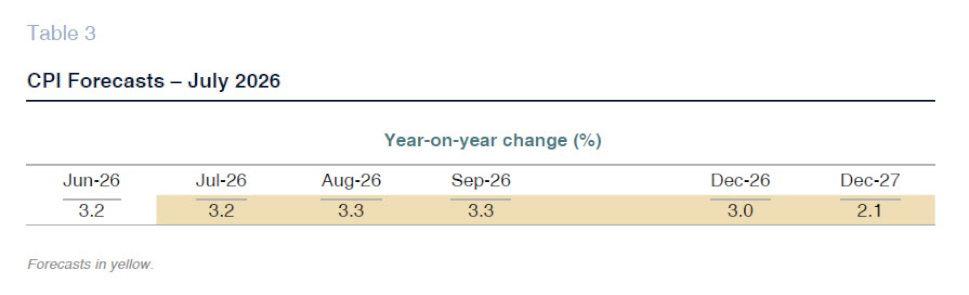
The conflict in the Middle East drove headline inflation from 2.3% at the start of the year to 3.4% in March, after which it fell back to 3.2% during the following three months. Core inflation, meanwhile, oscillated between 2.8% and 3%. However, the inflationary pressures already being felt in services are proving sticky, whereas pressure on food prices appears to have abated (although it is still too soon to say whether this phenomenon is structural or will prove transient).
The analysts expect inflation to increase slightly in the coming months, returning to 3% in December, which would imply an annual average rate of 3.2% (up 0.1pp from the last Panel). In 2027, annual inflation is expected to average 2.3%, ending the year at 2.1% year-on-year (as in the last round). As for core inflation, the consensus forecast for 2026 is unchanged at 2.7% but in 2027 core inflation is now expected to come in 0.1pp higher, at 2.5% (Tables 1 and 3).
Labour market
Unemployment forecast to drop to 9.6% in 2027
Following a weak first quarter on account of bad weather, growth in Social Security contributors gathered pace, thus increasing 0.8% in the second quarter. This is the best performance of the last 11 quarters, albeit distorted by the effect of the ongoing process of regularisation of immigrants.
The consensus forecasts have not changed much: employment is expected to increase by 2% in 2026 (up 0.1pp from the last Panel) and by 1.5% next year (unchanged). The average annual rate of unemployment is expected to drop to 10% in 2026 and 9.6% in 2027, unchanged from the last forecast (Table 1).
Productivity and unit labour costs (ULC), calculated on the basis of the forecasts for growth in GDP, employee compensation and employment (as per LFS), are expected to grow by 0.3% and 3%, respectively (roughly the same as in the previous consensus). In 2027, growth in productivity is forecast at 0.5% (unchanged), while ULCs would increase by 2.6% (up 0.1pp from the last survey).
Balance of payments
Favourable developments in the goods and services trade balance
In the first four months of the year, the current account surplus amounted to 10.8 billion euros, which is 1.55 billion euros less than in the same period of 2025. The downturn is the result of a deterioration in the deficit in the primary and secondary income accounts, which more than offset the improvement in the trade account, shaped by a lower goods deficit and higher services trade surplus, particularly in non-travel services.
The consensus forecast is for a current account surplus of 2.2% of GDP in 2026 and one of 2% in 2027, both figures unchanged from the last survey (Table 1).
Public deficit
Sharply diverging public deficit forecasts
The public deficit was flat year-on-year in the first quarter, at 6.43 billion euros, practically the same as last year, as the improvement in the regional governments’ accounts and Social Security funds was offset by an increase in the central and local government deficits. Importantly, adding in the April figures, the deficit at all levels of government other than the local layer (for which data are not yet available) decreased by 33.4% year-on-year.
The consensus forecast for the public deficit this year is unchanged at 2.5% of GDP, whereas the forecast for 2027 has increased 0.1pp to 2.4%. However, there are considerable differences among analysts with respect to deficit forecasts. Note that both government and international institutions and organisations predict a lower public deficit than the Panel consensus (Table 1).
International context
The ceasefire agreement in the Middle East marks a turning point but its fragility is weighing on expectations
The agreement reached last month between the U.S. and Iran has provided a respite to energy and other commodity markets. During the days following the announcement of the memorandum of understanding, traffic through the Strait of Hormuz picked up, facilitating oil and gas exports throughout the region. The most tangible result was a sharp drop in Brent oil prices, which plummeted from close to USD 115/barrel at the time of the last Panel to less than USD 70 in early July. Since then, the renewal of hostilities has jeopardised passage through the Persian Gulf, pushing Brent prices back up towards USD 80 at the time of writing.
In its recently updated World Economic Outlook, the IMF warns of the impact of the geopolitical uncertainties on confidence and expectations. The IMF is now expecting the eurozone economy to slow by more than initially anticipated, to 0.9% in 2026, which is 0.2pp below its spring forecast. The U.S. is expected to register growth of 2.3% (unchanged from the spring round), fuelled by investment in AI, with China projected to grow at 4.6% (up 0.2pp). Overall, the global economy appears to have withstood the geopolitical shock better than feared in some scenarios. The most recent PMI readings are even signalling a slight improvement in both the global economy and in Europe.
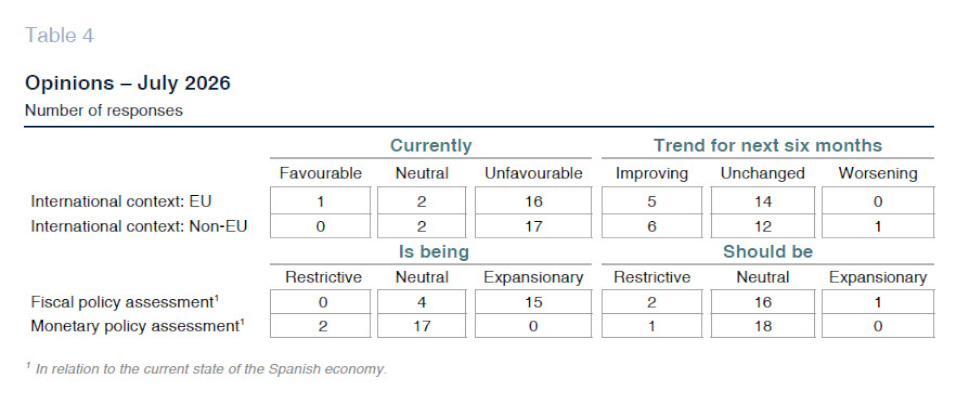
The analysts have factored in the inflection point marked by the agreement in the Middle East but remain cautious in terms of their assessments of the international environment. Most believe that the international climate is unfavourable, both within the EU and beyond it, and that the current situation will persist during the coming months (Table 4). However, the number of analysts who envisage a pick up in the EU has increased from 4 to 5, and from 4 to 6 in the case of the global economy.
Interest rates
ECB expected to pause its rate increases
At its June meeting, the ECB decided to raise its key interest rates by a quarter of a point, in line with the consensus forecast as of last May. The decision was motivated by the uptick in inflation and the need for preventing a hypothetical deanchoring of expectations. The Federal Reserve, meanwhile, decided it was not necessary to tighten its monetary policy, in light of the rate levels attained, of between 3.5% and 3.75%, compared to the ECB deposit facility rate of 2.25% (after the June increase).
Meanwhile, inflation is showing signs of slowing, at least in Europe, albeit still above the levels observed before the onset of the conflict in the Middle East. Eurozone CPI eased from 3.2% in May to 2.8% in June (still above the 1.9% recorded in February). This let-up has fuelled expectations that the ECB will pause its rate increases. In fact, the analysts now expect the deposit facility rate to remain anchored at 2.25% throughout the forecast horizon (Table 2).
12-month Euribor, the main benchmark in the mortgage market, has also taken a breather, currently trading at around 2.7%, down 0.1pp from May. The panellists expect that benchmark to continue to trend lower over the coming months, ending the year at around 2.75% (Table 2). In tandem, the yield of Spanish 10-year treasury bonds has eased a little. The analysts expect the yield to remain broadly unchanged during the projection.
Currency market
Dollar appreciation in the wake of the agreement in the Middle East
The dollar rallied on the back of the announced reopening of the Strait of Hormuz and has barely been affected by the exchange of missiles in recent days. It is currently trading at around 1.14 against the dollar, compared to 1.16 at the time of the last Panel. The growth differential between both sides of the Atlantic revealed by the most recent figures may have contributed to this realignment of the dollar. However, the consensus forecast is that between now and the end of 2027, the euro will gain ground, albeit less than was expected in our last report (Table 2).
Fiscal and monetary policy considerations
Fiscal policy should be less expansionary
The analysts believe that the Spanish economic cycle is sufficiently robust as to not need additional stimulus via fiscal policy. According to a majority of analysts, the budget remains expansionary when it should be neutral, meaning it should not provide additional stimulus. As for monetary policy, the perception is one of a better fit with the cycle: the consensus is that monetary policy is neutral, which is what the Spanish economy currently requires (Table 4).
*
The Spanish Economic Forecast Panel is a survey conducted by Funcas among the 19 research services listed in Table 1. The survey, which dates back to 1999, is published every two months, in January, March, May, July, September and November. The responses to this survey generate “consensus” forecasts, which are calculated as the arithmetic mean of the 19 individual forecasts. For comparative purposes, albeit not part of the consensus, the forecasts of the Spanish government, AIReF, Bank of Spain and leading international organisations are also presented.