
Spanish bank exposure to real estate: Structural correction and European comparison
Spain′s banking sector has undergone a structural transformation in its real estate exposure since the 2008 financial crisis, shifting away from high-risk developer and construction lending toward a more mortgage-dominated, better-quality loan book. Yet, exposure still exceeds the European average, reflecting deep-rooted home ownership culture rather than renewed speculative excess.
Abstract: Since the 2008 financial crisis, Spanish banks have radically rebalanced their real estate loan books, shedding the developer and construction credit that once defined their property exposure in favour of lower-risk home mortgages. Before the crisis, high-risk loans to those two segments dominated the portfolio; by 2025 their combined share of real estate credit had fallen from 42% to just 16%, while lower-risk home mortgages now account for the large majority of the banks′ property-related lending. The correction was accompanied by severe asset quality deterioration: non-performing loan ratios reached 30% in property development and 34.3% in construction at their 2013 peak, before recovering sharply as restructuring efforts and improved economic conditions took hold. Today, overall non-performance in real estate has receded to levels broadly in line with pre-crisis norms. A comparison with European peers, using European Banking Authority consolidated data, confirms that Spanish banks remain somewhat more exposed to real estate than the EU average, though this gap is attributable to Spain′s entrenched home ownership culture rather than speculative lending. In the higher-risk construction and developer segments, Spanish banks carry below-average non-performance ratios relative to European peers. On balance, the sector is navigating the current real estate cycle, characterised by rising prices driven by a supply-demand imbalance, from a position of substantially greater solvency and resilience than in the recent past.
Foreword
For the past two decades, the relationship between the Spanish banking sector and the real estate sector (in the broad sense, meaning loans for home purchases, construction activity and property development) has changed significantly and those changes explain why the banks’ current exposure to the sector is very different from that of the recent past. Shortly before the financial crisis erupted in 2008, exposure in Spain peaked at 61% of all credit extended to the resident private sector. The intense rate of growth in real estate lending in the preceding years had made Spain one of the European economies most financially reliant on the real estate sector, ultimately amplifying the impact on the banks of the crisis and bursting of the real estate bubble.
The bursting of the credit-real estate bubble triggered a property price correction, causing loan non-performance to spike and forcing provisions and write-downs worth millions of euros. The necessary subsequent sector restructuring has translated into continuous deleveraging in terms of an ever-shrinking stock of outstanding credit and an improvement in asset quality, which has been accompanied by higher solvency on the back of tighter capital requirements. The upshot has been a substantial reduction in the share of real estate credit in the total loan book with respect to the highs observed right before the crisis.
By comparison with other European countries, the trend is eye-catching. The German and French banking sectors were never as exposed to the real estate sector as Spain’s banks, making the Spanish case a clear story of structural correction following a period of intense sector concentration. The international comparison puts the magnitude of the Spanish problem and the scale of the subsequent correction into context. Today, although mortgage lending remains an important part of the retail banking business, direct exposure to the development and construction segments represents a much smaller share compared to 20 years ago.
Bank exposure to the property sector is particularly important from the financial stability perspective. The reduced volume of real estate assets on the Spanish banks’ books suggests that the sector is navigating the present economic and real estate cycle from a far more robust position than in the recent past: the composition of the banks’ exposure to real estate assets is radically different at present. Before the financial crisis, loans to construction firms and developers commanded a significant share, peaking at 42% of real estate credit, compared to just 16% today, when mortgage loans, which are far less risky, are predominant.
The purpose of this paper is to analyse the Spanish banks’ exposure to real estate and provide a comparison with the situation in Europe. To do that, we first analyse the trend in the domestic business (i.e., in Spain), followed by an assessment of the banks’ total exposure (including their business outside of Spain).
Trend in the Spanish banks’ exposure to real estate: The domestic business
By exposure to real estate, we mean three types of bank loans: loans to finance the acquisition or refurbishment of a home; loans to the construction sector; and loans to property developers. Adding the three types together, as shown in Exhibit 1, the outstanding stock peaked at 61.5% of total credit in 2006-2007, shaped by continuous sharp growth since 2000. Since the onset of the financial crisis in 2008, that figure has been coming down almost continually, landing at 49.6% at the end of 2025, revisiting the share commanded back in 2002.
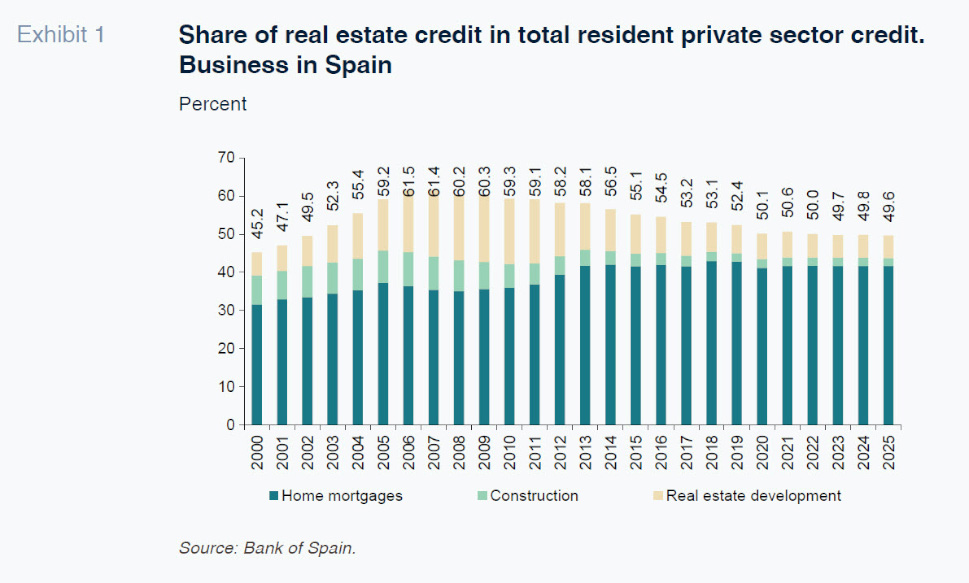
More interesting is the change in the composition of that real estate credit. At the start of the Great Recession, construction and developer credit accounted for 42% of real estate credit (with developer loans the bigger category), whereas by 2025 that figure had fallen to 16%, well below even the 2000 figure (30%). In parallel, the share of home mortgages, the category with the lowest non-performance ratios, has been climbing steadily since the crisis. As a result, the quality of the Spanish banks’ real estate loan books has improved considerably. Today, home mortgages account for 41.7% of all private sector credit, compared to shares of just 2.1% for construction credit and 5.9% for property developer loans. Developer credit is the category that has contracted the most, plummeting from 17.5% of the total in 2009, which is triple its share today.
If we focus on new credit flows rather than the accumulated stock, the mortgage segment registered growth of 20% in 2024 and 22% in 2025; those figures are high but are not exceptional compared to earlier years. Although new credit flows marked their highest level since 2009 in 2025, the volume was still well below (half) the levels observed in the years prior to the property bubble burst. Therefore, the growth in house prices in recent years is not being fuelled by unfettered growth in bank loans.
In the case of construction and developer credit, the stock continues to contract in the case of the former (by 0.2% in 2025) and has been increasing timidly since 2024 in the case of the latter (2.2% in 2025), in contrast to the heady growth of almost 50% shortly before the onset of the crisis. Indeed, the flow of credit for real estate activities increased by 49% in 2006 and grew by over 40% between 2003 and 2006.
Quality of real estate exposure in Spain
Such significant exposure to property, as depicted above, took an enormous toll due to loan impairments derived from the correction in property prices and the macroeconomic crisis itself, which affected households and businesses’ ability to service their debt. That asset impairment is illustrated by the trend in the non-performance ratio depicted in Exhibit 2. Before the financial crisis, the non-performance ratio on total credit was less than 1%; it went on to climb steadily, peaking at 13.6% in 2013. In the property development segment, non-performance peaked at 30% that same year and in the construction segment, that ratio went as high as 34.3%. Those ratios were many times the highest non-performance ratios observed in the mortgage segment, which peaked at 6%. It is noteworthy that during those years of crisis, for every 100 euros of non-performing loans, 72 euros were real estate exposures.
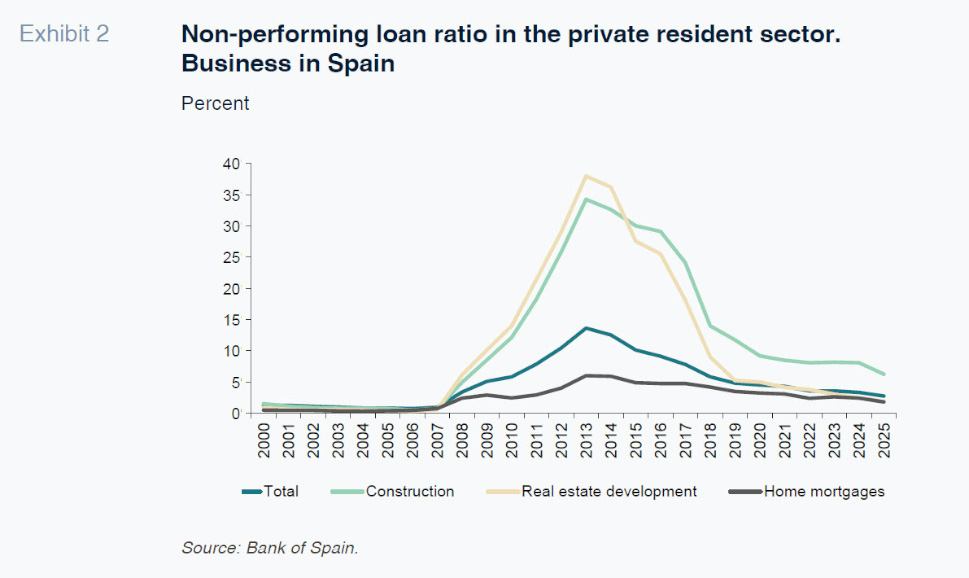
The ensuing restructuring effort and improvement in economic conditions explain the subsequent downtrend in non-performance. By the end of 2025, non-performance was back at 2.71% for total private sector credit, 6.24% in construction, 1.87% in property development and 1.8% in home mortgages. And for every 100 euros of non-performing loans, real estate accounted for 36 euros, exactly half the peak of the crisis. The non-performance ratio has come down most significantly in the property development segment.
How do the Spanish banks compare to their European counterparts in terms of their real estate exposure?
To compare the Spanish banks’ real estate exposure with that of their European peers, we looked to the information reported by the European Banking Authority (EBA) for consolidated groups. That means that the information used in the comparison includes the Spanish banks’ business in Spain and that of their foreign subsidiaries, so that the figures are not comparable with those analysed above, which related to their domestic businesses only.
The EBA has been providing this information since the end of 2019, preventing us from going back to the year when the crisis was hitting the banks the hardest. That year, the share of real estate credit in the Spanish banks’ loan books was 37% (it was higher, as we have seen, in the domestic business in Spain, at 52.4%), six points above the EU average (Exhibit 3). In 2019, Spain ranked somewhere in the middle of the European ranking, with Sweden and Slovakia taking pole position that year (60%). The Spanish banks’ exposure was higher than that of the German (22.5%), French (19.3%) and Italian banks (26.5%).
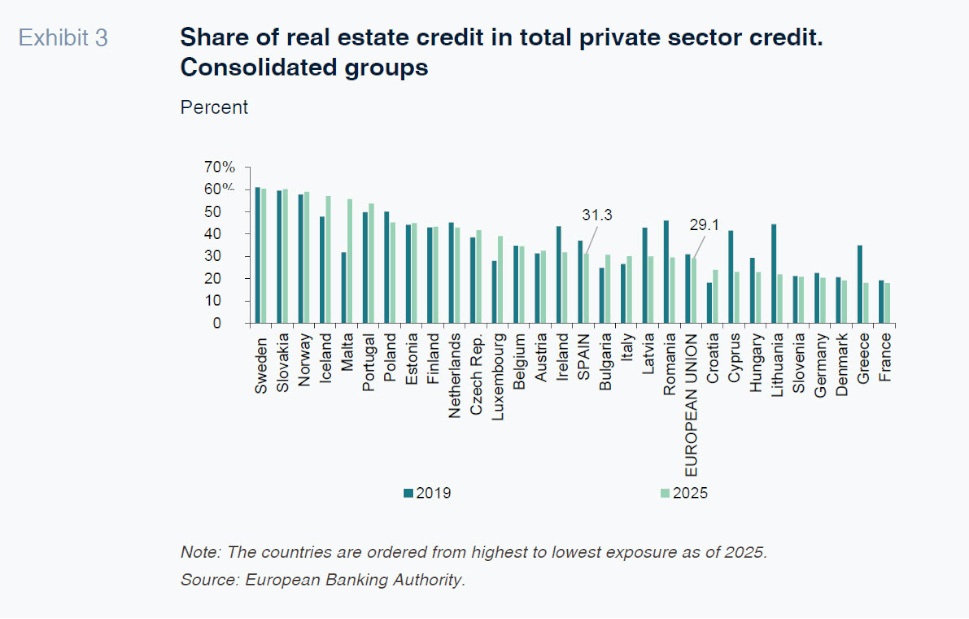
Today (the most recent statistics date to the fourth quarter of 2025), the real estate sector accounts for 31.3% of the Spanish banks’ private sector credit and the distance to the EU average has narrowed to just 2.2 points. The Spanish banks are still more exposed to the sector than the other major European economies. There is no clear time pattern in the different banking sectors’ real estate exposure although it has shrunk in more countries besides Spain.
The Spanish banks’ relatively higher exposure to the real estate sector at present is attributable to the mortgage segment, which accounted for 28% of total credit in 2025 and 90% of all real estate credit (compared to 84% in the domestic business), compared to averages of 22% and 75% in the EU. In contrast, construction and developer loans represent just 3% of the Spanish banks’ overall loan books, which is less than half of the EU average (7%).
Recall that in Spain, home mortgages have always constituted a large share of the banks’ business, shaped by a strong preference for home ownership, in contrast to the pattern in other European countries, where rental tenancy is more significant. In addition, for decades, tax policies and market conditions were conducive to buying over renting, reinforcing that preference.
Quality of real estate assets: Spain versus Europe
If we compare the most recent non-performance ratios for real estate exposures for the Spanish banking sector (consolidated groups, i.e., including their businesses outside of Spain) with those of the other European countries (Exhibit 4), we see that Spain places second on the ranking, with a ratio of 2.1%, above the EU average of 1.3%. Nevertheless, 2.1% is not a high ratio.
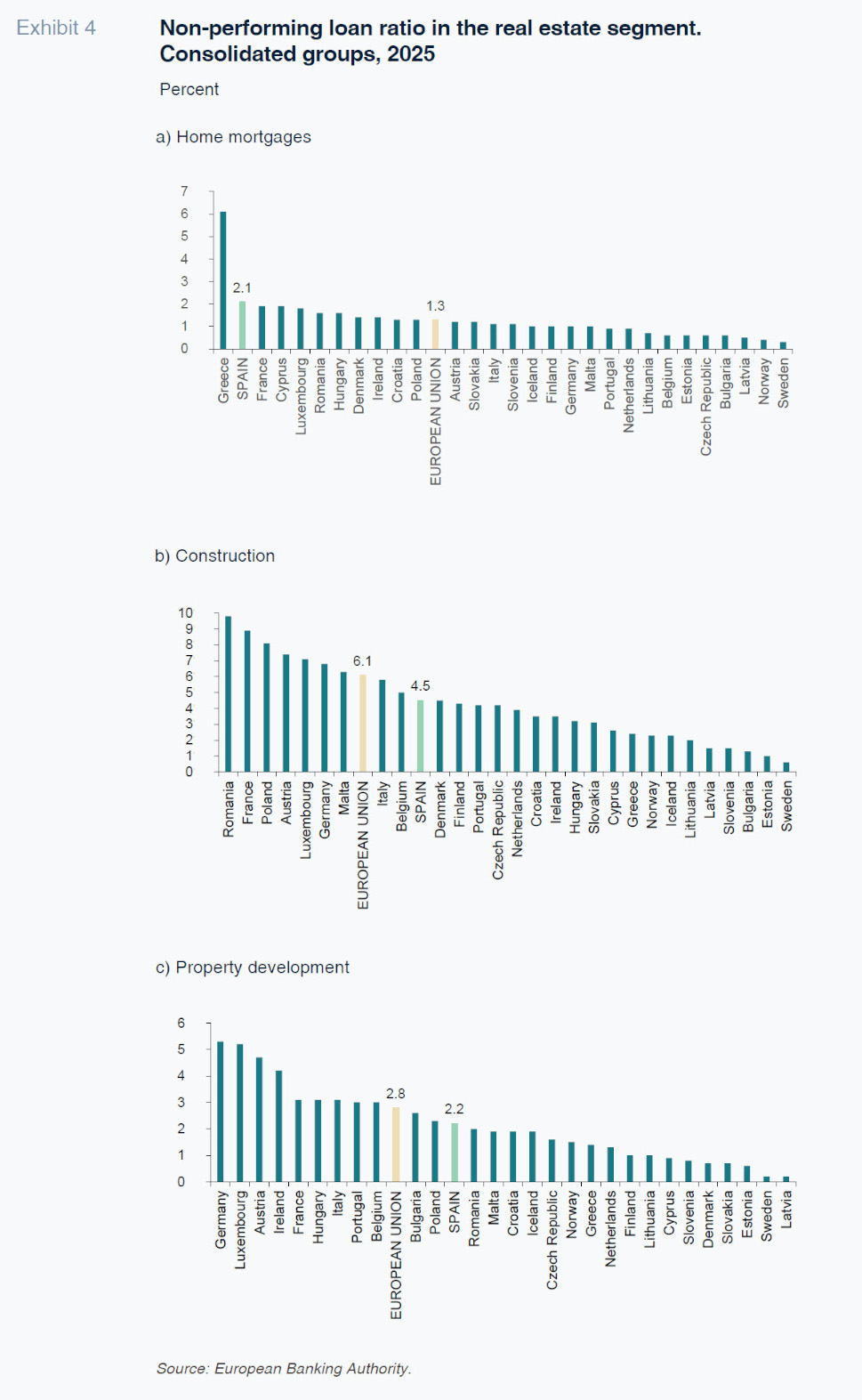
In the construction segment, the Spanish banks’ present lower than average non-performance (4.5% vs. 6.1%), as is the case in the property development segment (2.2% vs. 2.8%).
Conclusions and implications
The analysis carried out shows that the Spanish banking sector has radically transformed its exposure to the real estate sector since the financial crisis broke out in 2008. Compared to a legacy of concentrated real estate credit risk (which at one point accounted for over 60% of total private sector credit, with developer and construction loans accounting for significant shares), today’s exposure is far more balanced. Intense deleveraging, asset restructuring and regulatory tightening have unlocked significant reductions in the relative size of that exposure and in its risk levels. Today, home mortgages, which have long presented lower non-performance ratios, account for the large majority of the Spanish banks’ real estate exposure, while the shares of developer and construction credit have contracted to record lows. A comparison with the situation in Europe confirms that although the Spanish banks remain a little more exposed to the real estate sector than their European counterparts on average, the gap is attributable to the higher cultural and financial weight of home ownership (which is where Spanish households put their savings and create their wealth), rather than rampant financing of speculative activities, as was the case prior to the Great Recession. Moreover, the current asset quality indicators evidence a considerable improvement relative to the crisis years, marked by much lower non-performance ratios and a lower contribution by the real estate sector to overall non-performance. All of which is occurring against the backdrop of a private sector that is far less indebted than in the past.
As a result, the evidence indicates that the Spanish banking sector is navigating the current real estate cycle (marked by rising prices, as demand outstrips scant supply) from a position of increased solvency, lower vulnerability and significantly reduced exposure to the real estate sector. Moreover, the banks’ residual exposure is very different in structure from when it was the source of the banks’ woes in the not-too-distant past.
Joaquín Maudos. Professor of Economic Analysis at the University of Valencia, Deputy Director of Research at Ivie and collaborator with CUNEF