
Population ageing and public finances: Spain′s tax revenue gap by 2040
A static simulation applying 2040 demographic projections to 2025 household tax data estimates that population ageing alone would reduce Spanish tax revenue by around 3.3% through its impact on personal income tax, social security contributions, and VAT. The decline reflects the shrinking weight of younger and prime working-age households in the population, while immigration can only partially offset the shortfall and depends heavily on household composition and income levels.
Abstract: Population ageing poses well-documented risks to public finances through higher spending, but its revenue implications have received comparatively little attention in the Spanish literature. This analysis focuses on the three taxes that together account for around 77% of total tax revenue—personal income tax, social security contributions, and VAT—and estimates their exposure to demographic change through a static simulation that applies projected 2040 household age distributions to 2025 tax data. Personal income tax is the most structurally vulnerable, given its reliance on earned income, which peaks during prime working years before declining after retirement as wages are replaced by pensions. Social security contributions face analogous pressure as the pensioner share grows and the wage share of national income contracts. VAT revenue is affected both because older households spend less overall and because they devote a larger share of consumption to goods subject to reduced rates, such as food, medicines, and assistive devices. Aggregating across all three taxes, the simulation points to a total revenue reduction of around 3.3%, equivalent to approximately 12.9 billion euros, with the burden of revenue generation shifting toward households whose main earner is aged between 60 and 75. Offsetting this shortfall through immigration would require around 650,000 additional households in the 30–39 age bracket, although this estimate is conservative, as immigrant households tend to generate less tax revenue than native households of comparable age.
Population ageing and tax revenue: What do we know?
Population ageing is a concern due to impact on the sustainability of the welfare state. Both the European Commission and AIReF provide regular projections for public spending on pensions, healthcare and long-term care (European Commission, 2024; AIReF, 2023, 2025). Both underscore the pressure bearing down on public spending, which in the case of pensions is projected to increase from 12.0% of GDP in 2023 to 16.1% in 2050 (AIReF, 2025). Indeed, interest in the impact of population ageing on public finances has been largely focused on the spending side, paying less attention to the revenue aspect. One of the rare exceptions is López and Ramos (2024), who analyse the impact on the bases and effective rates for the main taxes, but without projecting the future impact on tax receipts. As far as we are aware, Romero-Jordán (2026) is the only study that projects the long-term impact of ageing on tax revenue, albeit focusing exclusively on VAT.
The contribution of this paper is to help fill that gap by projecting the impact of ageing on VAT, personal income tax and social security revenue. We concentrate on those three taxes, which account for around 77% of total tax revenue (IGAE, 2025). Personal income tax is the most exposed to ageing due to its reliance on earned income. In Spain, personal income tax contributes around 38% of tax revenue, which is 4 percentage points above the EU-27 average. Earned income etches out an inverted U-shape: it rises with age, stabilises at around the age of 50 and falls after retirement. López and Ramos (2024) flag two distinct effects of ageing on personal income tax. The first factor comes into play at the level of the tax base. People over the age of 65 declare less income, reducing the overall effective rate and tax receipts. The second is a composition effect, marked by a shift from wages to pensions. At the end of the 1990s, wages represented around 83% of the combined stock of wages and pensions. Since 2020, that share has been falling steadily and currently stands at close to 69% (AEAT, 2026). Population ageing reduces revenue from social security contributions in two ways. Firstly, the number of job holders paying into the system falls as the share of pensioners grows. Secondly, it exerts downward pressure on the share of wages in national income. This effect is bigger in Spain, where social security contributions accounted for 12.8% of GDP in 2022 and 34% of tax revenue, compared to 10.8% and 29.6% on average in the EU-27, respectively (López and Ramos, 2024).
In addition, population ageing alters both the level and composition of household spending (Romero-Jordán, 2026). Average VAT per household also follows an inverted U-shape, peaking at around 56. Ageing progressively alters the composition of the shopping basket, increasing the proportion of goods subject to the reduced and super-reduced rates — for example, food, pharmacy goods and assistive devices. By way of illustration, the share of the tax base subject to the super-reduced rate of VAT increases from 6.1% among those under the age of 30 to 15.7% among those over the age of 75. Lastly, wealth is concentrated in the older age categories and is dominated by property wealth. The households whose main breadwinner is over the age of 65 hold more than 40% of total net wealth in Spain (López and Ramos, 2024). Population ageing widens the potential wealth tax base associated with the older generations.
What impact will population ageing have on tax revenue in Spain by 2040?
To quantify that impact, we analyse what effects population ageing will have on social security, VAT and personal income tax revenue between 2025 and 2040. By means of a static simulation, we address the following question: What would the 2025 tax take look like using the demographics (older population) forecast for 2040? To do that we use two microdata bases: (i) the Living Conditions Survey (LCS-2026); and the (ii) Household Budget Survey (HBS-2025). The Living Conditions Survey provides information about the personal income tax and social security borne by each household, gleaned from the tax authority’s administrative records. The VAT tax burden borne by each household was estimated using the microdata from the Household Budget Survey, as per Romero-Jordán (2026).
Columns 1 to 3 of Table 1 provide the average tax revenue per household for each of the three taxes analysed in 2025. Columns 4 and 5 provide the breakdown of households by age category. The 2025 figures come direct from INE (2026), whereas the household breakdown for 2040 was estimated using the methodology described in Romero-Jordán (2026).
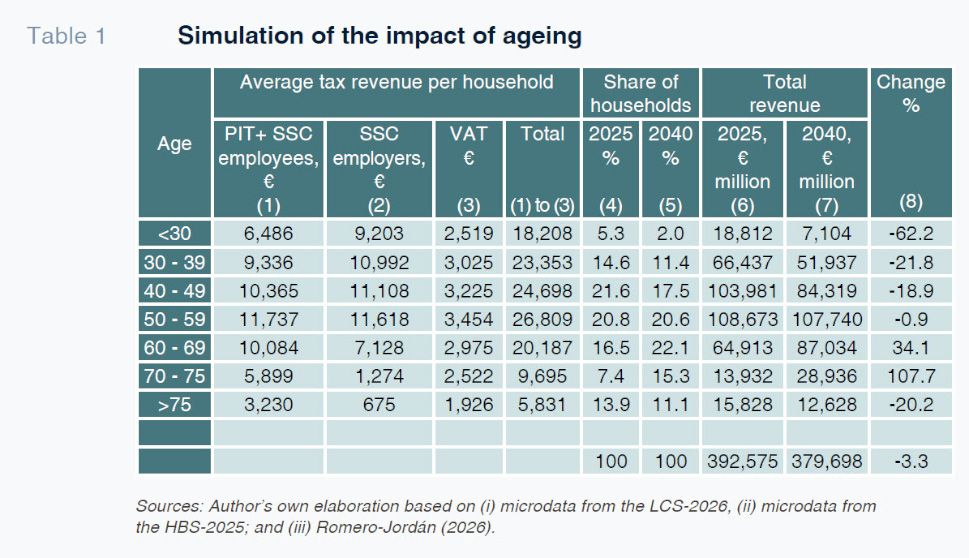
In this simulation, the total number of households in 2040 is kept the same as in 2025; only the breakdown by age category changes as a result of population ageing. Therefore, the tax revenue changes estimated between 2025 and 2040 are exclusively attributable to the standalone impact of ageing. In other words, the figures do not reflect any other economic effects as a result of wage growth, inflation or changes in employment or productivity. As shown in Table 1, the drop in the relative size of the under-50 cohort is offset by sharp growth in the share of households whose main earner is aged between 60 and 75.
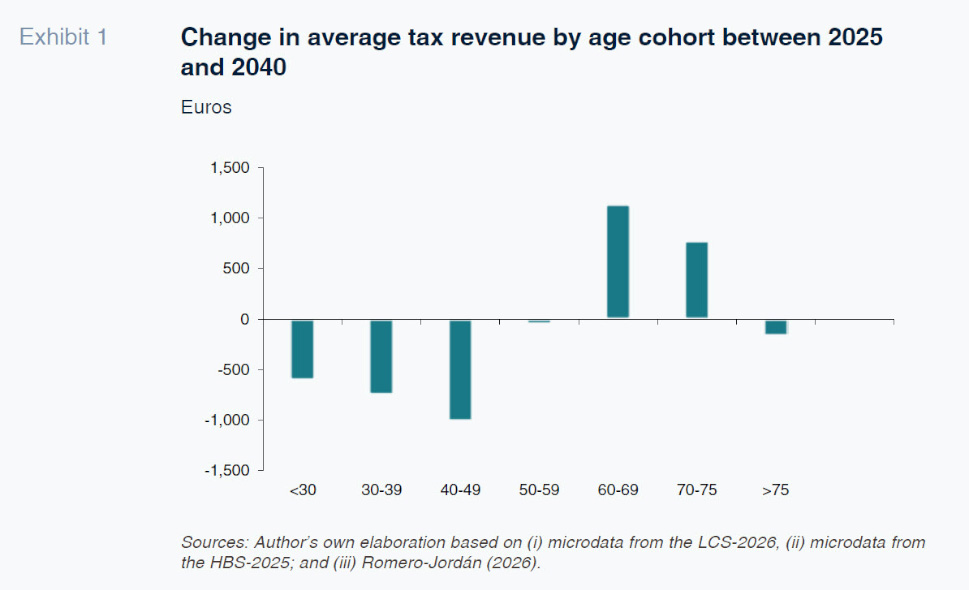
Average tax revenue per household peaks between the age of 50 and 59, at 26,809 euros. The households whose main earner falls into that age cohort generate 47% more tax receipts than those under the age of 30. Tax revenue per cohort increases gradually until it peaks; however, the subsequent fall-off is more pronounced as the age of the main earner rises. On aggregate, the results show that population ageing will reduce total tax revenue — personal income tax, social security and VAT — by around 3.3%, which is equivalent to around 12.9 billion euros. The reduction is not spread evenly by age category. As shown in Exhibit 1, revenue falls more sharply in households whose main income earner is under the age of 50, as a result of this cohort’s smaller share of the population in 2040. On the other hand, the revenue generated by households whose top earner is aged between 60 and 75 increases considerably on the back of a significant increase in their share of the population. This outcome demonstrates that population ageing not only has a moderate negative impact on total revenue but also shifts the brunt of its generation to the older age categories. In parallel, it reduces the bases associated with salaried employment, particularly the social security contributions (SSC) borne by employers.
How many immigrant households would Spain need to offset the population ageing effect?
According to the INE (2026), the average age of immigrants in Spain is around 33. Using that information, we ask how many immigrant households in the 30 - 39 age cohort would be necessary to compensate for the standalone impact of population ageing on tax revenue. As shown in Table 1, a household in that cohort generates an average of 23,353 euros of tax revenue per year, summing together personal income tax, social security and VAT. Therefore, to make up for the loss of 12.9 billion euros, Spain would need around 650,000 equivalent households in that age bracket.
That figure should be seen as a lower threshold, as the average revenue used includes both native and immigrant households. The tax burden borne by immigrant households is, on average, lower than that of native households due to differences in composition, income levels, spending levels and spending patterns. By way of illustration, in the case of VAT, the average difference in revenue between native and immigrant households in the under-65 bracket is approximately 850 euros per year (Romero-Jordán, 2026). Nevertheless, these figures provide an initial approximation of the potential role of immigration in offsetting the effect of population ageing on tax revenue.
References
AEAT (2026). Historical series tracking tax bases, rates and taxes accrued.
https://sede.agenciatributaria.gob.es/Sede/datosabiertos/catalogo/hacienda/
Informe_mensual_de_Recaudacion_Tributaria.shtmAIReF. (2023). Opinion on the long-term sustainability of the General Government: The impact of demographics.
Opinion, 1/23.
AIReF. (2025). Opinion on the long-term sustainability of the General Government: Demographics and climate change.
Opinion, 2/25.
EUROPEAN COMMISSION. (2024). 2024 ageing report: Economic and budgetary projections for the EU Member States (2022–2070).
European Economy Institutional Paper, 279. Publications Office of the European Union.
IGAE. (2026).
National accounts. Annual series. Impuestos y cotizaciones sociales de las Administraciones Públicas [Tax and social security statistics]. Ministry of Finance.
INE. (2025).
Household Budget Survey. INE
INE (2026a).
Living Conditions Survey. INE.
INE. (2026b). Foreign migration indicators.
https://ine.es/jaxiT3/Tabla.htm?t=29280&L=1LÓPEZ RODRÍGUEZ, D., & RAMOS, R. (2024). Los retos del envejecimiento poblacional para los ingresos públicos [Population ageing: The challenges for public revenue].
Papeles de Economía Española, 182, 164-176.
ROMERO-JORDÁN, D. (2026).
Envejecimiento y recaudación de IVA: ¿qué papel juega la inmigración? [Population ageing and VAT receipts: What role does immigration play?] Investigaciones de Funcas, 32/2026.
Desiderio Romero-Jordán. Rey Juan Carlos University and Funcas