
Loan portfolio profitability: Diversification and bundling as structural levers
Spanish banks are entering a phase of margin normalisation after rate-driven income growth, with lending showing early signs of recovery across segments. Portfolio composition and the depth of customer relationships are emerging as the primary determinants of sustainable profitability.
Abstract: As rate tailwinds fade, Spanish banks face the structural challenge of sustaining profitability without relying on net interest margin expansion. Loan portfolio composition proves central to this challenge. Banks with higher loan-to-asset ratios consistently generate stronger interest income, while holdings in fixed-income securities and interbank assets correlate negatively with yields. Within the loan book itself, segment diversification is a decisive differentiator: entities with greater exposure to business and consumer lending report higher loan yields than those concentrated in mortgages, reflecting the higher risk, shorter duration, and repricing flexibility of those segments. Given the structural weight of mortgage lending in Spanish bank portfolios, customer bundling emerges as a complementary lever. Banks with higher mortgage volumes show a strong positive correlation with off-balance sheet assets, and the resulting fee income offsets compressed interest margins on standardised products. Sustaining profitability ultimately requires balancing portfolio diversification with a shift toward customer-level profitability management, supported by analytical frameworks that link product mix to lifecycle value.
Foreword
Margins recovered sharply across the Spanish bank sector as rates increased between 2022 and 2024. They have since stabilised, heralding the start of a phase of normalisation in which banks can no longer rely on net interest margin expansion driven by rate hikes. In parallel, lending is showing incipient signs of recovery in an economic environment which nevertheless continues to be marked by uncertainty, not least of which the potential fallout from the conflict in the Middle East.
As a result, the banks are gradually turning their attention to defending their profitability and activating levers for sustaining it on an ongoing basis. Given the prevailing uncertainty and competitive pressure, it is pertinent to analyse to what extent asset diversification, particularly loan portfolio diversification, is key to explaining differences in profitability among entities and, now that the upside is more limited, to what degree the entities are focusing strategically on building long-term relationships with their customers with a view to unlocking their targeted profitability levels.
Diversification as a driver of loan portfolio profitability
As our starting point, it is critical to analyse the extent to which the composition of the banks’ assets explains their profitability by estimating potential correlation between more dynamic lending activity relative to wholesale funding as a prior determinant of the composition of the loan book itself. For this analysis to prove illustrative, we used a sample of banks which includes both significant institutions (SIs), which tend to present a more diversified business model in terms of both geographical presence and business lines, and less significant institutions (LSIs), which generally speaking pursue a more geographically focused business with higher concentration in the core financial intermediation activity.
An analysis of the asset structures depicted in Exhibits 1 and 2 appears to confirm the central role of the loan portfolio as the prime driver of recurring interest income. At the end of 2025, the banks with high percentages of loans to total assets presented higher profitability in terms of interest income over average total assets (ATAs). Exhibit 2 shows how the higher weight of other interest-bearing assets, such as fixed-income securities and interbank assets (which mostly represent the banks’ surplus liquidity) is negatively correlated to the interest income. This correlation is consistent with the role in those portfolios of investments in public debt where returns are lower, reflecting their reduced risk.
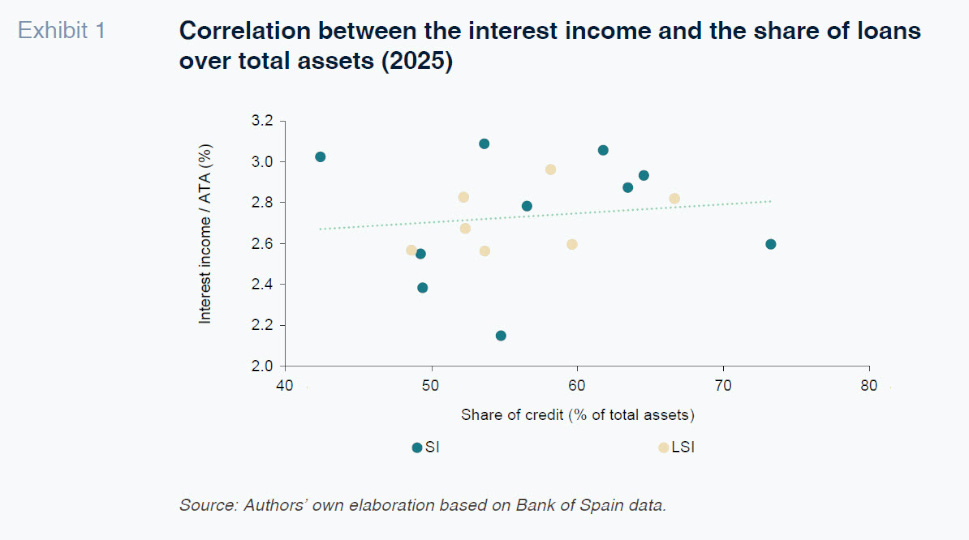
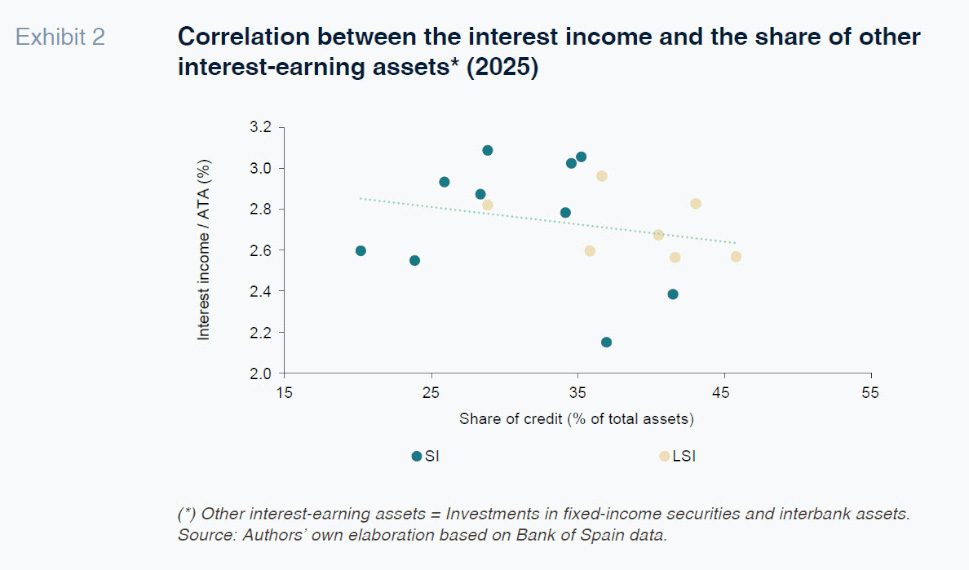
That being said, the contribution to profitability of the public debt portfolios can differ significantly from one entity to another insofar as the banks that have had the chance to make new investments or refinance existing investments when rates were highest, from mid-2022, will report a higher return on those securities than other banks carrying older, less profitable investments. Nevertheless, this pattern suggests that even though these assets fulfil a relevant function in terms of liquidity management, asset diversification and risk profile and capital optimisation, their contribution to the generation of interest income is, in relative terms, smaller than that of credit.
Beyond the higher return generated by the lending business, the positive effect on interest income is not uniform across the different banks. That is because the margin on the loan book is determined significantly by the type of financing provided, so that the composition of the portfolio itself, i.e., its diversification, is a key variable in explaining different profitability levels across the various entities.
A lower level of diversification (i.e., a lower index value) reflects a higher share of mortgage lending, whereas a higher degree of diversification (i.e., a higher value) corresponds to a larger presence in business and consumer loans.
To quantify the level of diversification of the banks’ loan portfolios we created a synthetic index calculated as the inverse of the Herfindahl-Hirschman Index
[1] (HHI), widely used as a measure of concentration, so that it can also be used conversely as a measure of diversification. To calculate it, we started from the relative weight of each credit segment over the total credit portfolio, using the breakdowns provided by the banks themselves in their annual financial statements. By inverting the HHI, the indicator can be interpreted in terms of diversification, so that a higher value denotes a more balanced mix of loans by segments, whereas a lower value depicts relatively higher concentration in the core segment. Given the reality of the Spanish banking sector, particularly the banks taken for our sample, a lower level of diversification (
i.e., a lower index value) reflects a higher share of mortgage lending, whereas a higher degree of diversification (
i.e., a higher value) corresponds to a larger presence in the other two segments: business and consumer loans and other loans.
The comparison between the portfolio diversification indicator and the profitability metric (Exhibit 3) demonstrates that diversification is a key driver of profitability. We see that the banks that are less diversified due to concentration in the mortgage business present lower loan yields. This pattern reflects the relatively reduced profitability of this segment, since mortgages are a more standardised and less risky product, while the segment has been characterised by intense competition of late.
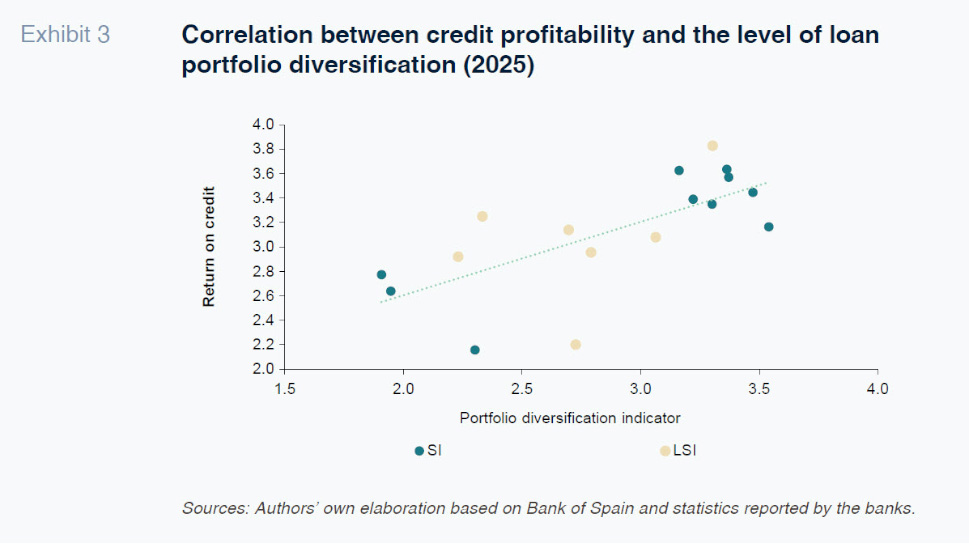
In contrast, higher diversification levels associated with relatively greater exposure to other segments, including business and consumer loans, have a positive impact on profitability. That higher profitability is not a coincidence; it is linked to transactions that are riskier, more sensitive to the economic cycle and enjoy less collateral, among other factors determining how they are priced and, by extension, explaining these segments’ contribution to income generation.
While diversification into other segments such as business and consumer lending can boost income generation and increase average loan returns, this effort also generally implies higher operating expenses relative to more standardised segments or products, as well as increasing exposure to credit risk.
As a result, diversification by segments needs to be analysed not only through the lens of the interest income associated with that lending activity but also the extent to which it translates into net profitability for the banks. Here it is interesting to analyse the extent to which more diversified loan books translate into net returns and whether their profits are more variable.
To check for correlation in this respect, we prepared an econometric model that relates credit segment diversification for a sample of banks to their profitability measured using their return on equity (ROE). That correlation is analysed from a dual perspective: firstly, assessing the possible relationship with average ROEs reported in a given period; and secondly, assessing the possible relationship between variability in ROE during different periods of the cycle.
The results of this analysis show how during periods of abrupt deterioration, such as the downturn sparked by the pandemic between 2020 and 2021, a more diversified portfolio, understood as one with more exposure to business and consumer loans, exhibits higher sensitivity to the economic cycle, increasing the loan-loss provisioning requirement and putting pressure on net profits, which oscillate by more and translate into lower ROEs during those times compared to the less diversified entities. In contrast, during periods of growth, such as that underway since 2022, portfolio diversification unlocks higher ROEs, thanks to higher spreads and more power to reprice assets given the shorter average maturities typical of these segments and the reduction in the cost of risk in times of economic bonanza.
In sum, the conclusion is that diversification across loan segments, in addition to boosting the ability to generate recurring income, can reinforce overall profitability during periods of growth but makes income more procyclical during episodes of stress.
Bundling customers as a means to capturing profits outside of interest income
The conclusions drawn reveal diversification, as opposed to excessive concentration in the mortgage segment, as a key driver of profitability. However, given the importance of the mortgage segment in the Spanish banks’ business mix, the same conclusions apply to the importance of a secondary and complementary driver: customer bundling, understood as a mechanism for reinforcing profitability in this segment outside of the interest earned on the loan itself.
This complementary lever is critical in both the business and retail segments. In the former, this lever is manifesting in a clear trend towards the creation of an ecosystem of products and services that provide full coverage of a business’ or professional’s needs, including beyond the strict financial realm. In the latter, its relevance is becoming increasingly patent in a market context in which competitive pressure is compressing margins on lending transactions. Against this backdrop, the long-term relationship enabled by the mortgage transaction creates an opportunity to gradually deepen the customer bond beyond the confines of the transaction, the goal being to become the customer’s go-to bank whenever a financing need arises.
In the mortgage segment, the attempt to sell the customer more products and services traditionally starts early on, in the form of the basket of products that accompanies the arrangement of the loan, usually tied to a potential reduction in the loan rate, provided the customer finds them worthwhile. The market reality at present, clear in the terms being offered by the main banks in Spain, shows how this initial bundling effort tends to focus on the transactional relationship (tying in payroll accounts, direct debits, use of cards), complemented by insurance products, such as insurance over the homes mortgaged, as well as life and health insurance. In addition, some banks complement that basket of products with investment funds and pension plans and, more recently, we are seeing the odd inclusion of related services such as discretionary portfolio management.
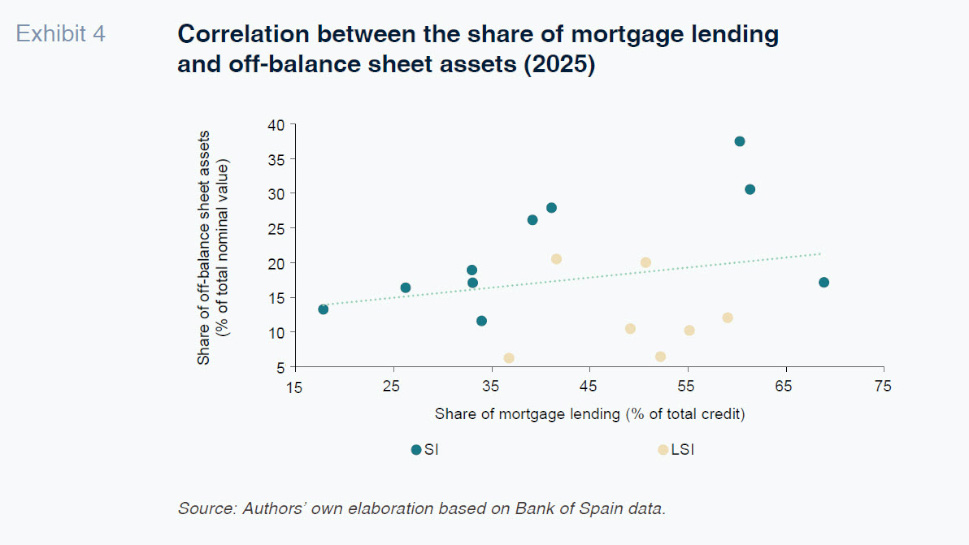
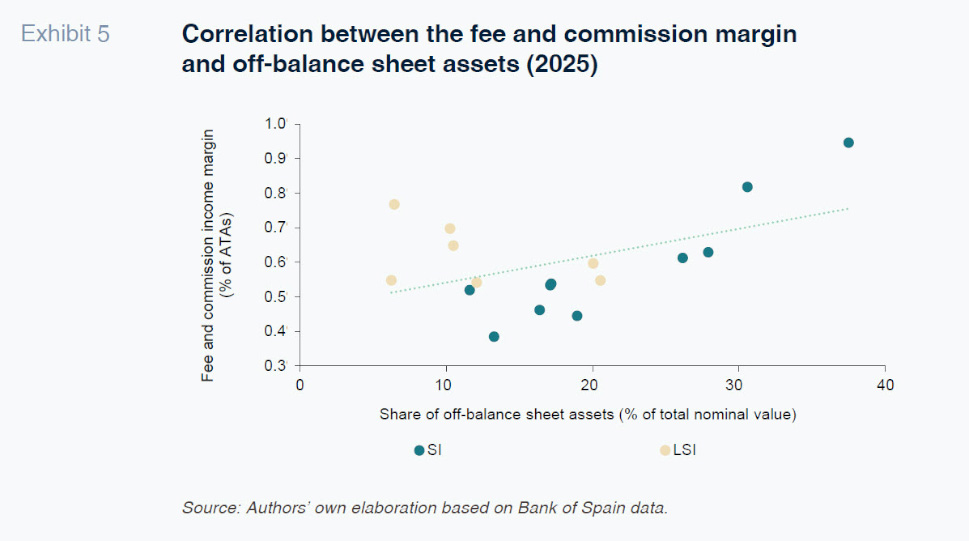
This relationship between the mortgage business and the marketing of off-balance sheet products can be inferred from Exhibit 4, which shows a clear positive correlation between mortgage lending and off-balance sheet asset volumes. This demonstrates how the value of a customer for a bank can extend, through product and service bundling, beyond the return generated by the mortgage. As is shown in Exhibit 5, this higher incidence of off-balance sheet business tends to lead to higher fee and commission margins, offsetting the reduced interest margin generated by these undifferentiated products.
Nevertheless, it is worth noting that in the highly competitive environment characterising the mortgage market in Spain today, the immediate return generated by initial customer bundling is very slim, if not insufficient, by comparison with other investment alternatives, falling short of the returns targeted by the banks themselves. This customer relationship therefore needs to be nurtured throughout the duration of the loan, which implies highly personalised and proactive management to convert customers’ medium- and long-term financial needs into a fundamental bond with the bank.
The sector is increasingly developing analytical methodologies for estimating the potential for binding a customer throughout the term of the loan so as to be able to assess their potential profile-based value. The use of these methodologies is driving the shift from individual product profitability to overall customer profitability. In this manner, the banks are generating value through a complementary business and financial perspective by linking proactive marketing efforts to deeper knowledge of customer needs depending on their profile and stage of life, setting profitability targets, underpinned by an optimal product mix, at the customer level.
Conclusions
The analysis carried out evidence that the sustainability of profitability in the current environment of fading rate tailwinds lies with two key levers which complement each other: diversification and bundling.
The key for the banks is, therefore, to strike the right balance between the two dimensions based on their business models: optimising loan portfolio composition from the perspective of the potential profitability of each transaction, while maximising overall customer value throughout their lifelong relationship with the bank. This balancing act is the reason for the shift in focus, which we are seeing more and more in the sector, to overall customer profitability, underpinned by the development of analytical capabilities and the use of management information as the basis for decision-making.
Notes
The Herfindahl-Hirschman Index measures the degree of concentration of a market by summing the square of the market shares of all of the companies operating in that market; the higher the value, the less intense the competition. It is used extensively by regulatory and anti-trust authorities to assess the impact of mergers and acquisitions on competition at the sector level.
Marta Alberni, Laura Ciriza and María Rodríguez. Afi