
Acting under uncertainty: The ECB′s shift toward discretionary monetary policy
On 11 June 2026, the ECB became the first major central bank to raise policy rates in response to inflation pressures stemming from the war in the Middle East, reversing a cut made one year earlier. The decision reflects a deliberate shift toward discretionary policymaking, driven less by current data than by the risk that firms and households begin embedding higher inflation into wages, prices, and contracts before evidence emerges that inflation expectations have become de-anchored.
Abstract: The ECB′s 25 basis point rate rise on 11 June 2026 sets it apart from the Federal Reserve and the Bank of England, both of which held rates steady the following week despite acknowledging elevated inflation and resilient growth. The divergence reflects the central role of judgement in monetary policymaking under conditions of deep uncertainty, when a ceasefire can be announced the day after a Governing Council meeting and collapse shortly thereafter. The war in the Middle East has produced a classic stagflationary tension: energy and commodity shortages pushing up prices while uncertainty suppresses investment and consumption, with second-order effects on trading partners amplifying both dynamics. The Governing Council′s primary concern is not the current data but the risk that firms and households stop looking through temporary price rises and begin embedding higher inflation into wages, contracts, and business models, a de-anchoring that survey data would only confirm with a significant lag. The ECB′s experience during the 2020-2024 inflation-disinflation cycle, when delayed action allowed inflation to exceed 10% before the tightening response, has raised the institutional premium on demonstrating a capacity to act early. Structural factors, including climate adaptation costs, AI investment, and demographic pressures pulling in opposite directions, mean the neutral rate remains contested and offers little practical guide, giving the Governing Council room to treat a 25 basis point move as predominantly symbolic. The broader implication is that other central banks may face similar pressure to show their own capacity to act, regardless of what the data say at the moment of decision.
Introduction
The Governing Council of the European Central Bank (ECB) decided on 11 June 2026 to raise its three policy rates — including, most important, the deposit facility rate (DFR), which is the rate paid to banks for holding surplus liquidity in the ECB — by 25 basis points, or one quarter of one percent. That decision — effectively reversing a movement made one year earlier at the end of the last inflation-disinflation cycle — was “unanimous” and “without reservation”. [1] ECB President Christine Lagarde explained that the move is necessary to position the Governing Council to “navigate the uncertainty” surrounding the war in the Middle East and overlapping geopolitical crises. She insisted that it is consistent with multiple scenarios for European economic performance looking ahead, even one more gentle than the baseline that the forecasting team at the ECB provided. And she concluded that it does not commit the Governing Council “to a particular rate path”; the Governing Council will continue to take its decisions “meeting-by-meeting” in a manner that is “data dependent”. [2]
Other major central banks took a different approach. When they met the following week, the members of the Federal Reserve′s (Fed) Open Market Committee (OMC) voted unanimously to hold interest rates constant. While they noted that “inflation remains elevated relative to the Committee′s 2 percent goal”, and they recognised that “economic activity is expanding at a solid pace despite elevated uncertainty” coming (in part) from the war in the Middle East, they found no strong reason to act.
[3]
Opinions were more divided on the Bank of England′s Monetary Policy Committee (MPC). The vote to hold rates steady split 7 to 2, with the dissenting voices arguing for a 25-basis point rise like that made by the ECB. There too, policymakers acknowledged that inflation is above target and growth is resilient (meaning, in the British case, still “expected to be subdued”). Nevertheless, seven of the nine remained confident that they would be able to bring inflation back to target; only the two dissenting voices arguing that an upward adjustment would “help anchor inflation expectations” and put the Bank in a good place “to address the significant uncertainties the MPC faces”.
[4]
This contrast between the ECB and the other two central banks reflects the importance of “judgement” in monetary policy making under conditions of extreme uncertainty. Monetary policy makers cannot make a “right” or “wrong” move when they cannot anticipate whether, for example, the United States and Iran will agree on a sixty-day ceasefire the day after they are meeting — which is what happened to the ECB′s Governing Council. They also cannot estimate whether that ceasefire might fall apart — as in the case of the Fed′s OMC and the Bank of England′s MPC. Those committees met between the formal announcement of the deal and Iran′s closure of the Strait of Hormuz in response to Israeli action in Lebanon. The ceasefire remains in place, but no one can guess for how long or with what impact.
Opinions were more divided on the Bank of England′s Monetary Policy Committee (MPC). The vote to hold rates steady split 7 to 2, with the dissenting voices arguing for a 25-basis point rise like that made by the ECB. There too, policymakers acknowledged that inflation is above target and growth is resilient (meaning, in the British case, still “expected to be subdued”). Nevertheless, seven of the nine remained confident that they would be able to bring inflation back to target; only the two dissenting voices arguing that an upward adjustment would “help anchor inflation expectations” and put the Bank in a good place “to address the significant uncertainties the MPC faces”. [4]
This contrast between the ECB and the other two central banks reflects the importance of “judgement” in monetary policy making under conditions of extreme uncertainty. Monetary policy makers cannot make a “right” or “wrong” move when they cannot anticipate whether, for example, the United States and Iran will agree on a sixty-day ceasefire the day after they are meeting — which is what happened to the ECB′s Governing Council. They also cannot estimate whether that ceasefire might fall apart — as in the case of the Fed’s OMC and the Bank of England′s MPC. Those committees met between the formal announcement of the deal and Iran′s closure of the Strait of Hormuz in response to Israeli action in Lebanon. The ceasefire remains in place, but no one can guess for how long or with what impact.
More fundamentally, monetary policymakers lack precise knowledge about how and how quickly the combination of geopolitical uncertainty, supply shocks, and price rises will work their way through the economy. They also do not know how and how quickly firms and households will adapt to rising prices. Their “judgement call” — borrowing from a recent speech by ECB Chief Economist Philip Lane — reflects a wide range of considerations that do not fit easily into the standard economic models used for monetary policymaking.
[5] And the implications of this reliance on “judgement” in monetary policymaking are significant for economic performance both within and across countries.
Conflicting pressures
The most immediate problem for monetary policymakers lies in the fact that the impact of the war in the Middle East accelerates the pace of inflation while at the same time putting downward pressure on growth and employment. This was obvious from the outset. The closure of the Strait of Hormuz by Iran and the United States created a shortage of energy resources and other basic commodities (like fertiliser) that pushes up prices. Meanwhile, uncertainty about how long the shortage will last and whether the conflict will spread makes it more likely that firms will delay investments and households will put off consumption. These first-order effects show up in the macroeconomic data only slowly as firms pass on higher costs to their customers and as caution spreads across firms and households. They show up even more slowly as workers respond to higher prices by demanding higher wages.
Monetary policy is not the only or even the best instrument to use in addressing this kind of tension. A better solution is to use existing stockpiles of fuel and other commodities to slow down the increase in prices while at the same time providing relief for firms and households so that they will continue to invest and spend. Governments have used these stocks and other forms of relief wherever they are available, primarily in the wealthier countries of North America, Europe, and Asia. By implication, the immediate problems have been more acute in other parts of the world, like Southeast Asia, Sub-Saharan Africa, or Latin America (Ro, 2026).
This unequal response across countries creates a second-order challenge insofar as these parts of the world are important trading partners for wealthier countries; the more emerging market economies are hurt by the immediate effects of the crisis, the less they are able to import and the more they are going to charge for their own exports. Shrinking export markets put more downward pressure on economic performance while rising import prices put more upward pressure on inflation (OECD 2026: 15-19). And so long as firms and households are uncertain about how strong these effects will be, the more they are likely to adapt accordingly by slowing down investment, putting up their own prices, and putting off consumption to increase savings.
Monetary policymakers worry that these second-order effects will become built into the expectations for firms and households about how prices will continue to rise and so those higher rates of inflation will need to be built into business models, spending patterns, and wage negotiations. This is what monetary policymakers mean by the “de-anchoring” of inflation expectations. The difficulty is to measure that de-anchoring in real time. They can observe the uptick in prices and the corresponding pace in economic activity, but they cannot see whether firms and consumers are going to “look through” a temporary increase in prices resulting from the conflict or whether they are going to build them into how they understand the way the economy works more generally. This tension was already clear when the ECB′s Governing Council met in March for the first time after the joint American and Israeli assault on Iran.
[6] It remained prominent when they met again in April.
[7] And it resurfaced in their discussions in June.
[8]
Between March and June, monetary policymakers became increasingly concerned that the conflict would last longer than initially expected, that a longer conflict would build more momentum in terms of price inflation, that it would run down available stocks used to buffer the shortages in energy supplies and other commodities, that it would start to stretch governments′ abilities to provide relief for firms and households, and that government efforts to cushion the impact of the crisis would start to reinforce inflation by keeping up demand for energy and other commodities while at the same time adding spending into the economy. Many of these concerns are hard to measure directly, but the data they did have showed increasing momentum building in terms of price inflation. The problem was not just that producer prices and headline inflation in the harmonized index for consumer prices (HICP) began to accelerate; it was that inflation accelerated in prices excluding energy and food (core inflation) and in the price of services. (See Table 1).
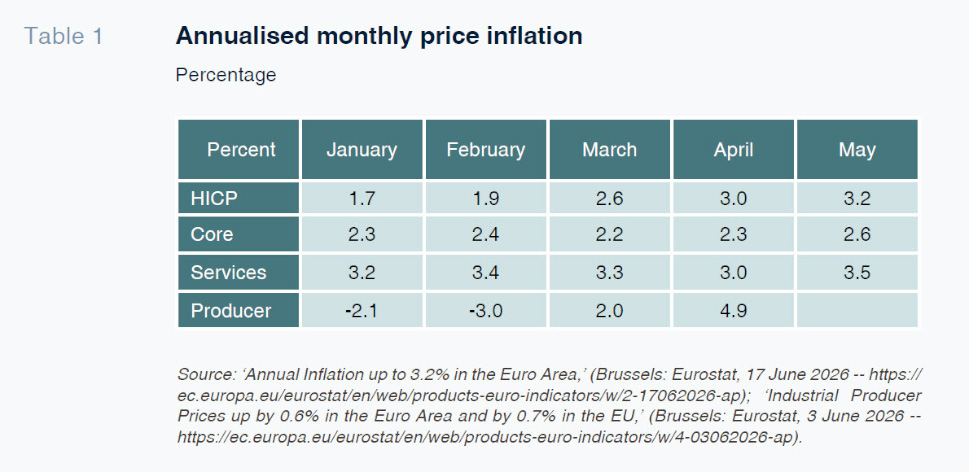
The chain of events linking this increase in momentum to a more fundamental change in expectations about inflation is hard to assess. In her press conference on 11 June, Lagarde pointed to the resilience in consumption, the continued moderation in wage bargaining, and other more specific indicators that inflation expectations remain anchored in the medium term at or close to the ECB′s target of an annual rate of 2 percent. Since much of this data is slow moving and takes time to collect, however, the possibility that momentum is building cannot be discounted entirely. The policy move, Lagarde argued, would put the Governing Council in a good place to respond to future developments.
[9]
Loose parallels
The difficulty for Lagarde lies in the comparison with the inflation shock that followed the pandemic and that gained momentum after Russia′s full-scale invasion of Ukraine. That shock started in December 2020. The Governing Council only began putting up its policy rates in July 2022. Between those two points, inflation moved from a slight annualized decline in prices to an annualized increase over 8.5 percent. By that time, many observers complained that the Governing Council had been too complacent in refusing to push back against inflation more quickly, particularly following Russia′s full-scale invasion of Ukraine (Jones 2022b). That charge still resonates and Lagarde pushes back against it consistently. [10]
She may have a point – certainly in the current context but perhaps also previously. When it did move, the Governing Council raised interest rates decisively, starting with a 50 basis point rise in July and followed by a two 75 basis point increases in September and November. By the time the tightening cycle ended in October 2023, interest rates had risen from -0.5 percent to 4.0 percent. Even in the face of that pressure, however, it took time for inflation to come back down. After peaking in October 2022 at an annualized rate of over 10.6 percent, inflation dropped back below 3 percent only a year later. This convergence on the 2 percent target progressed only slowly thereafter. The Governing Council began to put down its policy rates in June 2024 and the disinflation process came to an end in June 2025. (See Exhibit 1; see also Jones, 2025).
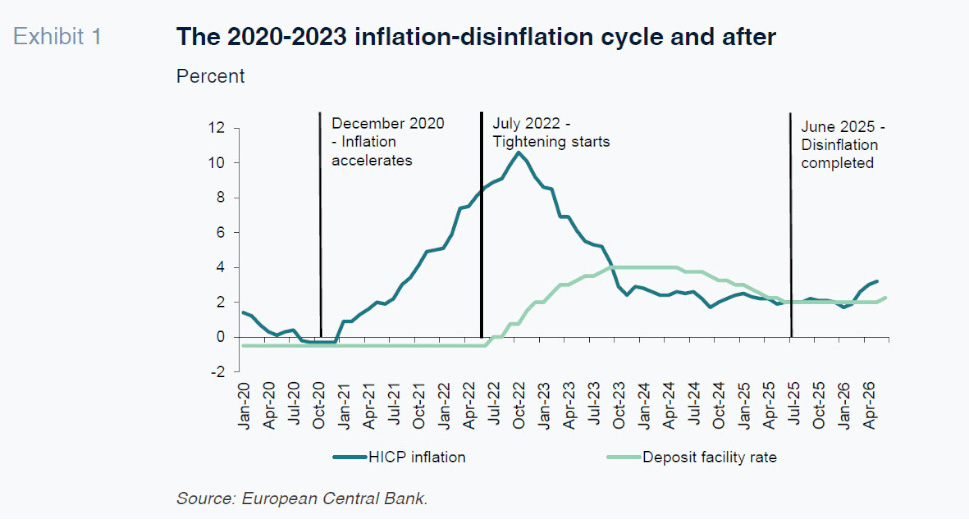
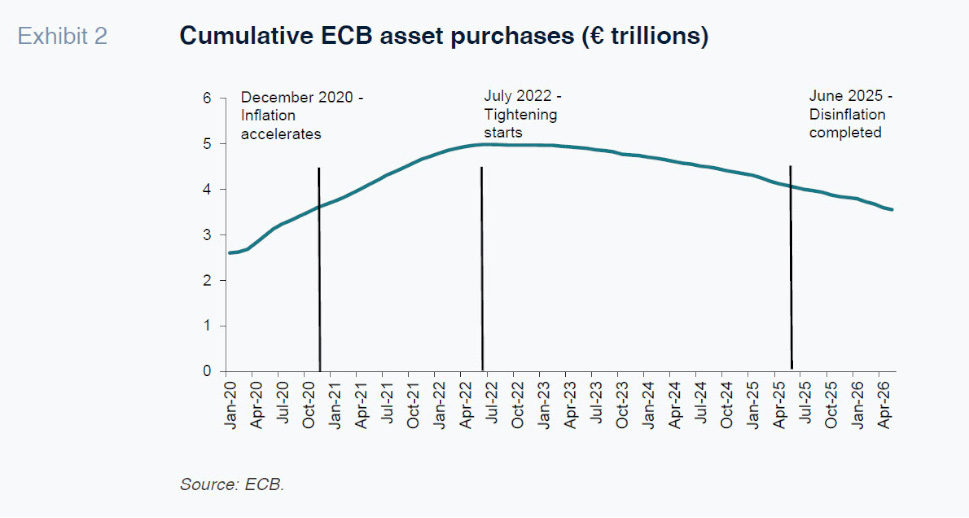
The 2020-2024 inflation-disinflation cycle was the first major deviation from the ECB′s target since the start of the single currency, and it marked a significant break from the long period of very low inflation (including episodes of disinflation) that followed the global economic and financial crisis. As such, it caught everyone — meaning firms and households as well as monetary policymakers— unaware. Monetary policymakers assumed that firms and households would “look through” the temporary increase in prices that resulted from the supply chain disruption experienced during and immediately following the pandemic. As a result, the policymakers themselves sought to “look through” higher prices rather than put up policy rates. The thinking at the time was that exercising caution would be better than putting up policy rates in a way that would only add to the economic distortions (Jones, 2022a). On the contrary, the Governing Council continued to use its large-scale asset purchase programmes (including one created specifically to deal with the pandemic) to add liquidity into the economy. The balance sheet for the Eurosystem had EUR 3.6 trillion in November 2020 and EUR 5.0 trillion in May 2022. (See Exhibit 2).
Firms and households did not “look through” the acceleration in price rises with the same determination. Although there was initial hesitation to embrace inflation as a justification to charge higher prices or to demand higher wages, that hesitation dissolved once it became clear that accelerating price rises were a new normal in the euro area economy. Unfortunately, the survey data and other indicators only reflected that change with a significant lag, allowing inflation expectations to become de-anchored and spreading the change in attitudes and reactions further. The policy response needed to be dramatic to shift expectations in the market.
That disinflation process was controversial, and the Governing Council was deeply divided through the end of the tightening phase. The Governing Council only came together again during the loosening phase of the cycle as interest rates came back down and the ECB began shrinking its balance sheet. As part of this reconciliation, they agreed on a new — more symmetrical — monetary policy strategy and the outlines for a new operational framework for monetary policy. They also agreed to disagree on where policy rates would be “neutral” with respect to output and inflation. With so many changes going on both in the real economy and in market attitudes toward inflation, the estimates for neutral policy rates were too diverse and imprecise to offer a meaningful guide for policymaking. Meanwhile, the rise of geopolitical uncertainties related to international conflict and domestic politics made it impossible for monetary policymakers to try and micro-manage economic performance (Jones, 2025).
By the end of the inflation-disinflation cycle, the Governing Council reestablished the credibility of its commitment to price stability. It also insisted on a new, clearer division of labour between the use of monetary policy instruments and other policy instruments controlled at the national and European levels for use in fiscal stabilization or market-structural reform. What it could not assess is how the experience of inflation had changed attitudes towards inflation among households and firms. The question is whether those actors will be even less willing to “look through” any increase in price levels in the future and so quicker to push for adjustments in prices and wages to compensate for higher costs. The lesson learned within the Governing Council is that effectively controlling inflation will require a quicker, more decisive policy response; just how much quicker and more decisive will depend on the lessons learned by households and firms.
Structural factors
Larger structural changes unfolding over the longer term may give the Governing Council greater leverage and more room for manoeuvre. This is evident both in debates about the “neutral” interest rate and the transition to the new operational framework. The reason that estimates of the “neutral” rate
are such a poor guide to policymaking is that so many factors have a potential impact on the relationship between interest rates and inflation. The costs of mitigating and adapting to climate change are one illustration. Those costs should result in rising prices no matter what the prevailing interest rate. Therefore, it is likely that interest rates will need to be higher to prevent inflation from spreading. A similar point could be made about the need for investment in new technologies like artificial intelligence. So long as that need is great and the cost is significant, we should expect an increase in demand for investment with costs being passed onto consumers. Again, the “neutral” interest rate will be higher. As Lane suggested in a speech on 23 March, the “neutral” rate could even be as high as 2.5 percent. [11]
The impact of population aging and demographic decline pushes in the opposite direction. These processes push down the demand for investment and any resulting upward pressure on prices no matter what the prevailing rate of interest. Therefore, the neutral rate could be lower with respect to the Governing Council′s inflation target. Given that both factors are happening at the same time, the combined impact could be large. And yet the interaction between these demographic concerns and the investments required for adaptation to climate change and new technologies is indeterminate. That is why the range of estimates for the neutral rate is so large. It is also why members of the Governing Council have agreed to disagree on where the neutral interest rate lies (Jones, 2025).
What this means in practice is that the Governing Council has room for manoeuvre in setting its policy instruments. Estimates of the “neutral” rate no longer feature prominently in monetary policy debates, if they arise at all. Lagarde made it clear in her question and answer that: “we have not discussed the neutral rate … we have not debated our positioning with reference to the neutral rate … this was not debated at all by the Governing Council.”
[12] That would change if a proposal were made to move outside the range of neutral rates, but it remains the case so long as the range estimates for the “neutral” rate contains whichever policy move is recommended.
Meanwhile, the gradual but continuous shrinking of the Eurosystem balance sheet makes even smaller changes in policy rates more important (Jones, 2024). Between May 2025 and May 2026, the ECB has pulled almost EUR 500 billion in liquidity out of the euro area economy. (See again Exhibit 2). As the volume of surplus liquidity diminishes, banks become more sensitive to policy and market interest rates in managing their regulatory liquidity requirements. This makes it easier for the Governing Council to signal its commitment to maintaining price stability with less dramatic policy shifts. Lagarde made that point explicitly in her press conference: “The decision we′ve made is not a forceful decision either, right? Twenty-five basis points is a decision which is clearly a signal….”
[13] Lagarde also insisted that the Governing Council would continue to adjust its instruments in whatever way necessary to ensure it achieved its price stability mandate.
Implications
This shift to policymaking by judgement calls represents an important change in the balance between rules and discretion in the conduct of monetary policy. When three major central banks face many of the same conditions, they should be expected to behave differently depending on who is setting the policy and not just depending on their mandates. That was always likely to be the case. Not all central bankers have the same outlook on monetary policy even though most belong to the same epistemic community (Johnson, 2016). But now the role of discretion is more prominent.
Concern for the possibility of paralysis through analysis is also more prominent. Given the Governing Council′s experience during the last inflation-disinflation cycle, the pressure to demonstrate a capacity for action must be immense — particularly when it could be argued that a policy change still lies within neutral territory and so is predominantly symbolic. There will never be enough data to demonstrate what is the precise balance between the underlying mechanisms at work until it is too late. Inaction becomes an explicit policy choice. This is as true for the Fed and the Bank of England as the ECB. While the monetary policy committees of those institutions took different decisions from the Governing Council, they may soon face the need to show their capacity to act as well (Smith, 2026).
Notes
See June press conference (note 1).
The monetary accounts for June are only available with a delay. Here you should look at the June press conference (note 1).
See June press conference (note 1).
See June press conference (note 1).
See June press conference (note 1).
See June press conference (note 1).
References
JOHNSON, J. (2016).
Priests of Prosperity: How Central Bankers Transformed the Postcommunist World. Ithaca: Cornell University Press.
JONES, E. (2022a). The ECB′s Policy Conundrum. SEFO –
Spanish and International Economic and Financial Outlook, 11(4), 47-54. [Published in Spanish as: “El dilemma de la política monetaria del BCE.”
Cuadernos de Información Económica, 289, 9-15.]
JONES, E. (2022b). The War in Ukraine and the European Central Bank.
Survival, (64)4, 111-119.
JONES, E. (2024). Rewiring the European Central Bank. SEFO –
Spanish and International Economic and Financial Outlook, (13)5, 31-38. [Published in Spanish as: “Reconectando el Banco Central Europeo.”
Cuadernos de Información Económica, 302, 28-36.]
JONES, E. (2025). The ECB’s Next Challenge: Monetary Policymaking in an Age of Uncertainty. SEFO –
Spanish and International Economic and Financial Outlook, 14(4), 5-11. [Published in Spanish as: “El próximo reto del BCE: la política monetaria en la era de la incertidumbre.”
Cuadernos de Información Económica, 307, 23-30.]
OECD. (2026).
OECD Economic Outlook: Under Pressure. Paris: Organisation for Economic Cooperation and Development (June).
RO, Ch. (2026). The Iran War Is Worsening Global Inequality.
Forbes (23 March 2026).
https://www.forbes.com/sites/christinero/2026/03/23/the-war-against-iran-is-worsening-global-inequality/.
SMITH, C. (2026). Warsh Wants the Fed to Send Fewer Signals: That Comes with Risks.
The New York Times (18 June).
https://www.nytimes.com/2026/06/18/business/federal-reserve-warsh-interest-rates.html
Erik Jones. Director of the Robert Schuman Centre for Advanced Studies at the European University Institute and Non-resident Scholar at Carnegie Europe