
A new risk taxonomy for European real estate markets
European real estate risks have shifted from credit-driven overheating to structural supply shortages and affordability stress, with Spain illustrating how household debt deleveraging and housing scarcity can coexist. Commercial real estate pressures, climate exposure, and counterproductive regulatory interventions add further layers to a risk landscape that conventional bubble-focused analysis no longer captures.
Abstract: European real estate markets no longer pose the risks that defined the pre-2008 period, yet policy and public debate have been slow to update their analytical frameworks. The central challenge has shifted from credit-fuelled oversupply to an ecosystem of interconnected vulnerabilities, namely supply shortfalls, affordability deterioration, commercial real estate stress, and climate exposure. Spain exemplifies the new profile: despite household debt falling from over 85% of GDP in 2010 to around 44% today, affordability has deteriorated sharply, annual housing completions fall well short of household formation rates, and the rate of young people living independently remains among the lowest in Europe, with housing access increasingly dependent on family wealth transfers. At the EU level, financial concern has migrated toward commercial real estate, where remote work consolidation, rising refinancing costs, and falling property valuations have created concentrated exposures in several northern European banking systems. Demand-side subsidies and rent controls, however well-intentioned, tend to inflate prices in unregulated segments when supply is structurally inelastic, substituting short-term relief for the structural reforms that shortages require. The broader implication is that housing can no longer be treated as an ordinary market: dysfunction can ripple through productivity, labor mobility, and intergenerational equity in ways that now make it essential economic infrastructure.
Housing: More than just a market
For years, economic analysis of the European real estate market was shaped by the memory of the global financial crisis. Every price increase immediately evoked the specter of 2008, and every decline in affordability reignited the debate over a potential bubble. However, that analogy is becoming less and less useful. Current tensions in European real estate markets stem from a different risk landscape. The problem is no longer, fundamentally, an excess of credit fueling an uncontrolled expansion of supply, but rather a structural housing shortage coexisting with persistent demand and new financial vulnerabilities. Housing is no longer just another sector of the economy. It has become a critical infrastructure that shapes labor mobility, productivity, birth rates, wealth inequality, territorial cohesion, and financial stability.
Spain is a prime example. The country no longer exhibits the credit imbalances that led to the 2008 crisis, but it has accumulated new vulnerabilities. Annual housing production is well below the rate of household formation, rents are rising faster than wages, affordability is deteriorating rapidly, and demographic pressure is concentrated in a few metropolitan areas.
The ECB, the Bank of Spain, the ESRB, the IMF, and the OECD agree on a fundamental point: the main European real estate risk is no longer a homogeneous bubble, but rather the accumulation of multiple interconnected vulnerabilities.
This article proposes a taxonomy of these risks and argues that some of the most significant ones barely feature in the public debate.
From a single risk to a taxonomy of interconnected risks
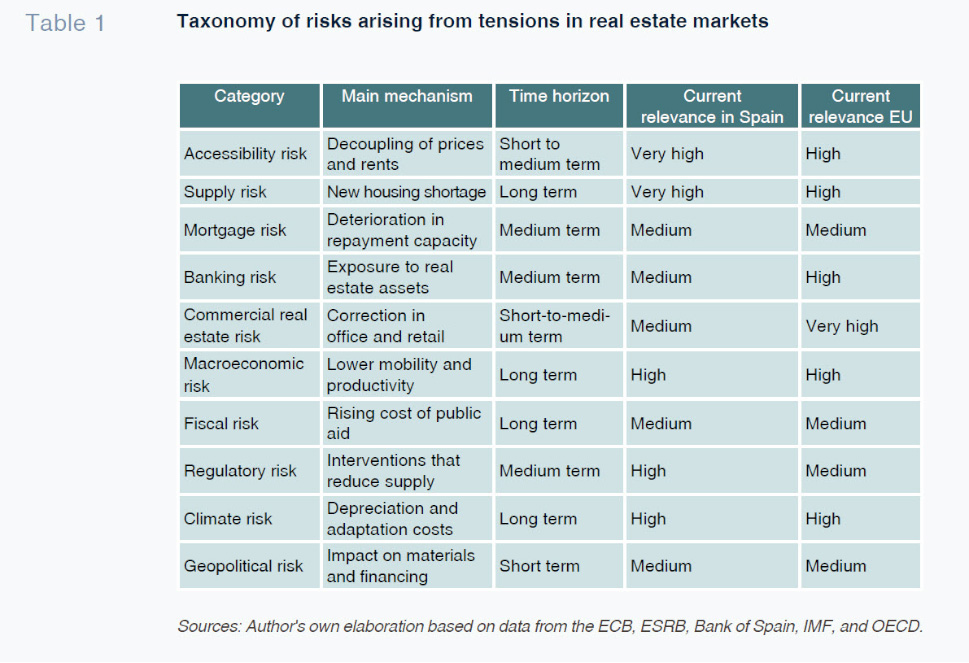
Traditional analysis has tended to reduce real estate risk to almost a single variable: price trends. This is an excessive simplification. Real estate tensions simultaneously generate risks of different natures and with different time horizons. Some are immediate and financial; others are structural and manifest themselves over decades (Table 1).
Spain: The main risk is a shortage, not a bubble
There is a general consensus that Spain does not currently have a real estate bubble in the traditional sense. Mortgage lending is growing at a moderate pace, lending standards are much stricter than they were two decades ago, and household debt has fallen significantly.
Spanish household debt has fallen from over 85% of GDP in 2010 to around 44% in 2025, one of the largest deleveraging processes in the EU. However, this financial improvement coexists with a rapid deterioration in housing affordability.
The Bank of Spain estimates that there is a cumulative housing deficit of nearly 500,000 units, while various estimates place annual construction needs between 220,000 and 250,000 units—far exceeding the approximately 100,000–120,000 units completed annually in recent years. The problem is particularly acute in Madrid, Barcelona, Málaga, Valencia, Alicante, and the Balearic Islands. Paradoxically, Spain has gone from suffering an excess of housing to facing a localized shortage. This is an extraordinarily complex transition from an economic standpoint: a country can simultaneously have vacant homes and a severe affordability crisis. It is not a contradiction — rather, a problem of the spatial distribution of supply.
The most underestimated risk: Housing as a drag on productivity
Real estate tensions are ceasing to be a sectoral problem and becoming a macroeconomic one. The ECB and the OECD have emphasized that housing shortages reduce labor mobility and hinder the efficient reallocation of human capital. When workers cannot afford to live near economic centers, three consequences arise: a reduction in aggregate productivity, the deterioration of the labor market, and the deepening of intergenerational inequalities.
Spain is one of the most extreme cases in Europe. The rate of young people leaving their parents’ homes remains one of the lowest on the continent, and more than 65% of young people aged 18 to 34 continue to live in the family home. Housing is becoming a mechanism for transmitting intergenerational wealth inequalities. In practice, access to housing increasingly depends on family transfers.
Financial risk has shifted toward commercial real estate
Europe’s primary financial concern no longer lies in the residential segment. The ECB, the EBA, and the ESRB have been warning about commercial real estate (CRE) for several years. Offices represent the most vulnerable segment. The consolidation of remote work has reduced the structural demand for space in numerous European markets. Three additional factors compound this:
- refinancing at higher interest rates;
- an increase in vacancy rates;
- falling valuations.
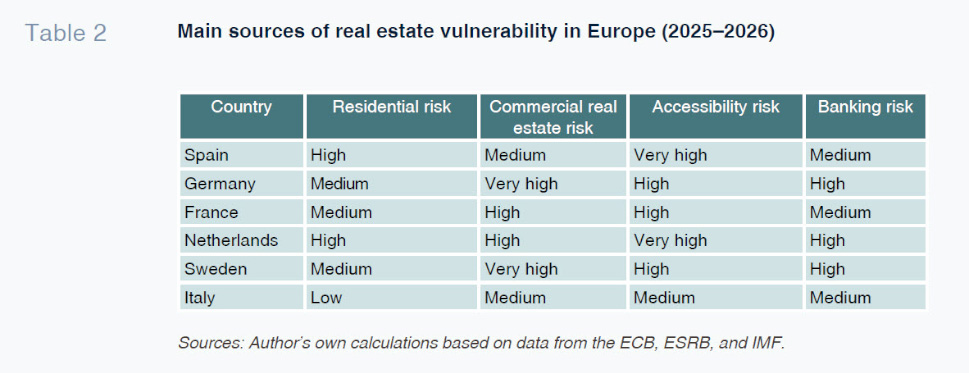
Exposures (Table 2) are particularly significant in Germany, Sweden, the Netherlands, and some Nordic countries. Losses will not necessarily trigger a systemic crisis, but they could constrain credit and amplify economic slowdowns. Spain has comparatively lower exposure, though it is not entirely immune.
Regulatory risks: When the solution makes the problem worse
Tensions in the housing market are creating strong political pressure to intervene.
However, international evidence accumulated over the past two decades shows that many interventions have counterproductive effects. Rent controls are the most obvious example. In the short term, they benefit existing tenants, but in the long term they tend to reduce supply, displace investment, and drive up prices in unregulated segments. Something similar occurs with numerous demand-side subsidies.
When supply is inelastic, part of the public aid ends up being passed on in the form of higher prices. The regulatory risk lies precisely in substituting structural policies with temporary relief measures. Not all interventions are ineffective. But there is an empirical pattern: no demand-side policy can compensate for a persistent shortage of supply.
Climate risk: The new frontier in real estate
Until recently, climate risk barely featured in real estate analysis. This is changing rapidly. The ECB estimates that a growing portion of Europe’s real estate stock faces two types of threats. The first are physical risks: floods, fires, droughts, and extreme weather events.
The second are transition risks: energy costs, regulatory requirements, and mandatory retrofitting. Spain is particularly vulnerable. Mediterranean coastal areas simultaneously face climate exposure, tourism pressure, and high residential demand.
Furthermore, the gradual implementation of the European Directive on the Energy Performance of Buildings could trigger a “green discount” phenomenon: energy-inefficient properties could experience relative losses in value.
Early warning indicators
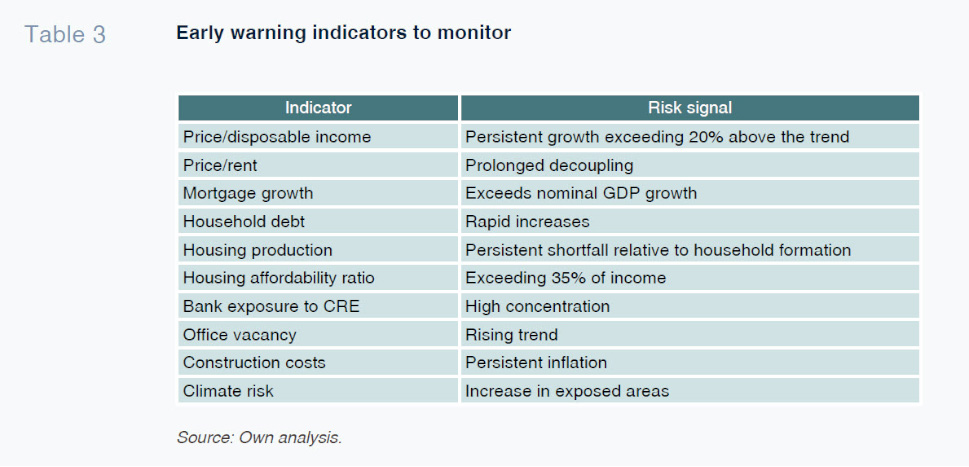
The experience of 2008 shows that real estate crises are rarely sudden. They are usually preceded by a gradual accumulation of signals (Table 3).
Conclusions: The greatest risk is assuming the problem is financial
The main lesson from recent experience is that Europe is fighting the risks of the 21st century using analytical categories from the 20th century. Housing can no longer be understood exclusively as a financial asset. It is economic infrastructure. The greatest risk for Spain is not a repeat of 2008, but the normalization of a situation of permanent scarcity. Insufficient housing undermines productivity, delays independence, amplifies wealth inequalities, reduces labor mobility, and increases social vulnerability.
At the European level, the main financial threat lies not in the residential market, but in certain segments of the commercial real estate market. Finally, there is a particularly significant political risk: the temptation to substitute structural reforms with short-term interventions. The accumulated evidence is clear. No regulation, subsidy, or administrative control can compensate for a persistently insufficient supply over the long term. Europe no longer has a problem of widespread real estate bubbles. It has something more complex: an ecosystem of interconnected risks whose defining feature is scarcity. And scarcity, unlike bubbles, does not burst. It becomes entrenched.
Francisco Rodríguez Fernández. University of Granada and Funcas