
NextGen EU funds: A transformation that has yet to arrive
Spain has led the EU in securing and allocating recovery funds, but actual disbursement and material execution remain slow. Heavy reliance on current expenditure and fragmented projects risk undermining the program’s structural impact.
Abstract: Spain has received more than €55 billion in transfers from Next Generation EU, making it one of the EU countries most advanced in terms of formal disbursements approved by Brussels. Yet actual execution lags far behind: in 2024, only €7.5 billion of the €34.1 billion budgeted was disbursed, with less than a third of credits converted into effective payments. Around a quarter of resources have gone to current expenditure, diluting the program’s long-term transformative impact. While Spain has complied with milestones to unlock European disbursements, the funds have too often failed to deliver meaningful structural change. With less than two years left before the 2026 deadline, the challenge is not only to accelerate absorption but also to ensure that investments and reforms deliver a lasting legacy.
Introduction
The Next Generation EU (NGEU or NextGen EU) program was conceived in 2020 as a historic response by the European Union (EU) to boost recovery after the COVID-19 pandemic. Spain, one of the largest beneficiaries, designed the Recovery, Transformation and Resilience Plan (PRTR) – also called España Puede (Spain Can) – with the expectation of modernizing its economy through unprecedented investments and reforms. In total, Spain is set to receive around €160 billion in transfers and loans from the Recovery and Resilience Facility (RRF), the central pillar of the NGEU. This injection is equivalent to more than 12% of Spanish GDP and must be fully implemented by 2026. The authorities proclaimed that these funds would be a "unique opportunity" to undertake pending structural transformations, from the ecological and digital transition to improvements in education, employment, and social cohesion.
At present, however, questions remain about the degree of transformation actually achieved. Almost four years after the plan was launched, only a fraction of the funds has actually reached the real economy, and many structural projects are still underway or have not even started. Spain has received five disbursements from the RRF from the European Commission to date (including the most recent one in summer 2025), meeting most of the agreed milestones and targets. However, internal budget execution is slow: in 2024, the government managed to disburse only a fifth of the funds planned for that year, deepening a trend of under-execution observed since 2022. At the same time, examples of interventions with low structural impact are emerging—funded actions that are either delayed and at risk of not being completed, or whose transformative contribution is questionable.
This article takes stock of the deployment of NGEU funds in Spain to date. It first describes the institutional framework of the PRTR, then presents a quantitative analysis with consolidated data, followed by a qualitative analysis with illustrative examples of expected impact. This is followed by a critical discussion of the plan’s achievements and obstacles, and finally, conclusions are offered.
Institutional framework of the PRTR
The Spanish Recovery Plan is part of the institutional framework of the NGEU, a temporary instrument endowed with €750 billion (at 2018 prices) for the EU as a whole. The centerpiece is the Recovery and Resilience Facility (MRR), which finances reforms and investments in exchange for the fulfillment of milestones and targets previously agreed with each country. In July 2021, the European Commission and the Council of the EU approved the Spanish plan "España Puede" (Spain Can), granting an initial allocation of €69.528 billion in non-repayable grants. Spain subsequently decided to also request the concessional loan portion, adding around €84 billion, through an addendum to the plan approved in 2023. This brings the total funding allocated to around €160 billion until 2026, the largest amount in the EU after Italy.
The Spanish PRTR is structured around four cross-cutting priorities (ecological transition, digital transformation, social and territorial cohesion, and gender equality), 10 lever policies, and 30 components covering key areas ranging from renewable energy, housing renovation, and sustainable mobility to education, healthcare, support for SMEs, and the digitalization of public administration, among others. It also incorporates 12 Strategic Projects (PERTE) aimed at leading sectors (electric vehicles, green hydrogen, microelectronics, agri-food, health, etc.), designed to channel high-impact, public-private investments. According to the European Commission, the modified plan (including the REPowerEU chapter on energy security) allocates 39.9% of spending to climate objectives and 26% to the digital transition, exceeding the minimum requirements of 37% and 20%, respectively. In addition, it is estimated that around 23% of spending is classified as social investment (education, care policies, labor inclusion, etc.), reflecting the priority of mitigating the social impact of the crisis.
The governance of the PRTR falls within a complex institutional structure. The central government (through the Recovery Commission, chaired by the Prime Minister’s Office, and various ministries, mainly Economy and Finance) coordinates planning, monitoring, and reporting to the EU. Implementation is channeled through ministries and national agencies, but also with significant involvement from the autonomous communities (CCAA) and local authorities. In fact, a substantial portion of the funds is transferred to the CCAA to manage investments in their areas of competence. As of December 31, 2024, €29.106 billion had been distributed to the autonomous regions for projects related to ecological transition, digitalization, education, health, tourism, employment, sustainable mobility, housing, water, aid to businesses, culture, sports, etc. In addition, in 2021-2022, Spain already transferred €10 billion to the autonomous regions and regional authorities under the REACT-EU fund (another NGEU tool for immediate support in the wake of the pandemic). This brings the total NGEU resources distributed across the country in those years to almost €39 billion.
A key feature of the mechanism is that payments from the European Commission to the Member State are conditional on the implementation of structural reforms. In the case of Spain, the plan included more than 400 milestones and targets to be achieved within different timeframes. For example, flagship reforms such as the new Education Law, the 2021 labor reform, pension reform, climate change and energy transition laws, and judicial digitalization, among others, have been requirements for unlocking disbursements. This conditionality seeks to ensure that the funds are not only spent but also leave a structural legacy in the form of modernized public policies. The deadline for implementing all measures (investments and reforms) is August 2026, according to the European MRR regulation. By then, Member States must have completed the projects and requested final payments. Any delay beyond that date entails a risk of losing funding.
Spain established control and monitoring systems to manage this volume of resources. In particular, the CoFFEE-MRR computer system was implemented to monitor projects and their contribution to milestones, and specific regulations were approved to prevent fraud, corruption, and conflicts of interest in the management of funds. The Spanish Court of Auditors, together with the regional control bodies, has also initiated specific audits of the PRTR to evaluate procedures and results. Similarly, the European Court of Auditors issued reports in 2024 focusing on implementation in various countries, including Spain. All these mechanisms provide an institutional framework for the implementation of the plan, striking a complex balance between agility in spending and rigorous accountability for the use of European funds.
Quantitative analysis: Financial execution and distribution of funds
Overall, Spain has secured approximately €79.8 billion in non-reimbursable transfers and €83.2 billion in loans from the RRF following the approval of the Addendum in 2023. This allocation is reflected in successive disbursements from Brussels, which have placed Spain among the most advanced countries in terms of attracting NGEU funds. By May 2025, Spain had received more than €48 billion in RRF transfers, meeting a high number of milestones at each stage (Exhibit 1). In the summer of 2025, the fifth disbursement was made, for a net amount of €23 billion (the largest to date), which included for the first time a significant loan component (around €16 billion) together with €7.1 billion in grants. This brings the cumulative amount received in transfers to more than €55 billion, around 70% of the total planned for Spain (around €80 billion). Spain remains the leading EU country in terms of the volume of non-repayable funds received, slightly ahead of Italy and France.
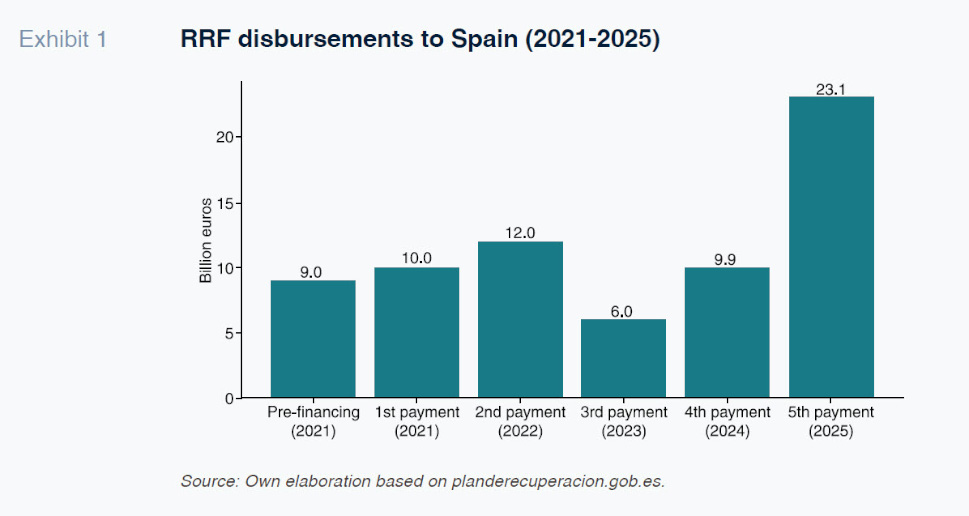
Exhibit 1 illustrates the sequence of payments from the EU. After initial pre-financing of €9 billion in August 2021 (equivalent to 13% of the amount of grants allocated), the first payment of €10 billion arrived in December 2021, and the second payment of €12 billion in July 2022. Spain was the first Member State to achieve both disbursements, thanks to its rapid fulfillment of the targets committed for 2021. The third payment of €6 billion, was approved in February 2023 upon certification of 29 milestones for the first half of 2022. Subsequently, the fourth payment, requested at the end of 2023, faced some delays due to difficulties in reforms (e.g., unemployment benefit reform and fiscal measures), and was finally authorized in June 2024 for an amount close to €10 billion. Finally, the fifth payment was approved in July 2025 and disbursed in August, combining €7.1 billion in grants (including €139 million pending from the previous tranche) and €16 billion in loans. Each disbursement corresponded to a six-month investment/reform package, except for the fifth, which also included objectives from the loan phase (addendum). It should be noted that two milestones in the fifth tranche were pending evaluation (the reform of diesel taxation and the digitalization of regional administrations) – the Commission temporarily withheld the part of the financing linked to them, pending resolution in the following months. In short, Spain is entering 2025 having obtained most of the available European funds in the form of transfers, although there is still some way to go to achieve 100% of the resources, including loans and the new objectives of the addendum.
A critical issue is how this inflow of funds translates into actual spending within Spain. Each year, the General State Budget has included substantial appropriations for the PRTR, but implementation rates reflect significant delays. In 2022, the first full year of implementation, only around 30% of the budgeted appropriations for the PRTR were executed. In 2023, the proportion fell to 24.5% (Exhibit 2). And in 2024, as of December 1, only 22% of the planned amount had been disbursed (7.538 billion euros actually paid out of a total of 34.134 billion budgeted). Even with the typical acceleration at the end of the financial year, it was impossible to get close to 100% annual execution—in fact, 2024 would be the worst year in relative terms, consolidating a downward trend in spending agility.
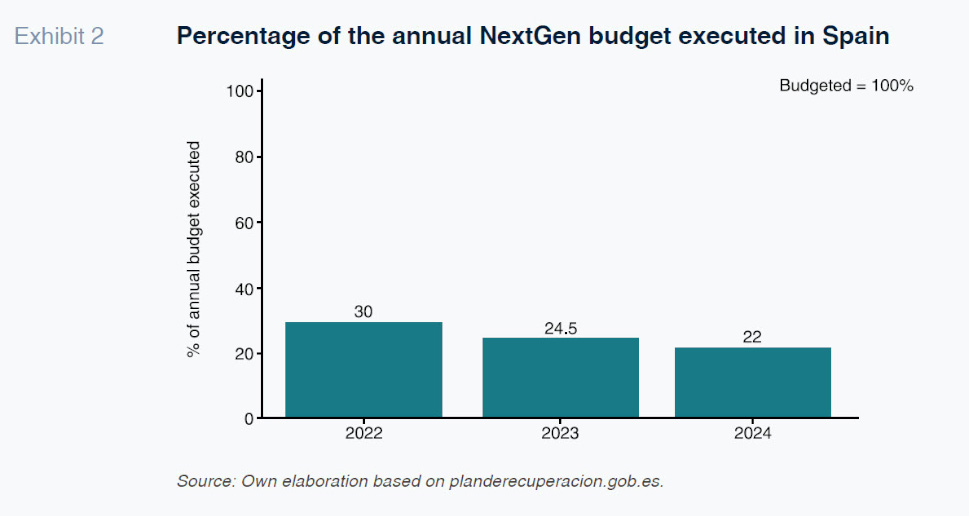
Each year more than two-thirds of the allocated funds do not reach the real economy within the planned timeframe. Several factors explain this situation: administrative delays in calls for proposals and awards, bottlenecks in the absorption capacity of some programs, and even initial overestimation of implementation rates. The government usually presents implementation figures in terms of "recognized obligations," which include funds committed but not yet paid, resulting in somewhat higher percentages (for example, 34.6% in 2024). However, in terms of actual payments made to final beneficiaries, the real figures are those mentioned above (22% in 2024). As a reference, between 2021 and 2023, the General State Administration awarded a total of €66 billion under the PRTR—equivalent to 95% of the €69.5 billion for the first phase of the plan—indicating that most of the funds have been committed to approved projects. However, of this amount awarded, only approximately €20 billion had been materialized in calls for grants and contracts awarded to private companies and self-employed workers by 2023. In other words, a large proportion is still in the implementation phase or pending disbursement. Table 1 illustrates this contrast between budget, funds, and implementation.
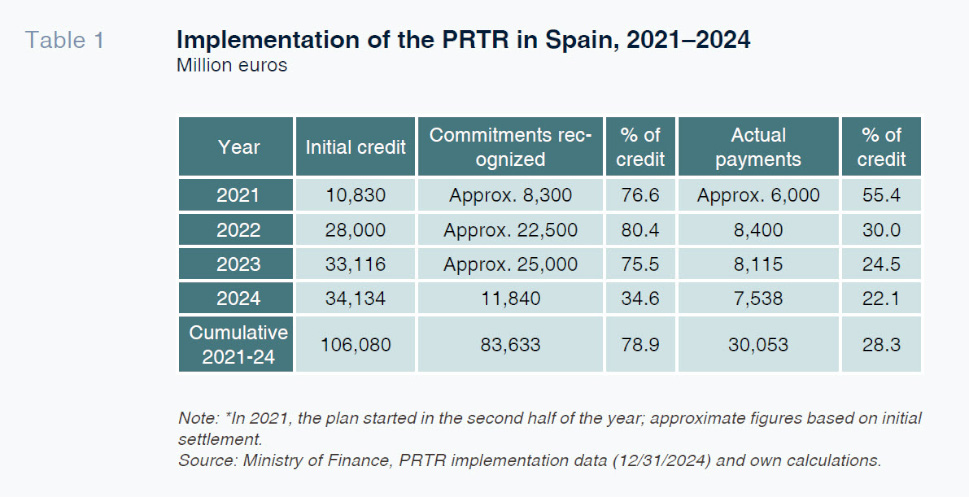
According to the latest consolidated official data, from 2021 to December 31, 2024, €106.08 billion in budgetary appropriations had been allocated to the PRTR, of which accumulated recognized obligations amounted to €83.633 billion (78.9%). This figure for recognized obligations represents the budgetary effort committed to ongoing projects. However, it is important to distinguish this from actual expenditure (cash basis). The delay in implementation can be seen from the fact that, at the end of 2024, more than €20 billion already committed remained outstanding. In fact, several ministerial items show significant delays in execution. For example, the Ministry of Finance (responsible for transfers to autonomous regions, sectoral conferences, etc.) had executed only 1.79 billion of the 13.138 billion budgeted for 2024 (13.6%). The Ministry of Transport, Mobility and Urban Agenda (Mitma), which manages housing programs, executed just €409 million of the €3.168 billion allocated (13%), despite the pressing need for investment in affordable housing. The Ministry of Science and Innovation spent €297 million of €912 million (32.5%) in 2024. The Ministry of Economic Affairs and Digital Transformation executed only 124 million of 707 million (17%) in its digital and civil service component. These examples illustrate that absorption capacity has varied greatly by area, with particularly notable delays in housing, administrative digitalization, and some industrial investments.
The problem of distinguishing between current expenditure and investment
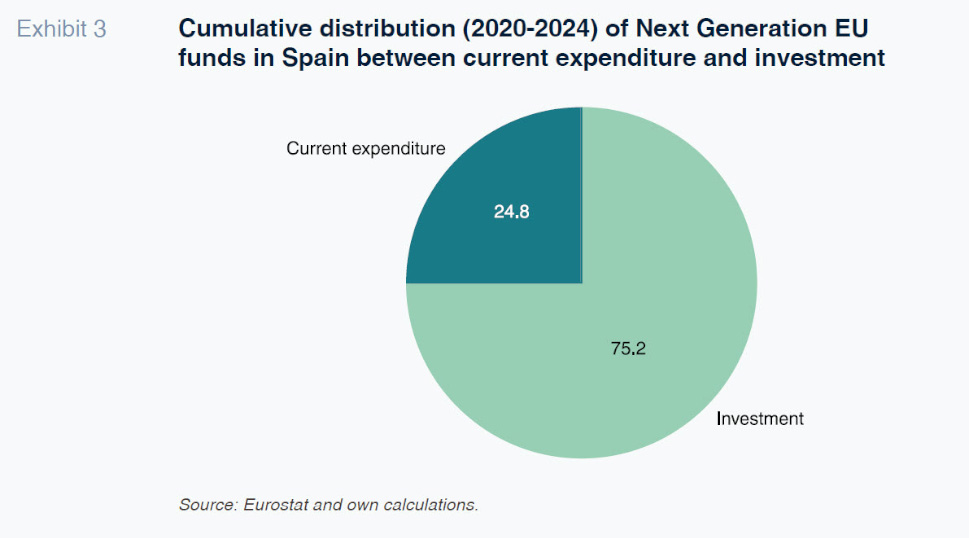
A stated objective of the NGEU was to finance capital expenditure (public investment) rather than current expenditure, in order to ensure a lasting transformative effect. In practice, Spain has allocated a significant portion of the funds to current expenditure (e.g., hiring staff, current transfers, benefits) to shore up public services during the crisis. According to Eurostat data, in the period 2020-2024, Spain allocated approximately €7.877 billion of the €31.821 billion received to current expenditure, i.e. 24.8%. The remaining proportion (75.2%) financed capital expenditure or investments.
Exhibit 3 shows this distribution. The use of temporary funds for current expenditure has implications: on the one hand, it made it possible to maintain or expand services (
e.g., hiring additional healthcare personnel during the pandemic, financing social programs,
etc.), contributing to social cohesion at critical times. But, on the other hand, it limits the long-term transformative impact, as current spending does not create lasting assets and will disappear once NGEU funds are exhausted. It also creates a future fiscal risk: policies or services financed by NGEU will need alternative sources when these extraordinary resources come to an end in 2026-2027. The areas with the highest weight of NGEU-financed recurrent spending in Spain include the reinforcement of regional health and education systems in 2021-2022, as well as transfers to active employment policies, support for SMEs (direct grants and subsidies) and certain social policy items.
The funds have been distributed among a multitude of sectors and programs. In terms of thematic priorities, the high weight of green and digital initiatives has already been noted. In figures, the updated plan allocates around €67 billion to climate or ecological transition measures (clean energy, sustainable mobility, energy rehabilitation, the environment, etc.) and around €40.4 billion to digital transformation (digitalization of SMEs, digital administration, broadband and 5G deployment, artificial intelligence, etc.). This means that more than 70% of total resources are concentrated on the dual green-digital transition. Within the ecological transition, investments such as €12 billion in energy renovation and efficiency of buildings (public and private), €13.2 billion in sustainable mobility (clean urban transport, rail infrastructure, electric vehicles) and nearly €6.1 billion in renewable energy and electricity grids in the original plan, reinforced with an additional €6.9 billion in the REPowerEU chapter for energy security. In addition, innovative financial instruments have been developed (through the ICO, EIB, COFIDES) that will mobilize up to €83.2 billion in loans to the private sector for green, digital, and social projects—for example, the ICO Green Line and the affordable housing program, for more than €34 billion, or the Regional Resilience Fund (€20 billion).
Quantitative analysis reveals both positives and negatives. On the one hand, Spain leads the EU in receiving funds and has committed most of the resources to actions aligned with green and digital priorities. Sectoral allocations reflect the original transformative objectives, with substantial investments planned in strategic areas. On the other hand, the speed of internal implementation is insufficient: a significant amount of money remains in the administrative pipeline without yet reaching the productive fabric or citizens in a tangible form. This lag feeds the perception that "the transformation is not happening" at the expected pace.
Qualitative analysis: Cases of low impact and implementation obstacles
While the PRTR has made it possible to finance numerous transformative initiatives, there are also examples of interventions whose structural impact appears limited or whose implementation has been problematic. These cases offer lessons on the difficulties of managing such an ambitious plan. Below are some documented examples that have generated public debate:
- Digitalization of local administrations with mixed results. In 2024, the Court of Auditors audited a PRTR program aimed at the digital transformation of local councils. It found widespread deficiencies in the definition, planning, and monitoring of projects at the municipal level. Out of a sample of 11 local councils (including Madrid and Barcelona) with 19 projects worth €17.2 million, most recorded changes in scope, deadline extensions, and significant deviations in implementation. In several cases, this led to the partial or total loss of the funding obtained: some local councils renounced the subsidy or had to repay funds because they were unable to implement the projects on time.
- Of the 145 municipalities that received funding in the 2021 call for proposals, only 15% had completed their projects by the end of 2022, and although the situation improved in 2023, nearly 30% of the actions were still unfinished at the end of 2023. This case reflects the technical and administrative bottlenecks in many small local authorities when it comes to managing innovative projects within tight deadlines. It also reveals design problems: digital equipment and infrastructure (€37.8 million) that were not a priority according to the original criteria of the call for proposals were funded, to the detriment of critical areas such as cybersecurity (€29.7 million was allocated to the latter). In short, despite its importance, local digitalization was implemented in a heterogeneous manner: some cities made progress, but others were unable to absorb the funds effectively, limiting the structural impact (e.g., classrooms with unused equipment due to lack of training, or software licenses purchased that were not integrated into municipal processes). The Court’s recommendation is to strengthen the rigor of project selection and monitoring to avoid loss of resources and ensure tangible benefits.
- Provision of devices to reduce the educational digital divide. Within the digital education component, programs were funded to provide laptops and connectivity to vulnerable students, with a planned investment of €970 million to deliver some 300,000 devices and equip 240,000 classrooms. This initiative, coordinated with the autonomous regions, sought to accelerate the digitalization of education during the pandemic. Although it succeeded in distributing equipment on a massive scale (more than 200,000 devices according to official figures) and undoubtedly alleviated the digital divide in many households, it has been evaluated by the control bodies to verify its effectiveness. The Court of Auditors (together with regional auditors) launched an audit in 2023 to analyze how this technological provision was managed in each region. The auditors have pointed out delays in deliveries and the need to ensure the effective educational use of these resources. Without parallel reforms in educational methodologies and teacher training, the mere delivery of hardware and software could have a limited educational impact in the long term. Furthermore, maintaining and renewing these devices in the future will place a burden on regional budgets once European funds have been exhausted. This example illustrates how necessary investments in human capital (educational digitalization) entail implementation challenges in order to achieve a real qualitative leap in the digital skills of students and teachers.
- Local sustainable mobility projects with little transformation. At the municipal level, several city councils have invested Next Generation funds in measures such as bike lanes, pedestrianization, and electric bus fleets. These measures, which are positive for urban mobility and the environment, have sometimes been criticized for their limited scope. For example, one municipality allocated a considerable sum to the construction of a tourist bike lane that, according to residents, is rarely used; another installed solar streetlights in a park, the safety improvement of which is debatable. While each project contributes on a small scale to the green agenda, in isolation they do not represent the profound "transformation" promised by the PRTR discourse. Part of this impression stems from the fragmentation of resources: the Destination Tourism Sustainability Plans, to cite one example, financed more than 175 local micro-projects (viewpoints, interpretation centers, trails, etc.), distributing €1.8 billion across hundreds of localities. The aggregate impact on tourism competitiveness may be positive but diluted and difficult to perceive nationally. These are projects that do not alter the country’s productive base or lead to productivity gains. This dilemma between capillarity and concentration of funds is inherent in the PRTR, which sought to reach every corner of Spain but at the cost of dispersing efforts.
- Low initial uptake in strategic industrial projects. The PERTE, designed for major sectoral transformations, have also faced challenges. For example, the PERTE for Electric and Connected Vehicles (VEC), with €2.975 billion in grants, had lower than expected demand in its first call for proposals: €877 million was awarded, leaving nearly 30% of the funds unallocated due to a lack of eligible applications. This forced the PERTE VEC to be redesigned with a second call for proposals in 2023 (still ongoing) to try to attract more projects. Something similar happened with the PERTE Chip (semiconductors): with €12 billion, it depends heavily on international private investment that has been slow to materialize. To date, no new chip factories have been set up, although aid for design centers and investment agreements have been approved that could bear fruit in the coming years. These examples show that it is not easy to convert money into rapid industrial transformation: it requires a prepared business ecosystem, streamlined procedures, and, sometimes, luck to attract large foreign investors. The initial slowness of some PERTEs reduced their immediate impact in 2021-2023, although they could take off later. In any case, they highlight the gap between planning and reality.
The above cases highlight cross-cutting difficulties in the implementation of the PRTR: limited administrative capacity (especially at the local level) leading to delays or loss of funds; questionable choices of some spending destinations that do not convince the public of their usefulness; and dependence on private or external actors to implement certain strategic projects, which can delay results. There is also an underlying problem of transparency and communication. In May 2025, the EU Court of Auditors pointed to a "lack of transparency" in Spain in identifying the final beneficiaries of the funds, which poses a risk that projects will be financed without adequate scrutiny. It also criticized the fact that the digital monitoring platforms implemented (such as CoFFEE-MRR or the website planderecuperacion.gob.es) do not satisfy auditors in terms of clarity of information.
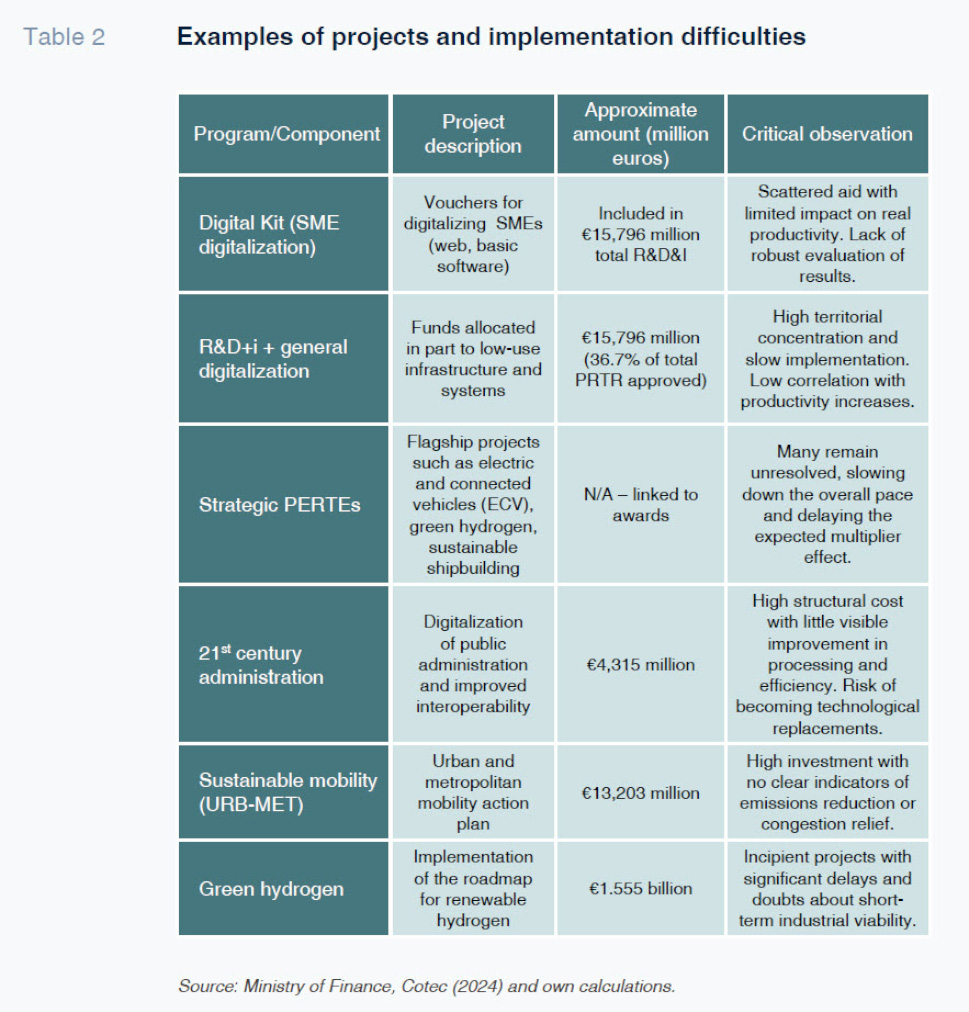
Another qualitative factor is the management of conditional reforms. Some have become political bottlenecks, delaying disbursements. One example was the condition of bringing diesel taxation into line with gasoline (eliminating a tax benefit for diesel), a commitment included in the original plan. This measure faced strong parliamentary and social opposition, to the point that the government failed to pass it. Finally, in its assessment of the fifth payment, the European Commission did not consider this "diesel reform" milestone to have been met, deducting around €1 billion from the corresponding disbursement. Spain will have the opportunity to reintroduce or compensate for this reform at a later date, but it illustrates how internal political difficulties (especially in the context of a minority government since 2023) can slow down the full implementation of the PRTR. The same happened with the aforementioned reform of active employment policies (unemployment benefits), which delayed the fourth payment: it was approved in extremis after extensions negotiated with Brussels. These tense situations create uncertainty about the receipt of funds and divert technical efforts towards political negotiation. Table 2 provides a list of critical observations on some of the best-known projects.
Provisional assessment
In mid-2025, the deployment of Next Generation EU funds in Spain offers a mixed picture. On the one hand, it is undeniable that the PRTR has boosted the post-COVID economic recovery: Spain’s GDP in 2024 is estimated to be 2.6% higher than it would have been without the Plan, and the cumulative impact is expected to reach 3.4% of GDP in 2031. Employment has also received a boost, and public investment has rebounded after years of austerity. However, when comparing the results with initial expectations, there is a sense that structural "transformation" has not materialized. Several critical issues support this assertion:
- Discrepancy between resources disbursed and actually executed. As we have seen, receiving €55 billion from Brussels is not the same as having €55 billion invested. Much of the transformative impact will only occur when the projects are completed (many in 2025-26) and depending on their cohesion and planning. This creates a temporal paradox: Spain is the EU leader in execution (because it complies with formalities and milestones), but internally, material execution is lagging behind, which in the eyes of citizens and businesses translates into less impact than expected at this stage.
- Risk of not using up funds and missing opportunities. There is less than a year and a half left (until August 2026) to complete the implementation of the enormous remaining financial envelope. Spain still has to fully implement some €25 billion in grants and virtually all of the €84 billion in loans from the Addendum. This is a colossal challenge in such a short period of time. The Independent Authority for Fiscal Responsibility (AIReF) and other entities have issued warnings about the risk that projects will not be completed or that not all available loans will even be committed. Although the loans have a tentative schedule until 2026, their absorption depends on demand from companies and administrations. Initiatives such as the ICO co-investment funds are underway, but mobilizing tens of billions more will require significant acceleration in 2025-26. The European Commission has warned that time is running out: any tranche not requested before the deadline will be lost. Spain "has a long way to go in terms of both funds and loans," the European Court of Auditors noted in 2025.
- If milestones or certifications are not completed on time, money will not be received. And if it is received but not spent effectively, the opportunity for its transformative effect will be lost. In this sense, 2025 is a critical year: the government must urgently implement ongoing projects and reformulate those that have stalled, so as not to reach 2026 in a last-minute rush (which could result in inefficiencies or poor quality spending).
- Uncertain structural impact dependent on reforms. The Ministry of Economy’s own projections indicate that the permanent legacy of the PRTR will come mainly from reforms rather than investments. It is estimated that structural reforms could raise GDP in the long term by 3 percentage points, while investments would add only 0.4 points. This suggests that, even assuming full implementation, many investments are cyclical or temporary rather than permanently transformative. For example, infrastructure construction and fleet renewal help modernize physical capital, but their contribution to potential growth may be diluted if they are not accompanied by profound organizational or technological changes. In contrast, reforms such as labor reform (which reduces temporary employment) or vocational training can permanently alter productivity and the economic structure. This assessment raises the question: to what extent are NGEU funds changing the Spanish "production model"? For now, many resources have been allocated to strengthening existing sectors (e.g., sustainable tourism, green automotive) without necessarily diversifying into new areas with higher added value. This is not negative in itself—modernizing traditional sectors is valuable—but it means that the Spanish economy in 2025 will continue to be based on patterns similar to those before the pandemic, only with incremental improvements (cleaner vehicles, more efficient buildings, etc.). The expected "transformation" may require continued efforts beyond 2026, as five years may not be enough to change entrenched structures.
- Issues of absorption and institutional capacity. Experience to date has highlighted shortcomings in the management capacity of administrations, especially at decentralized levels. Spain’s administrative fragmentation complicated the governance of the PRTR. Some autonomous communities have excelled in implementation, but others have delayed calls for proposals or have had to return uncommitted funds.
In short, the analysis points to a "transformation that is not happening." Some foundations are being laid (legal reforms, projects launched), but the construction of structural change is more questionable. This does not mean that the PRTR will fail—it is still too early for definitive judgments—but it may have a much more limited impact than expected.
Finally, this discussion must be framed within a volatile political and economic context. The year 2025 is marked by an economic slowdown in Europe, inflationary pressures, and a change in the monetary policy cycle, making European funding even more important. At the European level, the possibility of extending or supplementing the RRM in the next financial framework is already being discussed, but for now, 2026 remains the insurmountable goal. All these elements paint a picture where the clock is ticking and the pressure to demonstrate tangible results is at its highest.
The experience gained should serve to simplify procedures and share good implementation practices in this final period. If implementing entities apply the lessons learned (e.g., avoiding overburdening local governments without capacity, strengthening technical assistance, extending deadlines when reasonable so as not to lose funds, etc.), it is feasible to improve absorption. The Commission’s flexibility to reschedule milestones or reallocate funds (as was done with the pending diesel milestone) will also be a valuable ally, provided that the transformative essence is maintained.
Beyond 2026, the question will remain: was the transformation achieved? Judgments will likely have to wait a few more years. Many PRTR investments will have effects that will be felt in the second half of the decade: for example, new transport infrastructure completed, industrial capacities strengthened by the PERTE, a more digitalized and agile administration, or a generation of young people with better training thanks to educational reforms. If these promises are fulfilled, the transformation will have arrived, albeit late. Conversely, if, after the end of the program, the Spanish economy returns to its previous inertia—with public investment once again declining, unfinished projects, and watered-down reforms—then it could be argued that the NGEU was a largely wasted opportunity.
Finance and Digitalization Department. Funcas